

НАСТОЯЩИЙ МАТЕРИАЛ (ИНФОРМАЦИЯ) ПРОИЗВЕДЕН, РАСПРОСТРАНЕН И (ИЛИ) НАПРАВЛЕН ИНОСТРАННЫМ АГЕНТОМ ПРОЕКТОМ “ПОСЛЕ”, ЛИБО КАСАЕТСЯ ДЕЯТЕЛЬНОСТИ ИНОСТРАННОГО АГЕНТА ПРОЕКТА “ПОСЛЕ” 18+
Russia’s “Shadow Fleet” Risks Becoming a Disaster
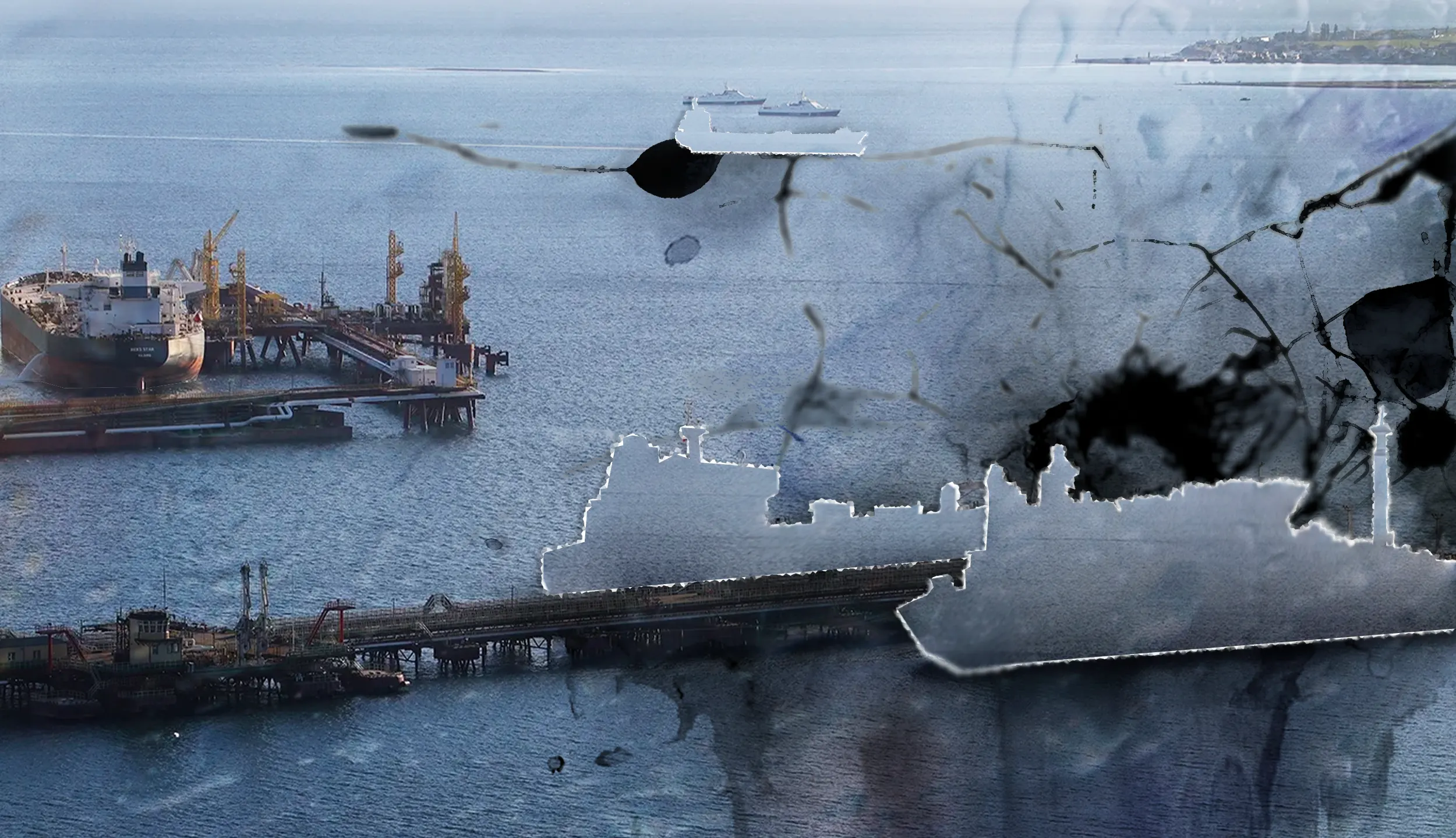
How did Russia’s “shadow fleet” come about? What environmental risks are associated with its operations? Why is the Arctic’s future a particular cause for concern? Can these threats be mitigated? Journalist Alexei Martov examines these questions with insights from experts
Over a Thousand and Counting
The U.S. sanctions-tracking firm Castellum.AI estimates that Western countries — including Australia and Japan — imposed nearly 24,000 restrictions on Russia between February 22, 2022 (the day after Moscow recognized the independence of the “Donetsk People’s Republic” and the “Luhansk People’s Republic”) and August 15, 2025. Seeking measures to curb Russia’s military campaign against Ukraine, the G7 countries (the United Kingdom, Germany, Italy, Canada, France, the United States, and Japan) introduced a $60-per-barrel price cap on Russian oil in December 2022.
Western leaders faced a difficult challenge in crafting this restriction. On the one hand, the ongoing war in Ukraine called for urgent measures to increase financial pressure on the Kremlin. Targeting the oil and gas sector — a cornerstone of the Russian economy — was an obvious choice. On the other hand, Russia’s status as a major player in the global oil market forced them to proceed cautiously to avoid triggering a sharp surge in fossil fuels prices.
Thus, the G7 introduced a “price cap” to reduce the flow of money into the Kremlin’s military budget while keeping Russian oil on the global market. Western carriers and insurers were prohibited from working with Russian oil sold above $60 per barrel. Given that, until February 2022, Western tankers carried the lion’s share of Russian oil exports, and that 90% of marine cargo insurance was provided by 12 P&I clubs (mutual insurance associations for shipowners), the measure was expected to hit Moscow hard.
However, while the flow of petrodollars into Russia did decline, the“price cap” proved less effective than anticipated. Russia wasted no time creating a “shadow fleet” to circumvent the restrictions. In order to do this, it started buying and chartering tankers whose owners and insurers fell outside the jurisdictions of countries participating in the sanctions. These are mostly older ships that, under other circumstances, would likely have been scrapped. By the summer of 2025, the “shadow fleet” numbered 1,140 vessels with an average age of 20.2 years, compared with 15 years for a typical “legal” tanker.
As the BBC explains, the term “shadow” refers to ships that do not comply with the International Maritime Organization’s rules and regulations. They may, for instance, switch off AIS transponders, concealing data on a tanker’s position, speed, course, name, flag, and type; obscure ownership by repeatedly changing a vessel’s name and flag; transfer oil to other tankers at sea to avoid calling at ports considered “unsafe” from a sanctions perspective and to conceal the oil’s origin; misreport their location; or even broadcast the unique IMO numbers of ships that have already been sent for scrapping.
Meanwhile, in the EU’s 18th sanctions package, the “price cap” on Russian oil was lowered to $47.6 per barrel. In the latest, 19th package, 117 “shadow fleet” tankers were added to the blacklist, bringing the total number of sanctioned vessels to 557. The problem persists, however, and this fleet — now more akin to a “shadow armada” — continues to grow.
A Delayed Disaster
By blacklisting vessels one by one, EU and U.S. authorities aim to make it harder for Russia to circumvent the price cap. But beyond the war in Ukraine, there is another equally important reason to tackle the “shadow fleet.” Experts say it poses a serious environmental threat, sharply increasing the risks of ecological damage. An ecologist who asked to remain anonymous told Posle.Media that, compared with the legal fleet, the environmental risks associated with the “shadow fleet” may be roughly ten times higher, although making a precise assessment of the scale of the threat is “difficult, if not impossible.”
In the spring of 2025, Novaya Gazeta Europe reported — citing a representative of the CREA research group — that more than 30 incidents worldwide were linked to the “shadow fleet” between 2022 and 2024. As experts interviewed by Posle.Media argued, the fact that no major disaster has yet occurred directly involving “shadow” vessels is largely a matter of luck.
There has, however, been an environmental disaster indirectly linked to the “shadow fleet.” On December 15, 2024, two tankers — Volgoneft-212 and Volgoneft-239 — sank in the Black Sea, triggering one of Russia’s largest environmental disasters of the 21st century. Neither vessel was officially listed as part of the “shadow fleet,” but both were not authorized to go to sea in December, and their mission was to transfer their cargo to the tanker FIRN, which was part of the “shadow fleet.” A year later, oil spills are still being reported along the coast of the Black Sea in Krasnodar Krai.
In September 2024, Greenpeace published a study warning that Russia’s “shadow fleet” could trigger a major oil spill in the Baltic Sea. Since January 2021, the number of oil tanker voyages passing Germany’s Baltic coast has increased by 70%. While the average age of tankers sailing in the Baltic Sea was 8.9 years in 2021, it had risen to 16.6 years by the end of 2024. For example, on August 5, 2024, three tankers passed along the German coast, potentially carrying up to 328,000 tons of oil. Sailing under the flag of Panama, the vessels were 17, 18, and 19 years old. In the event of an accident, this volume could create an oil slick covering 4,000 square kilometers, with an average thickness of 0.1 mm.
Greenpeace’s concerns are far from theoretical. In March 2024, for example, the tanker Andromeda Star collided with another vessel in the Danish Strait. It later turned out that there was no pilot on board to assist in navigating the difficult passage, the vessel’s insurance was invalid, and the registered address of its owner was in an Indian village. Fortunately, the tanker was returning to Russia and was not carrying oil; otherwise, the incident could have turned into a full-scale environmental disaster. Notably, Andromeda Star had previously operated as a conventional tanker, with standard insurance and regular inspections — until November 2022.
As a Russian expert told Posle.Media, the main risk associated with tanker transportation is an oil spill, and its likelihood and potential impact depend on several factors.
One key factor is the age of the vessels. “Engines and machinery wear out from prolonged use, as metal fatigue builds up, leading to more frequent break downs. Older ships are also equipped with outdated systems — from communications and navigation to safety equipment and, for example, bilge drainage. While these can be upgraded, that is often not the case with the ‘shadow fleet’,” the expert said.
The second factor is crew quality. Since most maritime accidents are caused by human error, the lower level of training and professionalism on “shadow fleet” vessels is particularly worrying. “There is a concept known as substandard shipping, when shipowners cut costs by bypassing standards, rules, and requirements. The ‘shadow fleet’ is a vivid example of this. Savings are also made on the quality of the crew: people with less experience and lower qualifications are hired. In some cases, there are not even enough people in the crew,” according to the expert.
The third factor is financial and legal liability. If a shipowner carries “junk” insurance that does not meet strict international standards, this automatically reduces their financial liability for spills. As the expert noted, the level of liability a tanker owner faces is crucial: significant financial and legal consequences give companies a strong incentive to take every possible measure to prevent accidents.
A turning point came with the wreckage of the tanker Exxon Valdez off the coast of Alaska in Prince William Sound on March 24, 1989. The spill had devastating consequences for the environment and the economies of local communities — consequences that, in many respects, persist to this day. In 1990, the United States passed the federal Oil Pollution Act, which significantly increased shipowners’ liability for oil spills, helping drive a steep decline in spill accidents.
“Nobody knows better than shipowners themselves how to ensure maximum safety in tanker transportation — not officials, not activists, not environmentalists, and not journalists. That is why advanced economies focus on incentive by introducing legislation that increases shipowners’ liability,” our expert explained.
But the owners of “shadow” tankers have far less incentive to act responsibly. In the event of an accident, the company that owns the vessel may declare bankruptcy — or simply shut down — to evade its obligations.
In addition, responding to a spill requires rapid action on three fronts: ensuring the crew’s safety, containing the spill on the water’s surface, and stopping the flow of oil from the tanker into the sea (which can take time). Rescue services can act independently on the first two tasks, but the third typically requires immediate contact with the shipowner, since the damaged tanker remains private property and cannot be handled without the owner’s consent.
Reaching the legal owners of “shadow” tankers — often registered offshore or even to a nominal address in an Indian village — is extremely difficult, let alone contacting the real beneficiaries. As a result, rescuers can be forced to remain idle during the critical first hours and days. In that time, for instance, a tanker that has run aground and could have been towed away, if done quickly, may instead be driven onto the rocks by the storm.
Finally, insurance is not enough to prevent accidents. Yet tankers with “junk” insurance often avoid ports where they could receive proper servicing — but where they might also be inspected. At the same time, major responsible ports increasingly deny such vessels entry. As a result, this reduces tanker inspection control and increases the risks.
Black Ice
All the experts emphasize that the environmental consequences of an oil spill depend heavily on where it occurs. In warmer waters, oil and its byproducts can biodegrade over time alongside cleanup efforts. In Arctic waters, by contrast, fully restoring the environment may be impossible. The Exxon Valdez spill is a case in point. Even today — nearly 40 years later — Alaska still has “lost bays” where oil was absorbed into coastal soils. The Pacific herring population that existed there before 1989 has yet to recover to its previous levels, permanently reshaping the economies of local fishing communities.
So far, there have been no major accidents in the Arctic involving Russia’s “shadow fleet.” However, the fleet’s increasingly active use of the Northern Sea Route (NSR) — combined with the shortcomings typical of “shadow” tankers — has raised serious alarm among environmentalists, who warn that a disaster may be only a matter of time.
As Ksenia Vakhrusheva, an expert with the Bellona Arctic Project, told Posle.Media, the number of “shadow” tankers using the NSR remains relatively small compared with other routes (in 2024, seven such tankers were spotted there), but the risks are still high.
“Oil is an organic substance that decomposes in the environment. However, natural breakdown takes far longer in cold water or ice than it does in a warmer climate. An oil spill in the Arctic can threaten ecosystems for decades. Moreover, there are currently no truly effective methods for cleaning up oil spills in Arctic waters. Conditions in the Arctic are harsh: visibility is often poor due to fog, and strong winds and waves are common. Rescue capacity along the Northern Sea Route is limited. Historically, vessels trapped in ice during past incidents have had to wait a week, two weeks, or even a month for assistance. If a spill occurs under such conditions, it may be impossible to contain or recover the oil before it freezes into the ice and drifts with the currents,” the expert said.
Vakhrusheva also stressed that the issue is not limited to the “shadow fleet,” but reflects broader Russian practices in Arctic shipping. For instance, Russia has not joined the international ban on the use of heavy fuel oil in the Arctic, because, as she put it, “it is cheaper than lighter diesel fuels.”
“Fuel oil spills are particularly dangerous. But even burning it has a significant negative impact on the climate and the environment. First, it releases greenhouse gases. Second, it emits soot — black solid particles. When soot settles on ice, it darkens the surface and increases the absorption of sunlight, intensifying melting and, in turn, accelerating climate change,” the ecologist emphasized.
Finally, Vakhrusheva noted that Russia still uses small, single-hull tankers — without ice-class certification — for domestic shipments of petroleum products in parts of the Northern Sea Route, a practice that is prohibited under international standards.
According to another expert, who asked to remain anonymous, such tankers are just as dangerous as the “shadow fleet.” “There are currently at least 75 old single-hull tankers operating in Russian waters in the Arctic and the Far East — about 18% of the total number of tankers in the region,” the expert said.
Nayil Farkhatdinov, head of analytics at the Arktida project, likewise told Posle.Media that the problems of Arctic shipping extend beyond the “shadow fleet.” Among the permits issued for passage along the NSR in 2025 are vessels over 25 years old, and some even over 45. While some single-hull ships have been modernized, he said, this is still not enough to significantly reduce environmental risks.
“Ships that should have been decommissioned are still being used because new ones are difficult to obtain. They are often bought second-hand and may be in poor condition. Their age, condition, and the technological solutions that were state-of-the-art decades ago when they were built all increase the risks — as does the state’s push to set new cargo-transport records on the Northern Sea Route every year,” the expert said.
In his view, if a spill occurs in Arctic waters, recovering the oil would be virtually impossible.
“If that happens, it would be a horror story — worse even than the nightmare we saw in the Black Sea in December 2024. The ice surface, blackened for many kilometers, would lose its reflectivity and begin to melt more rapidly,” Farhatdinov added.
With Russia focused on the war and on bringing in petrodollars by any means necessary, it is hard to expect these risks to be treated as a priority. As Vakhrusheva noted, it is Russia’s broader policy framework that poses the greatest threat to the Arctic: even official strategic guidelines explicitly place economic interests above all others. In practice, this means that little to no funding is allocated to environmental protection — let alone to climate-change mitigation.
Still, one expert who spoke to Posle.media on condition of anonymity said that international action could reduce the risks posed by the “shadow fleet” and, more broadly, by Russia’s approach to Arctic shipping. For example, the International Maritime Organization could decide to gradually ban the operation of vessels above a certain age. A similar approach has been used since the 1990s to phase out single-hull tankers.
“If we look at trends in seaborne oil transport over the past 30 years, the volume shipped has increased steadily. Yet over the same period, both the number of spills and the total amount of oil and petroleum products entering the sea have declined. One reason for this positive trend is precisely the ban on single-hull tankers,” the expert explained.
However, the ban on single-hull tankers was not comprehensive. It applied to vessels built after 1996, as well as to older ships with a deadweight of more than 5,000 tons. It does not cover pre-1996 tankers with a deadweight below 5,000 tons. That is why Russia can still operate them on a large scale — including outside the “shadow fleet.”
According to the expert, there is a broad industry consensus that 25 years is the maximum reasonable service life for a tanker — and that 40 years is clearly excessive. Yet there are no international rules that directly restrict the operation of older tankers.
“If such a restriction existed, the disaster in the Black Sea would not have happened,” the expert concluded. Indeed, both tankers that sank were more than 50 years old.
In any case, as the “shadow fleet” expands, so do the risks to the environment and the climate. Yet because Russia’s policies prioritize economic gain over environmental protection, the problem extends beyond “shadow” tankers alone. In theory, the international community could devise effective solutions, but so far there are few signs of serious political will. For now, the specter of an environmental disaster hanging over the world’s oceans is not going away — and may only grow.

Мы намерены продолжать работу, но без вас нам не справиться
Ваша поддержка — это поддержка голосов против преступной войны, развязанной Россией в Украине. Это солидарность с теми, чей труд и политическая судьба нуждаются в огласке, а деятельность — в соратниках. Это выбор социальной и демократической альтернативы поверх государственных границ. И конечно, это помощь конкретным людям, которые работают над нашими материалами и нашей платформой.
Поддерживать нас не опасно. Мы следим за тем, как меняются практики передачи данных и законы, регулирующие финансовые операции. Мы полагаемся на легальные способы, которыми пользуются наши товарищи и коллеги по всему миру, включая Россию, Украину и республику Беларусь.
Мы рассчитываем на вашу поддержку!


To continue our work, we need your help!
Supporting Posle means supporting the voices against the criminal war unleashed by Russia in Ukraine. It is a way to express solidarity with people struggling against censorship, political repression, and social injustice. These activists, journalists, and writers, all those who oppose the criminal Putin’s regime, need new comrades in arms. Supporting us means opting for a social and democratic alternative beyond state borders. Naturally, it also means helping us prepare materials and maintain our online platform.
Donating to Posle is safe. We monitor changes in data transfer practices and Russian financial regulations. We use the same legal methods to transfer money as our comrades and colleagues worldwide, including Russia, Ukraine and Belarus.
We count on your support!



другие подкасты


«Это базис». Почему леваки не ходят голыми?

«Это базис». Как делаются деньги

Политический дневник #52: После Пригожина, национализм как мазохизм, горящая планета
SUBSCRIBE
TO POSLE
Get our content first, stay in touch in case we are blocked

Еженедельная рассылка "После"
Получайте наши материалы первыми, оставайтесь на связи на случай блокировки


.svg)

