

НАСТОЯЩИЙ МАТЕРИАЛ (ИНФОРМАЦИЯ) ПРОИЗВЕДЕН, РАСПРОСТРАНЕН И (ИЛИ) НАПРАВЛЕН ИНОСТРАННЫМ АГЕНТОМ ПРОЕКТОМ “ПОСЛЕ”, ЛИБО КАСАЕТСЯ ДЕЯТЕЛЬНОСТИ ИНОСТРАННОГО АГЕНТА ПРОЕКТА “ПОСЛЕ” 18+
MAX by Mandate
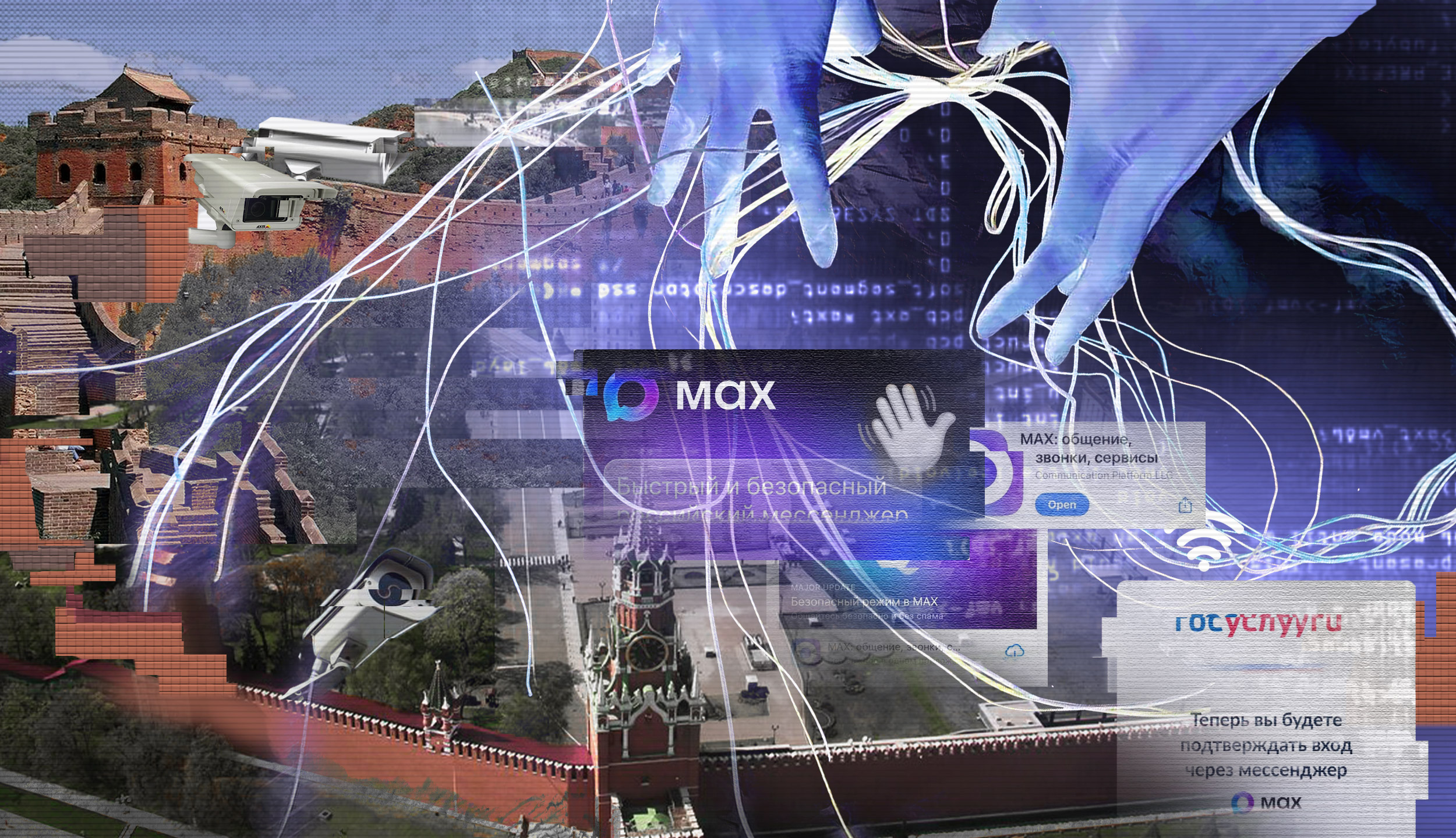
Who is pushing the country towards a single, state-backed messenger, and why? Where is the line between convenience and control? Is it still possible to opt out? Independent journalist Daniil Gorodetsky explores these questions
“A country with digital sovereignty is a country capable of maintaining its digital ecosystem, even if it is cut off from the external internet or experiencing interference with its internal digital services. Such countries are fewer in number than countries with nuclear weapons,” said Andrei Lipov, head of Roskomnadzor [editor’s note: the Russian federal agency responsible for controlling Russian mass media], as he defined the objective of Russia’s digital policy and the logic now shaping the country’s network infrastructure.
Russian authorities have entered a new, more severe phase of isolating Runet [editor’s note: the term Runet means the Intenet that uses the Russian language]. This process began in 2022, shortly after the full-scale invasion of Ukraine, when the state began systematically restricting major Western internet platforms under the pretext of “protecting the information space.” Since then, digital isolation has not only continued but also solidified into a long-term strategy. Selective digital censorship has evolved into the deliberate construction of a semi-enclosed national segment of the internet.
While this isolation initially appeared to be a reaction to foreign-policy shock, by 2025, it was evident that it was not a temporary measure, but a deliberate restructuring of the digital environment to align with state priorities. The Internet is no longer treated as open infrastructure. Instead, it is being reshaped into a managed ecosystem in which core services are domestic, controllable, and integrated into the hierarchy of state control. This logic now sets the tempo of digital policy — from mandatory government apps to technological barriers that restrict access to the global web.
A National Messenger
The idea of a “sovereign messenger” long predates the current wave of digital isolation. The idea first emerged in 2015, following the occupation of Crimea and the outbreak of war in the Donbas, when Russian authorities began to consider ways to control the rapidly expanding digital space. Amid deteriorating relations with the West and emerging information security concerns, the concept of a state-controlled, proprietary communications platform gained traction. In 2017, VK launched its own messenger, TamTam; however, the project failed to attract a significant user base and was effectively abandoned.
In March 2025, during the third year of the war in Ukraine, the technology corporation VK announced the development of a new cross-platform messenger called MAX. The project was presented as a significant step toward digital sovereignty, offering a unified state communications backbone modeled functionally on China’s WeChat. According to its developers, MAX would combine messaging, access to government services, digital identification, payment systems, and business tools within a single interface, effectively turning a chat app into a universal infrastructure platform.
The announcement of MAX sounded less like a routine product launch and more like a declaration of a new digital paradigm. For years, Russian authorities had been searching for a tool that could standardize communications, control information flows, and build a domestic digital ecosystem independent of foreign platforms. MAX was presented as precisely such a “point of convergence” — an infrastructure through which citizens’ everyday activities would pass, including private correspondence, doctor’s appointments, utility payments, and authentication for accessing state services.
In reality, this amounted to the construction of a universal digital gateway through which much of social interaction would be routed. As China’s experience has shown, this model increases user convenience and enables the consolidation of data governance and centralized identification, while marginalizing independent platforms. For Russia, which is under sanctions and becoming increasingly isolated digitally, this became a logical extension of its drive toward technological autonomy.
By early autumn, the rollout of MAX had ceased to be piecemeal and had turned into a full-scale government campaign. A key milestone occured on September 1, 2025, when the messenger became mandatory preinstalled software on all new smartphones, tablets, and other mobile devices officially sold in Russia, as stipulated by earlier legislation. For the tech sector, this effectively created a digital equivalent of “society-mandated software,” a tool that users would have regardless of personal preference.
The next step was the Ministry of Digital Development’s decision to add MAX to the list of services that remain accessible even when mobile internet access is restricted. Such lists are usually reserved for critical communication services, such as emergency alerts, government portals, and banking systems. By including a new messenger, the Ministry of Digital Development placed it on par with infrastructure platforms deemed essential to the functioning of the state and society. Symbolically and practically, MAX was no longer just an app — it became part of the government-mandated digital environment.
However, the extensive promotional campaign failed to generate the anticipated level of trust. On the contrary, users greeted the rollout with suspicion. The more aggressively the messenger was advertised, the stronger the skepticism grew. Reports proliferated on social networks and in tech forums that the app behaved “like spyware”: collecting device data, analyzing user activity, and requesting permissions that users felt exceeded the app’s stated functions. These concerns were amplified by the broader context of increasing digital surveillance and shrinking transparency in the country.
Living with a Permisson Slip: How Digital Infrastructure Becomes a System of Subordination
When confronted with the fact that a voluntary mass relocation to the state messenger was not happening, the authorities quickly turned to a familiar toolkit of administrative pressure. The logic was bluntly pragmatic. If users were unwilling to change their established digital habits, then those habits had to be made less accessible.
The first step was to restrict voice calls on Western messaging apps, especially WhatsApp and Telegram. The measures were officially described as “technical” and aimed at “ensuring network stability.” In practice, however, users experienced degraded call quality, interruptions, and partial feature outages. The result was an artificial scarcity: familiar channels of communication no longer worked as before, and the domestic messenger was promoted as a “reliable alternative.”
The next phase targeted public-sector employees. According to foreign media outlets and human rights organizations, pressure on state workers became systemic: government institutions employees were instructed to install MAX and formally confirm this to their supervisors. Sources say that refusal or evasion was no longer treated as a matter of personal choice, but rather as a breach of institutional loyalty that could result in disciplinary action.
This practice appears to have been especially severe in Crimea. There, school and state agency employees were reportedly asked to provide written confirmation that they had installed MAX, thereby approving their use of the state messenger. In some cases, the consequences went beyond reprimands or warnings and included explicit threats of dismissal.
At the same time, pressure began spreading into the student environment — another group that seems free but is highly dependent on administrative decisions in reality. Using MAX increasingly became a de facto condition for accessing education. As Novaya Gazeta Europe reports, students at Russian universities said that they could not receive course materials, join group chats, or get timely information about exams and assessments without the messenger.
In some cases, the refusal to install MAX was met with direct threats. Students say they were warned about potential problems with certification, lower grades, and even expulsion. Such measures were rarely formally documented. Yet, it was precisely this informal approach that made the pressure especially effective. Decisions were made “on the ground,” and responsibility was diffused among deans’ offices, faculty, and administrators. Thus, a digital application became a hidden gatekeeper to basic educational rights.
Another step in embedding MAX into everyday infrastructure was the decision to digitize student ID cards and gradebooks via the government services portal, Gosuslugi, and the state messenger. The State Duma passed a corresponding bill, effectively making the abandonment of paper documents the new norm. To accelerate adoption, the authorities used a combination of coercion and incentives. Students who installed MAX were promised discounts on transit passes, reduced prices on museum and concert tickets, and other bonuses.
In an interview with Posle.Media, Felix Levin, a coordinator of the University Platform, described the situation as follows: “The pressure on students and faculty can be divided into two categories: ‘persistent requests’ and outright coercion. At some universities, group curators are regularly instructed to promote the installation of MAX. Elsewhere, especially at meetings with applicants or first-year students, the transition to MAX is presented as a fait accompli. In some cases, rectors or vice-rectors personally call staff who refuse to install the messenger and plead with them emotionally, claiming that they will otherwise be fired by the Ministry of Education. In these instances, leadership does not necessarily threaten sanctions. The Higher School of Economics is an example of ‘soft’ implementation. The university has a channel on MAX, and some internal information about professional development courses is now available only in MAX chats. However, neither students nor faculty are forced to use it.
At other universities, students and faculty members are facing direct pressure and threats. Administrations claim to maintain lists of individuals who have ‘registered’ and those who have ‘evaded.’ In the repressive environment of Russian universities, being placed on such a list is understood as a threat of dismissal or expulsion. Some institutions resort to subtle intimidation tactics: students are threatened with failing grades, denied state certification, barred from help, ignored by dean’s offices, and not allowed to leave classrooms during lectures. Each university chooses its own threatening tactics — and, as we can see, they have no shortage of ideas. In some places, students are threatened with expulsion or disciplinary action. At the Polzunov College in Yekaterinburg, the head of one department forced those who refused to write letters of voluntary withdrawal. At Kuban State University, the dean of the Arts and Graphics faculty issued an order banning the use of any messenger app other than MAX. All of these threats are illegal. In both cases, after complaints were filed with the rector, the prosecutor’s office, Rosobrnadzor, and the Ministry of Science and Higher Education, the administrations backed down. The most common method of pressure involves transferring academic and work-related information into new MAX chats. This isolates ‘dissenters’: if they do not install the messenger, they simply stop receiving revelant information regarding their education. In some universities, online lectures have been moved to MAX.”
Levin calls the rollout of MAX “one of the tools of disciplining” the university community and explains why it provokes resistance:
“Forcing people to install a messenger is a way of disciplining Russia’s university community. The compulsory transfer of students and faculty to a single messenger further narrows the space for free communication and university activism.
Personal correspondence in this format could potentially be accessed by third parties, including security services. This directly affects the right to privacy. MAX is known to collect significant amounts of sensitive personal data without user consent, including information about other messenger accounts and geolocation data.
Moreover, forcing universities onto a single platform restricts the digital rights of the academic community, especially the right to choose one’s communication tools. Given the lobbying efforts of digital service owners, it is difficult to rule out a scenario in which students and faculty are left with no alternatives as other messaging platforms are gradually restricted or blocked.”
According to Levin, the rollout of MAX has met with widespread dissatisfaction among students and faculty: “Students publicize cases of pressure and contact independent university media outlets or initiatives. The student outlet Groza monitors universities that force students to install the messenger. Students also file complaints with their rectors or seek help from human rights projects, such as Molniа or Po Sobstvennomu Zhelaniyu, which in turn prepare appeals to prosecutors, Rosobrnadzor, and the Ministry of Science and Higher Education. In December 2025, university initiatives, including the University Platform, launched a nationwide campaign against MAX. Campaign participants prepared templates for individual and collective statements opposing the installation of the messenger for students and faculty and launched a petition. We also plan to support campaigns against MAX at various universities.”
After being tested in universities, the logic of forced implementation was extended to the school system — an environment that is even more hierarchical and vulnerable to administrative pressure. On September 1, 2025, the Moscow authorities announced that school and parent chat groups would be transferred to MAX. Officially, the transfer was presented as “recommended,” with central officials emphasizing convenience and standardization. As in universities, however, the recommendation quickly became an obligation in many schools.
Investigations by Novaya Gazeta and Novaya Gazeta Europe revealed that the pressure mechanisms were virtually identical. Teachers and school administrators were explicitly instructed to use MAX, and those who refused were threatened with reprimands, reduced bonus pay, and other disciplinary measures. These sanctions were rarely formalized in writing, but their informal nature made them especially effective. Decisions were left to the discretion of school heads, and accountability remained blurred.
Following the transfer of education and school chat groups, the logic of forced assimilation of the messenger expanded beyond individual institutions to the everyday interface between citizens and the state. The next lever, which was far more sensitive, was linking access to Gosuslugi, Russia’s core digital government portal, to the national messenger. While MAX installation could previously be formally avoided, by the end of the year, that option was rapidly disappearing.
On December 5, 2025, Gosuslugi changed its authorization mechanism: users logging in from mobile devices found that the option to receive verification codes via SMS was no longer available. Instead, the system persistently presented MAX as the primary channel for two-factor authentication. Formally, alternative login methods still existed, but in practice MAX became effectively mandatory for a significant share of users. The “Skip” button disappeared, and refusing to install the messenger complicated access to state services.
For those designated as “foreign agents,” the mandatory link between MAX and Gosuslugi means more than just the loss of digital choice; it means a sharp increase in institutional vulnerability. This status already entails heightened reporting obligations and constant interaction with the state. The forced use of a government messenger integrated with the country’s key administrative platform concentrates sensitive data within a single controlled circuit. The boundary between formal oversight and everyday life begins to erode, increasing the risk of contact deanonymization, pressure on professional networks, and self-censorship, particularly among journalists, academics, and human rights workers. In essence, the “foreign agent” label transforms from a legal marker into a digital constraint embedded in the infrastructure of access to basic state services.
Despite skepticism and open distrust from users, the accelerated transition to MAX had neither halted nor been meaningfully adjusted. On the contrary, taken together, official decisions indicate a politically mandated objective with strict deadlines. Mandatory preinstallation, integration with Gosuslugi, and administrative pressure on public employees, students, and schools all suggest a centralized intention to shift domestic communication onto a single messenger by the end of the year, regardless of public reaction.
Digital Authoritarianism as the New Political Normal
The pressure on the online sphere is increasingly looking less like a uniquely Russian phenomenon and more like a global trend. The free internet of the early 2000s, which was built on the ideals of openness, decentralization, and minimal state interference, has effectively receded into history. In its place, a fragmented digital landscape has emerged, where online communication is divided among major technology corporations and increasingly enveloped by government regulation.
The peak of internet globalization appears to have passed. What was once a single, borderless transnational space is quickly fragmenting into national segments. Governments are increasingly discussing “digital sovereignty” and the necessity of protecting their information environments from outside influence, whether from foreign platforms, cross-border data flows, or foreign political interference. According to this logic, the internet ceases to be a universal network and becomes a matter of national security, similar to energy or defense.
China has gone the furthest down this path by constructing a multilayered system of internet control known as the Great Firewall. This system combines technological traffic filtering, stringent platform regulation, and the development of domestic digital ecosystems that fully substitute for Western services. This model is often described as a form of “effective sovereignization”: users are not merely cut off from the global internet, but also integrated into an alternative infrastructure that is rich in functionality and under constant state oversight.
It is precisely this model that Russian authorities increasingly invoke. In official rhetoric, China serves as proof that strict censorship and technological isolation do not necessarily lead to digital stagnation.
At the same time, the push to “close” the internet is not confined to authoritarian regimes. Europe and the United States — albeit in a softer form — are moving in a similar direction by steadily curbing the influence of foreign digital services, particularly those from China. Citing national security, personal data protection, and critical infrastructure, Western governments are imposing stricter regulations on platforms, tightening control over cross-border data flows, and expanding the powers of regulators.
In the United States, this has manifested as attempts to restrict or ban Chinese apps suspected of collecting data and collaborating with foreign governments. In the European Union, these efforts have resulted in a complex regulatory architecture of digital control. Although laws such as the GDPR, the Digital Services Act, and the Digital Markets Act are designed to protect users’ rights and curb monopolies, they also strengthen the state’s role as an arbiter and observer of online life. Platforms must disclose their algorithms, swiftly remove content, and provide data to authorities upon request.
Against this backdrop, a growing number of voices argue that the only real way to reverse the trend toward sovereignization and total internet control is through a mass movement by users. Rather than protesting a specific app or law, this movement would demand the socialization of digital platforms and the return of data control to the people who generate it. In this vision, the internet would cease to be the territory of states or corporate ecosystems, and it would be understood once again as a shared social good. This would require abandoning the current model, in which private corporations monetize the behavior of billions of people, while governments use the same data for surveillance and discipline.
In Russia’s case, “digital sovereignty” has definitively ceased being about security or development. Instead, it has become a euphemism for centralized control over everyday life. Through the MAX platform, forced integration with the state services portal Gosuslugi, and sustained administrative pressure, the government is systematically eliminating the very possibility of choice in the digital environment, replacing autonomy with technical inevitability.
In Russia, the internet is no longer considered a space for communication and self-expression. Instead, it is being transformed into a system of control, where access to education, employment, and basic rights depends on loyalty to an imposed platform.
This development formally fits within the global trend of network fragmentation. In substance, however, it more closely resembles the Chinese model — without China’s resources or public trust. Thus, the country is thus moving not toward digital autonomy but toward digital dependency on a single operator, interface, and political will, leaving users with no alternatives or voice.

Мы намерены продолжать работу, но без вас нам не справиться
Ваша поддержка — это поддержка голосов против преступной войны, развязанной Россией в Украине. Это солидарность с теми, чей труд и политическая судьба нуждаются в огласке, а деятельность — в соратниках. Это выбор социальной и демократической альтернативы поверх государственных границ. И конечно, это помощь конкретным людям, которые работают над нашими материалами и нашей платформой.
Поддерживать нас не опасно. Мы следим за тем, как меняются практики передачи данных и законы, регулирующие финансовые операции. Мы полагаемся на легальные способы, которыми пользуются наши товарищи и коллеги по всему миру, включая Россию, Украину и республику Беларусь.
Мы рассчитываем на вашу поддержку!


To continue our work, we need your help!
Supporting Posle means supporting the voices against the criminal war unleashed by Russia in Ukraine. It is a way to express solidarity with people struggling against censorship, political repression, and social injustice. These activists, journalists, and writers, all those who oppose the criminal Putin’s regime, need new comrades in arms. Supporting us means opting for a social and democratic alternative beyond state borders. Naturally, it also means helping us prepare materials and maintain our online platform.
Donating to Posle is safe. We monitor changes in data transfer practices and Russian financial regulations. We use the same legal methods to transfer money as our comrades and colleagues worldwide, including Russia, Ukraine and Belarus.
We count on your support!


другие подкасты


Политический дневник #48: Ход войны, международная панорама, «Дождь» и эмигрантские СМИ

Политический дневник #50: Россия и соседи, загадка персональных санкций, коррупция и сущность российской элиты

Политический дневник #55. Университет — новый special
SUBSCRIBE
TO POSLE
Get our content first, stay in touch in case we are blocked

Еженедельная рассылка "После"
Получайте наши материалы первыми, оставайтесь на связи на случай блокировки


.svg)

