

НАСТОЯЩИЙ МАТЕРИАЛ (ИНФОРМАЦИЯ) ПРОИЗВЕДЕН, РАСПРОСТРАНЕН И (ИЛИ) НАПРАВЛЕН ИНОСТРАННЫМ АГЕНТОМ ПРОЕКТОМ “ПОСЛЕ”, ЛИБО КАСАЕТСЯ ДЕЯТЕЛЬНОСТИ ИНОСТРАННОГО АГЕНТА ПРОЕКТА “ПОСЛЕ” 18+
“We Have Become Rank-and-File Bureaucrats”
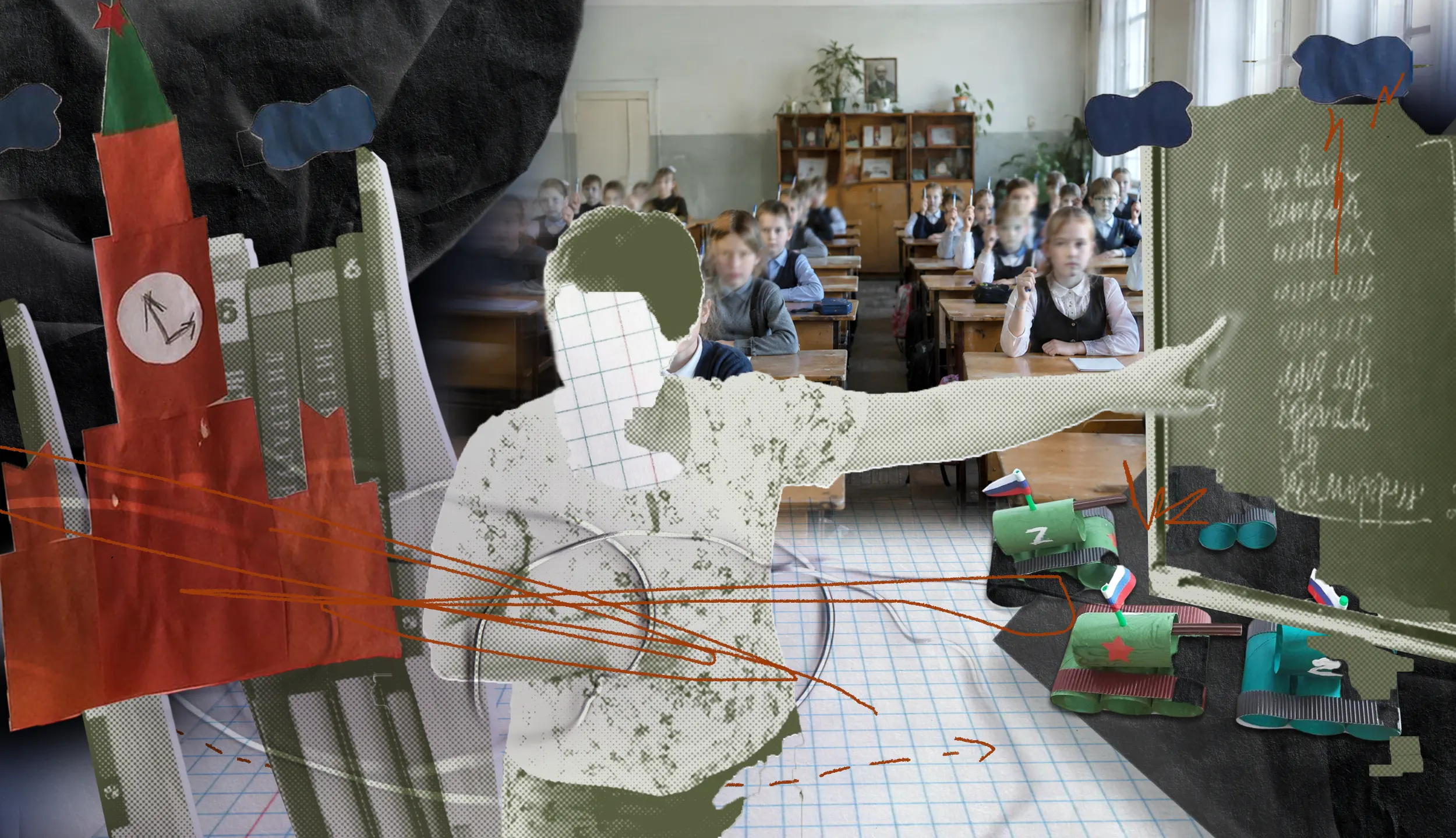
How has life changed at an ordinary city school in Russia since the start of the full-scale war against Ukraine? How are students and teachers responding to the growing militarization of society? And how effective is state propaganda in schools? Margarita B., a teacher, answers these questions
— Could you tell us a little about yourself? Where do you work, what do you teach, and why did you agree to this interview?
— I teach Russian language and literature at a city school with an advanced curriculum, and I’ve been doing it for almost 30 years. Why did I agree to the interview? I have great respect for independent media, and I’m glad if I can be of some use. I suppose I also feel a need to talk about what hurts, because what is happening in our society as a whole, and in schools in particular, calls for serious discussion and reflection. Working at a school since the invasion of Ukraine began has been a traumatic experience for me.
— Since the war began, the lives of Russian schoolchildren have changed noticeably: schools now hold ceremonial assemblies, offer military and physical training, and have introduced new classes such as “Conversations About Important Things.” New textbooks and teaching materials with a pronounced ideological component are also appearing. Is that an accurate picture? How noticeable are these changes in your work and at your school?
— Yes, that’s exactly what’s happening. The most fundamental changes have taken place in the work of homeroom teachers, who have become the main conduit for ideological education. There is now a unified educational program and a standardized plan, where teachers essentially just have to check boxes to show that each requirement has been fulfilled. The freedom of choice that existed before 2022 is gone.
Many teachers welcome this push for uniformity, because it makes life easier under a crushing workload. The depersonalization of education is proceeding at full speed, with virtually no resistance from teachers. Children are made to attend extracurricular classes that have become mandatory, such as “Conversations About Important Things” and “Russia — My Horizons” [a career guidance course], to attend flag-raising ceremonies, to wear standardized school uniforms, to join the government-created youth organization Movement of the First, and so on.
When students or parents try to opt out of these new requirements, they are usually met with aggression from teachers and the administration. Since the whole process is controlled from above, every school has to carry out the “state order” and report on its fulfillment.
Of course, schools carry it out in different ways. It all depends on the administration’s stance and on how low it is willing to bow to its superiors. Some schools are ideologically charged: everyone there sings and dances to the propaganda tune for all they’re worth. Others simply try to meet the reporting criteria for patriotic education so as not to fall out of step.
I work in a relatively fortunate environment in that respect. And I’m no longer a homeroom teacher, so I don’t have to constantly walk a tightrope, trying, on the one hand, not to irritate my superiors and, on the other, not to compromise my conscience.
In that sense, I’m certainly more at peace, if “peace” is even possible in a dehumanizing environment where hatred toward a neighboring people is being cultivated.
— How are the children and your colleagues reacting to the growing ideological and military component in schools? Some say children don’t pay much attention to this kind of propaganda anyway, so nothing terrible is happening. Is that really so, in your view?
— I have never seen anyone who was genuinely happy about any of these innovations. The general administrative insanity is hardly something anyone could welcome, even if their political views happen to align with the rhetoric coming from the authorities.
Schools had long lacked the resources for a quality educational process, and now they have been put under the pressure of “patriotic education” while funding has been cut. Everyone is being crushed by the pressure, but they are expected to perform happiness at their ideological awakening and broadcast an emphatic “We’re delighted!” through ever more elaborate reporting requirements.
Officials couldn’t care less how schools are supposed to squeeze patriotic lessons into curricula and schedules already constrained by SanPiN regulations [Russia’s sanitary and health regulations], or where they are supposed to find the money and the teachers for a new course called “Family Studies,” meant to promote traditional values as an alternative to Western ones. The programs for “Family Studies,” “Conversations About Important Things,” and “Russia — My Horizons” were slapped together by God knows whom and God knows how, so they provoke disputes on both sides of the ideological barricades and are taught any old way, just to tick a box.
Administrators rack their brains over how to hold flag-raising assemblies in huge schools, where to find fathers willing to sing in a patriotic choir, how to herd the whole school into the military-themed performances that are now mandatory, and so on. The authorities keep stoking this ideological cauldron, and schools survive in the boiling water as best they can, feigning loyalty to the state’s political course while cursing the officials behind closed doors
It is painful for any sane person to watch this spectacle being staged across the country. Can a badly made production influence the way people think? Unfortunately, it can. We are not exactly a particularly discerning public; decades of state television have trained people to consume things that are simply inedible.
Uniformity does make life somewhat easier for overburdened teachers: there is nothing to invent, no energy to spend on initiatives. Following instructions is easier and safer. So many teachers have no problem with a single textbook, a standardized curriculum, and a ready-made educational plan. It allows them to absolve themselves of responsibility for their own choices: I was ordered to do it, so I did it.
What happens to the children, the school, and all of us as a result interests very few people. Conformism has always flourished among teachers and has been cultivated through administrative pressure.
The war has exposed the failure of humanities education in Russia, which, when put to the test, turned out to be empty talk recited from teaching manuals.
A humanistic understanding of the world, in my view, has proved alien to the overwhelming majority of teachers, who long ago embraced bureaucratic values: the number of high achievers, top students, medal winners, Olympiad participants, rankings, and reports documenting performance bonuses. We have become rank-and-file bureaucrats, losing the ability to think independently and make our own decisions. We turned out to be willing to carry out any absurd order handed down from above. The most frightening thing is that almost no one seems to recognize what has happened to us.
In my view, propaganda should never be underestimated. It easily affects adults, so why would we assume that children are more resistant to it?
Of course, it affects everyone differently. A great deal depends on the child’s personality, the environment they grow up in, the views their parents pass on, and whether the adults around them have enough authority to make the child want to listen.
Most children really don’t take the adults’ strained patriotic efforts seriously. Not because they have any particular political views, but because of their age: they have their own problems and interests. Extra obligations like marches, anthems, ceremonial assemblies, and additional classes only irritate them and do nothing to build any so-called national identity or the rest of that bureaucratic tinsel.
Xenophobic ideas, however, take root very easily in adults and children alike. We can see it, for example, in attitudes toward migrants. And with the start of the so-called “special military operation,” such a xenophobic barrage was unleashed that it has been hard to withstand. Many haven’t.
School has ceased to be an environment for development and has become a toxic one. It has also become a place where people have to resist negative influences coming from outside.
It helps if a child has a supportive adult nearby and the psychological flexibility to adapt to our traumatic reality. But that adaptation comes at a cost, too. People get used to formalism and hypocrisy at school, to hiding their views, to the idea that sticking your neck out and arguing is dangerous. Children get used to agreeing just to avoid trouble.
And eventually these children will become adults. It isn’t difficult to imagine what kind of adults they will be.
— Many teachers did not support Russia’s invasion of Ukraine. Yet teachers probably find it harder than most people to simply ignore what is happening and go on with their lives. How calm and safe can a teacher feel today discussing current events, or politics in general, with colleagues or students? Do such conversations happen?
— I don’t know these “many teachers” who didn’t support the war. In my school community, there are only a handful, and it’s the same at other schools. Some take a neutral stance, not out of conviction but because they are completely indifferent to politics. And then there are militant nationalists who think Ukraine should be bombed into the ground, with no mercy even for the children, because supposedly the people there are no longer people but “fascists.”
At first, there were far more high school students who were interested in politics and understood what was going on than there were teachers, who were used to trusting the TV.
That was obvious right away.
Out of an old habit, students rushed to tell teachers openly what they thought about the invasion and argued heatedly, especially those with relatives in Ukraine. Conflicts flared up both between and during lessons, because the two sides’ positions were irreconcilable. In the heat of genuine indignation, a teacher could easily breach professional ethics by insulting a student who felt sorry for Ukrainians. Once, an entire class rebelled against a teacher with a pro-government stance. The teacher complained to the principal, who gave the class a dressing-down.
To keep such situations from happening, the heavy artillery was sent into schools: historians and political scientists from universities came to help teachers, running ideological crash courses. Picture an auditorium full of teachers applauding someone who ought to be put on trial for inciting hatred and deliberately distorting historical facts to please the authorities. How this became possible among teachers, especially humanities teachers, I simply cannot understand.
The jingoistic onslaught, together with high-profile arrests across the country for “discrediting the army,” swept away the wave of open protest among students. The children were quickly made to understand that arguing was unsafe, and the arguments stopped.
Teachers did talk among themselves in 2022, when it all began. That was also when those who had political convictions split bitterly along political lines. And it became clear that at school, criticizing the president and the war was now equated with betrayal, and not by the authorities but by teachers themselves, even those you had been close to.
Political arguments among colleagues ended in hostility and estrangement, as they did everywhere else.
The war has laid bare the hypocrisy of our education system: its sham nature on the one hand and its inhumanity on the other. It is the biggest disappointment I have ever felt, in people and in my profession.
Over four years, people have grown accustomed to living in a state of permanent war, because for most people it has not affected their daily lives very much. The passions have subsided somewhat, but not everyone has adapted to the new reality. Yes, the immediate intensity has faded, but the world around you has split apart, and in your mind you are always on the barricades.
— Have there been any significant changes in teachers’ work over the past four years? Has the workload grown, perhaps because of patriotic events, the switch to new textbooks, or changes to the curriculum? Are salaries keeping up with inflation?
— The transition to new textbooks is in full swing. Historians have suffered the most: whatever their views, they have not taken at all to Medinsky’s textbooks [the new unified history textbooks co-authored by presidential aide Vladimir Medinsky]. Literature teachers have seen unwelcome changes too, though at first glance less significant ones.
But the 11th-grade curriculum has brought back two ideological Soviet novels that were dropped after perestroika, The Young Guard by Alexander Fadeev and How the Steel Was Tempered by Nikolai Ostrovsky. Meanwhile, George Orwell, author of the famous novel 1984, has disappeared from the list of recommended reading, while Metropolitan Tikhon (Shevkunov) has been added with his book The Demise of an Empire: A Russian Lesson, which has nothing to do with literature as an art form.
Literature as a school subject is being reshaped before our eyes to suit the needs of the state, but in a completely mindless way, because the authorities have no ideology as a coherent system, and officials are imitating something that doesn’t exist.
Meanwhile, the school, as the basic social institution of education, has lost its authority with the public, and children simply ignore anything they find uninteresting or of no obvious use. Teenagers cut their reading to a minimum long ago.
But the militarization of education starts in kindergarten and continues at school across a range of subjects, not just the humanities. For example, the life-safety course [OBZh] has been replaced by “Fundamentals of Security and Defense of the Motherland” [OBZR], where handling an assault rifle and operating drones are supposed to become basic skills for every graduate.
Military patriotism and self-sacrifice are the key themes of the texts in many practice books for the final Russian-language exams. We used to write essays about love, friendship, creativity, and human nobility; now war and wartime heroism dominate.
Not long ago, there was still at least a little room to choose textbooks and curricula. Now academic freedom exists only on paper. To keep teachers from free-thinking and to make them easier to control, schools have been required to administer national standardized tests [VPR] in every grade and almost every subject, and the test materials have been tied to the standardized curricula.
The bloated program of character-building activities has added headaches not only for homeroom teachers but for subject teachers too. Lessons keep getting canceled because of events, yet the same quality of teaching is still demanded. Teachers who are held responsible for the results are put in an increasingly difficult position.
Salaries stopped keeping up with anything long ago, whether inflation or common sense. But as long as schools obediently carry out every whim of the authorities, pay will never be fair compensation; it will remain a handout.
When people stop walking on a leash held by the authorities, then we can talk about something else. But for that to happen, an entirely different generation will have to grow up.

Мы намерены продолжать работу, но без вас нам не справиться
Ваша поддержка — это поддержка голосов против преступной войны, развязанной Россией в Украине. Это солидарность с теми, чей труд и политическая судьба нуждаются в огласке, а деятельность — в соратниках. Это выбор социальной и демократической альтернативы поверх государственных границ. И конечно, это помощь конкретным людям, которые работают над нашими материалами и нашей платформой.
Поддерживать нас не опасно. Мы следим за тем, как меняются практики передачи данных и законы, регулирующие финансовые операции. Мы полагаемся на легальные способы, которыми пользуются наши товарищи и коллеги по всему миру, включая Россию, Украину и республику Беларусь.
Мы рассчитываем на вашу поддержку!


To continue our work, we need your help!
Supporting Posle means supporting the voices against the criminal war unleashed by Russia in Ukraine. It is a way to express solidarity with people struggling against censorship, political repression, and social injustice. These activists, journalists, and writers, all those who oppose the criminal Putin’s regime, need new comrades in arms. Supporting us means opting for a social and democratic alternative beyond state borders. Naturally, it also means helping us prepare materials and maintain our online platform.
Donating to Posle is safe. We monitor changes in data transfer practices and Russian financial regulations. We use the same legal methods to transfer money as our comrades and colleagues worldwide, including Russia, Ukraine and Belarus.
We count on your support!


другие подкасты


«Это базис»: Сначала институты, потом политика? Необходимость и достаточность институциональных реформ для России

«Это базис». Урбанистика и право на «право на город»

Политический дневник #55. Университет — новый special
SUBSCRIBE
TO POSLE
Get our content first, stay in touch in case we are blocked

Еженедельная рассылка "После"
Получайте наши материалы первыми, оставайтесь на связи на случай блокировки


.svg)

