

НАСТОЯЩИЙ МАТЕРИАЛ (ИНФОРМАЦИЯ) ПРОИЗВЕДЕН, РАСПРОСТРАНЕН И (ИЛИ) НАПРАВЛЕН ИНОСТРАННЫМ АГЕНТОМ ПРОЕКТОМ “ПОСЛЕ”, ЛИБО КАСАЕТСЯ ДЕЯТЕЛЬНОСТИ ИНОСТРАННОГО АГЕНТА ПРОЕКТА “ПОСЛЕ” 18+
Women in Prison: Serving Full Time
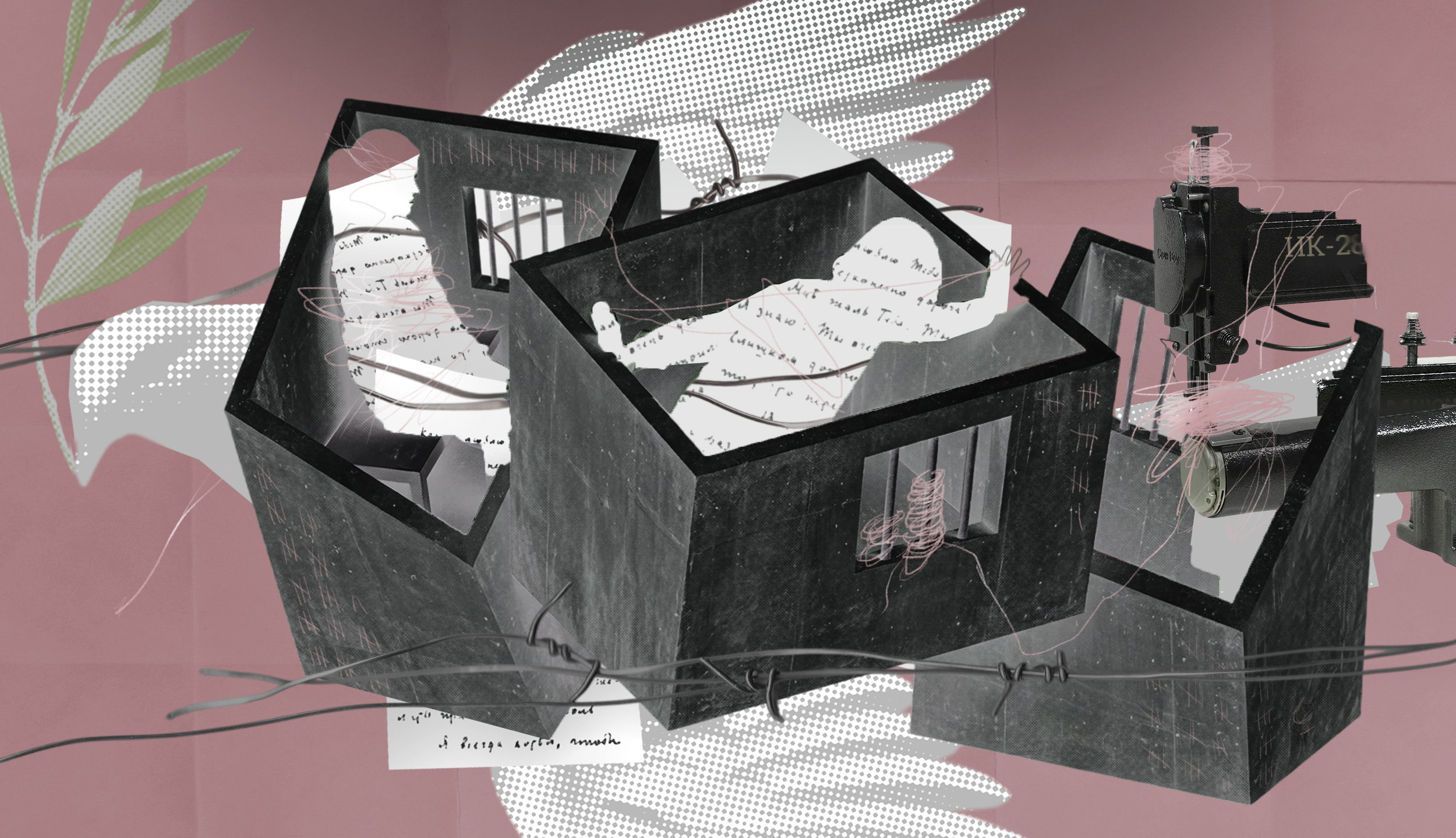
How do women political prisoners cope with pressure from prison authorities, and how do they build relationships with their fellow inmates? How do they pass on the support they receive from the outside to other women behind bars? Feminist and LGBT activist Liliya Vezhevatova answers these questions in a piece co-written with Sasha Graf, founder of the Women’s Term project
Over the past four years, the persecution of women on political grounds in Russia has grown dramatically. In 2022, 53 women political prisoners were behind bars. By spring 2026, that number had more than tripled, to over 200. And these are only the cases confirmed by human rights defenders: some families deliberately avoid publicity, fearing that attention could put their loved ones at greater risk.
The growing number of political cases has drawn attention to the conditions women face after arrest and conviction. Abuse, a lack of medical care, and total dependence on prison staff have long been part of everyday life for thousands of women serving sentences for ordinary crimes.
Political prisoners don’t live in a separate prison world. They face the same treatment that has been meted out to prisoners for decades. Whatever a woman has been convicted of, she may end up in an overcrowded cell that is either stifling or freezing, doing grueling work, and facing arbitrary punishment and abuse from staff.
“Prisons are just brutal, a nightmare, and nobody should ever be in one at all,” says one volunteer.
Political cases, however, are more likely to attract public attention. Support networks form around prisoners, while journalists and human rights organizations publish their letters and document their experiences. This gives the public a view of what rarely made it beyond the walls of penal colonies and pretrial detention centers before. Individual stories reveal not isolated exceptions but the everyday workings of Russia’s prison system, a system marked by cruelty, degradation, and inhumane treatment.
Still, a woman’s political status does change her position within this system, adding extra layers of control and pressure to the standard practices of Russia’s Federal Penitentiary Service (FSIN).
Special Regime for ‘Political’ Prisoners
Political prisoners face closer scrutiny, harsher censorship, and hostility from prison staff. One of the main forms of pressure is that parole is effectively off the table. Prisoners convicted of ordinary crimes can hope for early release if they work well and keep a clean disciplinary record, but political prisoners are made to understand from the start that they will serve every last day of their sentence. This is especially hard on women with children on the outside, for whom early release would mean so much.
Family ties themselves become a lever. For many women prisoners, being able to phone their children or see their relatives matters so much that they will put up with any humiliation without protest, meet production quotas in the sewing workshops, and even sign “voluntary” waivers of independent legal counsel to keep that contact.
Some colonies put political prisoners in isolation over public holidays as a preventive measure. This is what happens to Nina Slobodchikova, who was sentenced to twelve years for sending money to Ukraine and is serving her sentence at Penal Colony No. 9 in the Novosibirsk Region. On major holidays like New Year’s, Victory Day, and Russia Day, the administration sends her to a punishment cell even when there is nothing to punish her for, just to be on the safe side.
Censorship is another tool prison authorities use to put psychological pressure on political prisoners and cut them off from the world.
Galina Dovgopolaya, 71, who is serving twelve years for “treason” at Penal Colony No. 1 in the Vladimir Region, has described severe censorship of her mail. In her letters, she wrote that the administration destroys any letters sent to her that mention the war or politics or contain material from independent media.
According to Irina, who coordinates aid to prisoners, trying to pass on news from the outside can earn a prisoner a warning from colony officials, in what are known as “preventive talks”:
“They can tell you directly: if you keep receiving this kind of news, you’ll get an additional sentence. Or… you’re getting letters from some volunteers, and if you keep communicating with them, you’ll get another sentence.”
Volunteers believe these talks come down to staff covering themselves: officers fear being reprimanded by their superiors for letting “uncensored” news slip through. But for women trapped in the system, such threats deepen their isolation, pushing them to cut themselves off from the outside world of their own accord.
The most complete isolation is reserved for prisoners in “special” cases. Karina Tsurkan, also held at Penal Colony No. 1, is a case in point. The former Inter RAO executive, sentenced to 15 years on espionage charges, was systematically cut off from the outside world by the colony administration, with no legal basis. Her son and elderly mother sometimes went six months without hearing from her. Then a single letter would get through saying she was fine, and silence would fall again. Some letters sent to her never reached her either, although postcards and some other mail were allowed through.
At Penal Colony No. 50 in Yurga, in the Kemerovo Region, a commission reviewing political prisoner Arina Ivanova’s private mail found signs of “religious extremism” in one of her letters. She was then warned that she would be watched more closely from now on. “As a particularly dangerous prisoner, I suppose,” she wrote from the colony. Ivanova is serving five years for an anti-war social media post.
Censoring mail is only one way of limiting political prisoners’ contact with the outside world and with each other. The administration keeps just as close an eye on who they talk to inside pretrial detention centers and colonies.
Women charged under extremism laws may share a pretrial detention cell with women accused of treason, but two women charged under the same article, for instance for spreading “fake news” about the army, are usually kept apart. Colonies follow a similar principle, separating prisoners who share a case, a background, or the circumstances of their prosecution. At Penal Colony No. 1 in Golovino, for example, two Ukrainian citizens accused of plotting a terrorist attack, Yana from Kharkiv and Yanina from Melitopol, were placed in different units. For a long time they lived in the same colony without knowing the other was there, until a visiting volunteer told them.
“They Don’t Medically Treat Them at All…”
Access to medical care is another serious problem. Prisoners often have to fight for treatment even when they have a diagnosed condition that needs ongoing care. The case of journalist Olga Komleva is a telling example. Sentenced to twelve years for taking part in an “extremist community” and spreading “fake news” about the military, she is serving her sentence at Penal Colony No. 28 in Berezniki. While in pretrial detention, Komleva lost her voice and could not speak for several months, which she attributes to the violence she endured there. Yet only ten days after she arrived at the colony, the administration reprimanded her over it, rejecting her explanation that the cause was psychological.
In February 2026, the situation became a direct threat to her health. Komleva has type 2 diabetes and needs to take medication regularly, but the colony stopped giving it to her. She went on hunger strike to demand her treatment back and received her medication a day later.
Maria Bontsler, a lawyer and human rights defender from Kaliningrad, is in an even more serious situation. For years, she defended people in political cases; now she is in pretrial detention herself. In March 2026, her initial charge of “confidential cooperation” with a foreign state was upgraded to “treason.” She was taken into custody shortly after being hospitalized with a hypertensive crisis, even though she suffers from a serious chronic illness. As early as summer 2025, Mariana Katzarova, the UN Special Rapporteur on the situation of human rights in Russia, warned that the lack of timely medical care posed an immediate threat to Bontsler’s life.
Bontsler has had repeated hypertensive crises in detention, and her condition has continued to deteriorate. In summer 2026, she said the temperature in her cell at the Kaliningrad detention center had risen above 40°C. In July, her lawyer reported that she had passed out in her cell one evening and stayed unconscious until morning. Although her blood pressure had reached 210/100, the ambulance crew that came did not take her to the hospital.
Yet the lack of timely diagnosis and treatment is by no means limited to political prisoners. Anna, a volunteer who buys supplies for prisoners in several regions, puts it bluntly:
“They don’t treat her at all… But it’s not because she’s a political prisoner — they don’t treat anyone.”
In these conditions, political prisoners who stay in regular contact with the outside world and with human rights defenders often become the only hope for women who have no family to help them. An anonymous volunteer with Women’s Term recalls a young woman from Uzbekistan who suddenly lost the use of her arm in the colony, while the prison medical staff simply ignored her symptoms:
“At some point her arm just stopped working, and nobody knew what to do. A political prisoner asked us to get in touch with her and help, to arrange a visit from a lawyer so we could find out what was going on and let the colony know she had legal representation. After that, they took her to the hospital and ran tests. In the end, she got the use of her arm back.”
In another case, the colony refused to take a seriously ill woman to a civilian hospital. A political prisoner in her unit then asked a friend to advise the woman by phone on how to take her immunosuppressants.
Two Strategies for Doing Time
Under the harsh colony regime, how often a woman faces disciplinary sanctions or sent to a punishment cell depends not only on what she was convicted of but also on how she chooses to handle prison life. Volunteers with human rights projects who go through requests for help from the colonies note that the shorter a woman’s sentence, the more careful she may be to avoid clashing with the administration, earning disciplinary penalties, or facing the other consequences of disobedience.
Five or six years is a very long, painful sentence, but it is still possible to picture a life after release. That gives a prisoner a reason to adapt to the prison routine, grit her teeth, and stay out of trouble, even when the administration tells her plainly from day one that parole is not an option.
With longer sentences of twelve or fifteen years, life after prison becomes far harder to imagine, and attention increasingly turns to what is happening inside the colony. The fear of punishment or of worse conditions can start to lose its hold. Some women become willing to take on the system openly and refuse any compromise with the administration. With decades of prison ahead, it can feel as if there is nothing left to lose.
In women’s colonies, where prisoners are expected to comply without question, simply standing up for one’s rights can be seen as a challenge to the established order. Refusing to do what the administration demands, including working in the sewing workshop, can set off a cascade of penalties, from disciplinary reports and punishment cells to transfer to stricter conditions of detention. This isn’t reserved for political prisoners: women convicted of ordinary crimes who come into conflict with the administration can face the same response.
Journalist Maria Ponomarenko is living through one such traumatic standoff. In 2023, she was sentenced to six years for a post about the Russian strike on the Mariupol Drama Theater. Although she has been diagnosed with claustrophobia, Ponomarenko is held alone in a seven-square-meter cell whose window faces a blank wall. “Every day feels like unimaginable, round-the-clock torture,” she wrote.
She has also been almost entirely prevented from writing about what is happening to her. According to a friend, her outgoing mail was blocked in spring 2026 because of her “bad mood” and the “destructive nature” of her letters. Since her imprisonment, two new criminal cases have been opened against her, both for “using violence against prison officers.” She denies both charges.
Nika Novak, a journalist from Chita sentenced to four years for “confidential cooperation” with a foreign organization, is serving her sentence at Penal Colony No. 11 in the Irkutsk Region. After clashing with the administration, she was repeatedly sent to a punishment cell and eventually moved to stricter conditions of detention. Novak linked the penalties partly to her refusal to tell the media that “everything is fine” in the colony and her refusal to work as a seamstress. An aggressive cellmate, a provocateur, was moved in with her; her colored pencils were confiscated as “dangerous items”; and all her incoming mail was blocked. In response, Novak went on three grueling hunger strikes.
At Penal Colony No. 5 in Vyshny Volochyok, artist Lyudmila Razumova has been locked in a long-running conflict with the administration. Sentenced in 2023 to seven years for anti-war posts and graffiti, she began complaining about her conditions and the conduct of staff within her first few months. In response, she was hit with a string of disciplinary reports and penalties, sent repeatedly to the punishment cell and the colony’s lockdown unit, and in autumn 2024 moved to stricter conditions of detention. In March 2025, after a hunger strike, Razumova was transferred to a prison hospital in Torzhok, where she got into an altercation with another prisoner. According to Razumova, she threw hot water at the woman to defend herself from an attack; the woman then beat her and tried to strangle her with the cord of an immersion heater. In the end, it was Razumova who faced a new criminal case.
Ulkyar Gashimova, an activist from Derbent, is serving four and a half years at Penal Colony No. 3 in the Kostroma Region for anti-war comments that a court classified as calls for terrorism and extremism. In pretrial detention, she spoke of being put in punishment cells and threatened with forced psychiatric commitment. Since arriving at the colony, she has been sent to the punishment cell again and again. In October 2025, she said, she spent almost the entire month in isolation.
“She’s practically living in the punishment cell. They don’t give her medication there. We’re trying to find her a lawyer now. We’ve already complained to the prosecutor’s office. But then again, she refuses to work. She has pretty firm views about how things should be, about how to handle being in prison, about work,” says Irina, the aid coordinator.
The second strategy is to deliberately avoid confrontation and adapt to daily life in the colony while holding on to one’s own boundaries. This is the approach Anna Bazhutova has taken. Sentenced to five and a half years for a livestream about crimes committed by Russian soldiers in Bucha, she is serving her sentence at Penal Colony No. 5 in Vyshny Volochyok, where she has managed to stay on good terms with both the administration and the other prisoners. Struggling with the work in the sewing workshop, she found another role for herself in colony life. She draws the colony’s wall newspapers, decorates its club room, and takes part in events. This lets her avoid constant conflict with the administration while doing something she genuinely enjoys. But outward compliance does not mean giving up her views. Bazhutova chooses her own repertoire for performances, and the works she reads at colony events include Anna Akhmatova’s Requiem.
Theater director Yevgenia Berkovich, who is serving five years and seven months at Penal Colony No. 3 in the Kostroma Region for “justifying terrorism,” has chosen a similar path. She works in the colony’s production shop, avoids open conflict with the administration, and takes part in the colony’s daily life. But even this approach offers no protection from further restrictions. After several months of involvement in the colony’s cultural activities, Berkovich was banned from doing theater or any other creative work.
Another example is Olga Smirnova, sentenced to six years for anti-war posts. At Penal Colony No. 2 in Ulyanovka, in the Leningrad Region, she tried to avoid open confrontation and keep as low a profile as possible. That did not spare her from close monitoring. Soon after she arrived, Smirnova was put on a watch list as someone “prone to terrorism and extremism.”
Politics in the Barracks
Taken from their lives on the outside and placed in the general units of penal colonies, many women convicted on political charges find themselves in a deeply unfamiliar world. Political prisoners rarely form close, trusting relationships with the other women in their units. Their habits and interests are often different from those around them. They read a lot, do crossword puzzles, knit, and draw, trying to hold on to the routines of their lives outside, and so they may keep somewhat to themselves.
Relationships within a unit, however, are more complicated than they might seem. Anti-war posts or “treason” charges can indeed draw criticism from other prisoners. But according to prisoners’ relatives and friends, these conflicts rarely turn into sustained bullying.
In everyday life, political prisoners and women convicted of ordinary crimes can live side by side quite peacefully, despite having radically different views and life experiences. Lera, a volunteer with a prisoner support project, puts it this way:
“To keep conflict to a minimum, you just talk about other things. First and foremost, these are people. It’s up to each of them how to handle the situation. You can stir up conflict and get into arguments, or you can just step back and not talk about it.”
Political prisoners often earn the respect of women who have been in the colony for years and are serving long sentences themselves. What strikes these women most is how out of proportion the punishment is: six, ten, or more years for an online post or private correspondence. According to relatives and volunteers, the women in the units understand that political prisoners are “doing time for nothing.” Their political differences don’t go away, but the shared experience of prison can sometimes matter more than political disagreement.
Political prisoners are also valued for their literacy and education and for their willingness to help others in the unit, for instance by drafting legal complaints or official requests for their cellmates. Their talents and their part in the colony’s creative life also win them recognition. At Penal Colony No. 5, Bazhutova’s fellow inmates admire her drawings and her competition wins, and miss her when she is taken to the hospital. In this way, life in the barracks can turn initial distrust into lasting bonds, and the empathy of political prisoners becomes a real source of support for women convicted of ordinary crimes.
Help from the Outside
Living together in a colony often breaks down familiar social and political boundaries, and very practical forms of mutual aid grow up in their place.
Women political prisoners who receive regular support from outside, such as care packages from volunteers, donations, and money raised at events organized by human rights groups like the June 12 Marathon, almost never keep it all to themselves. They use their connections to help the most vulnerable women in their own barracks and in neighboring units.
“Political prisoners write to us: listen, there are other people here too. They’re human too, and they’re having a hard time too. They’re here because they were charged on some strange grounds, or they just ended up here somehow. They’re actually good people. They’re actually smart,” says Irina, a volunteer.
To understand why this help matters so much, you need to know how poor life in women’s colonies really is. Prisoners earn a token wage for exhausting work in the sewing workshops. Court-ordered fines, where they apply, are deducted from their pay, along with charges for electricity, water, and food. In the end, women take home around 1,000 rubles a month. Meanwhile, basic necessities and hygiene products in the colony shop often cost one and a half to two times more than outside. Without outside help, women simply cannot keep themselves clean or eat properly.
Anna, a volunteer who buys supplies for prisoners, says that many of the women she helps at first find it hard even to say what they need. They assume she is paying out of her own pocket and try to ask for as little as possible.
“A lot of my girls really struggle to tell me what they need, because they all think I’m spending my own money, and with the censorship I can’t just write that it isn’t mine. So I try to hint as hard as I can. A few times I’ve written it outright: if I’m asking, it means I can afford it. Write me a list!”
As trust grows, the requests become more frequent. But often they are not for the political prisoners themselves. They are for women who get no help from outside: women who grew up in orphanages, the seriously ill, foreign nationals. This solidarity has its limits, too. Some refuse on principle to help women convicted of murder, while making a point of supporting young women serving long sentences for drug offenses, especially when they believe the woman took the blame for someone else or was framed by her partner.
Human rights defenders have recorded many stories of this kind of mutual aid among prisoners. One involves Olga Kolkova, who is serving 15 years for treason at Penal Colony No. 1. For a long time she sent volunteers only very modest requests, careful not to burden the project. Then one day she sent Anna, a volunteer, a shopping list that filled half a page, apologizing for how long it was. It later turned out that everything on it was for a birthday party for Kristina, a prisoner serving time for an ordinary crime who had no one at all left on the outside. Olga wanted to make her day.
Something similar happened at Penal Colony No. 5 in Vyshny Volochyok, where Anna Bazhutova and Lyudmila Razumova are serving their sentences. The two women live in different units, have completely opposite temperaments, and have chosen very different survival strategies: Bazhutova seeks diplomatic accommodation, while Razumova openly confronts the regime. Yet they showed the same sensitivity to others. Within a couple of weeks of each other, each contacted a human rights project through her own volunteers, asking it to send food and support to the same fellow prisoner, a woman convicted of an ordinary crime who, they had noticed, was struggling physically and emotionally.
Much of the help political prisoners arrange is meant not for individual women but for the whole unit. At their request, relatives buy garbage bags and cleaning supplies for everyone to use, and send in large sheets of paper, paints, and pencils that all the women can share.
A Measure of Humanity
Surviving the inhumane conditions of imprisonment changes not only the prisoners themselves but also the human rights community that supports them. Anna, the volunteer who deals with the harsh realities of the prison system every day, says that at some point she made a conscious decision to drop the word “political” entirely from her work and from the names of her projects. Her stance is, in effect, a manifesto against dividing human suffering into artificial categories:
“The word ‘political’ gets on my nerves. Some petty people sitting in big offices with their salaries get to decide who deserves help and who doesn’t. I would help all the ordinary women too if I could manage it. You can’t divide them into categories once you’ve seen what the prison camps are really like.”
Within the FSIN system, human rights defenders increasingly come across cases of women of every kind whose stories are just as painful and show the same utter lack of rights. Among these broken lives are survivors of domestic violence convicted of murder or grievous bodily harm (Articles 105 and 111 of the Criminal Code) after defending their lives against abusive husbands, on the grounds that they went beyond the limits of self-defense. There are also young women given long sentences under Article 228, the drug article, often because their partners implicated them to get lighter sentences themselves.
In the face of such systemic violence, the artificial barriers, labels, and hierarchies of the outside world lose all meaning. In a place where the prison TV broadcasts pro-government propaganda every day and women sometimes have to fight for their place in line at the washbasin, survival depends not on ideology but on something much simpler: basic human compassion.
Russia’s prison system is designed to break the will through exhausting, monotonous labor and isolation. But in practice it always runs up against human empathy, which can never be stamped out completely. In a shared barracks, offering someone a piece of sausage or a pack of sanitary pads from a volunteer’s package, or helping a cellmate write a legal complaint, becomes the one true measure of humanity. The experience of women in prison shows that even under the total control of the FSIN’s punitive machine, the ability to stay human, to feel another person’s pain, and to support those around you ultimately proves stronger than any system of repression.
Women’s Term is an independent project and podcast that tells the stories of women in prison and supports them through letters, care packages, and legal advice.

Мы намерены продолжать работу, но без вас нам не справиться
Ваша поддержка — это поддержка голосов против преступной войны, развязанной Россией в Украине. Это солидарность с теми, чей труд и политическая судьба нуждаются в огласке, а деятельность — в соратниках. Это выбор социальной и демократической альтернативы поверх государственных границ. И конечно, это помощь конкретным людям, которые работают над нашими материалами и нашей платформой.
Поддерживать нас не опасно. Мы следим за тем, как меняются практики передачи данных и законы, регулирующие финансовые операции. Мы полагаемся на легальные способы, которыми пользуются наши товарищи и коллеги по всему миру, включая Россию, Украину и республику Беларусь.
Мы рассчитываем на вашу поддержку!


To continue our work, we need your help!
Supporting Posle means supporting the voices against the criminal war unleashed by Russia in Ukraine. It is a way to express solidarity with people struggling against censorship, political repression, and social injustice. These activists, journalists, and writers, all those who oppose the criminal Putin’s regime, need new comrades in arms. Supporting us means opting for a social and democratic alternative beyond state borders. Naturally, it also means helping us prepare materials and maintain our online platform.
Donating to Posle is safe. We monitor changes in data transfer practices and Russian financial regulations. We use the same legal methods to transfer money as our comrades and colleagues worldwide, including Russia, Ukraine and Belarus.
We count on your support!


другие подкасты


«Это базис». Почему леваки не ходят голыми?

«Это базис»: В чём сила? Российские международные отношения

«Это Базис». Илон Маск и веган-кафе шпана
SUBSCRIBE
TO POSLE
Get our content first, stay in touch in case we are blocked

Еженедельная рассылка "После"
Получайте наши материалы первыми, оставайтесь на связи на случай блокировки


.svg)

