

НАСТОЯЩИЙ МАТЕРИАЛ (ИНФОРМАЦИЯ) ПРОИЗВЕДЕН, РАСПРОСТРАНЕН И (ИЛИ) НАПРАВЛЕН ИНОСТРАННЫМ АГЕНТОМ ПРОЕКТОМ “ПОСЛЕ”, ЛИБО КАСАЕТСЯ ДЕЯТЕЛЬНОСТИ ИНОСТРАННОГО АГЕНТА ПРОЕКТА “ПОСЛЕ” 18+
The Russian-Speaking Left in German Politics
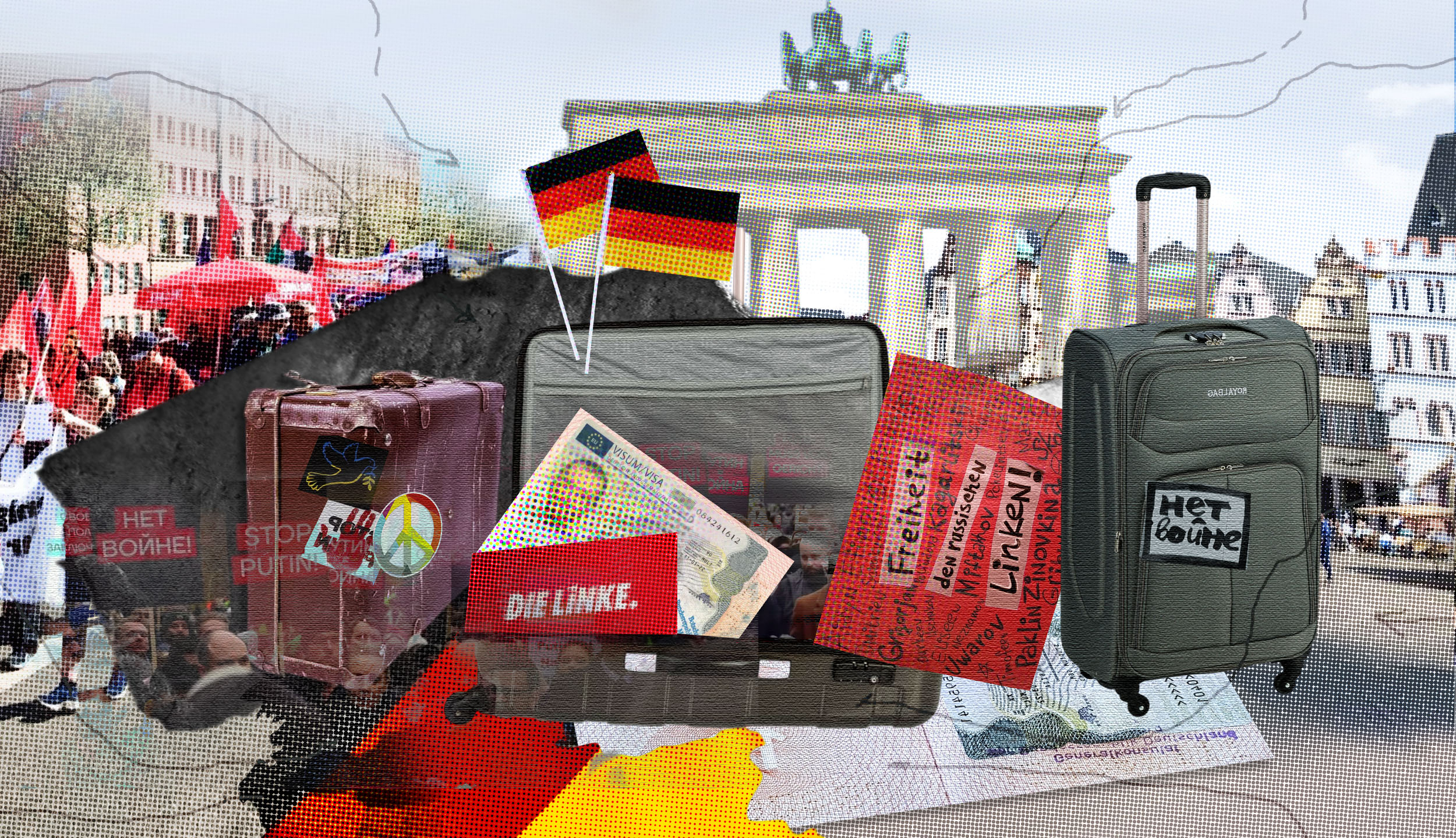
Who are Germany's Russian-speakers, and why are both the left and the far right vying for their votes? How do anti-war émigrés from Russia and the children of late resettlers come together inside Die Linke — and what unites them with the Ukrainian left? And can working in one’s native language bring back into politics those who for decades were considered lost to it? Activist Semyon Mikhailov talks about the “Russian-Speaking Left” — a young group that aims to transform the diaspora from an object of propaganda into a political actor in its own right
Germany and Russia are countries with deep historical ties and geographic proximity. German settlers migrated to the Russian Empire throughout the eighteenth and nineteenth centuries, while subjects of the Russian tsars moved to Germany to escape political repression, pursue higher education, or seek better economic opportunities.
In the 1990s, descendants of those German settlers were given the opportunity to return to their ancestral homeland and obtain German citizenship. In the early twenty-first century, Germany also saw growing migration from Russia, driven by both economic and political factors. After Russia’s full-scale invasion of Ukraine in 2022, when many Russians chose to leave their country in protest of the war or out of fear of its consequences, Germany became a refuge for a significant number of them.
As might be expected, left-wing activists from Russia have become actively involved in their new political environment despite the challenges of exile and resettlement. Many learn German quickly, join political organizations, and build networks both among themselves and with other Russian-speaking communities. Within the party The Left (Die Linke), a group known as “Russian-Speaking Leftists” (Russkoyazychnye Levye, RL) has already emerged, with ambitious goals and considerable organizing potential.
Who Are the Russian Speakers in Germany?
“Russian speakers in Germany” is an exceptionally broad category encompassing people who arrived in the country at different times and under very different circumstances, primarily from the former Soviet Union. They are not necessarily ethnic Russians, nor are they necessarily migrants from the Russian Federation.
According to German statistical data, Russian is now the third most widely spoken language at home in Germany, after German and Turkish. Overall, 77 percent of Germany’s residents speak only German at home. Another 17 percent use multiple languages in their households, while just 6 percent do not speak German at home at all. Of the 15.5 million people who primarily or exclusively use languages other than German at home, 14 percent speak Turkish, 12 percent Russian, and 9 percent Arabic. In other words, roughly 2.5 million people — or about 3 percent of Germany’s total population of 83.5 million — use Russian at home to some extent.
These figures reflect only active language use. The number of people who understand or speak Russian is considerably higher. As of 2024, Germany was home to approximately 4.7 million people with roots in the former Soviet Union, including those born in the USSR or one of its successor states, as well as their children. Among the 3.8 million people in this group who were born outside Germany, most came from three countries: Ukraine (30 percent), Russia (28 percent), and Kazakhstan (26 percent).
In the early 1990s, Germany experienced a large influx of Spätaussiedler (“late repatriates”) — ethnic Germans whose families had been subjected to repression and deportation under Stalin. They were granted citizenship upon arrival and, for the most part, entered the labor market relatively quickly. Many were highly skilled workers, engineers, and other professionals who nevertheless found themselves employed in lower-paid and less-qualified jobs because of difficulties with credential recognition and language barriers.
For many, full integration into German society remained elusive, contributing to a lingering sense of disappointment and resentment. It is important to note, however, that the second generation, those born or largely raised in Germany, has generally integrated successfully. Many occupy professional and social positions comparable to those of their German peers, while Russian often functions primarily as a language of family communication and as an additional cultural and professional asset.
Late repatriates remain the largest group of people in Germany with roots in the former Soviet Union, numbering around 2.5 million today. But ethnic Germans were not the only migrants arriving from the region. Roughly 200,000 Jewish immigrants also settled in Germany, while the economic collapse and social upheaval that accompanied the dissolution of the Soviet Union pushed many others to seek better employment opportunities, educational prospects, and a more open social environment.
Before Russia’s full-scale invasion of Ukraine, the number of immigrants from the former Soviet Union who had obtained German citizenship through employment-based migration was estimated at between 200,000 and 250,000. In addition, Germany was home in 2022 to approximately 263,000 Russian citizens and 156,000 Ukrainian citizens. Many of these migrants were highly educated professionals from large urban centers. As a rule, they did not rely on public assistance, and obtaining citizenship required meeting a number of demanding criteria, including, until recently, renouncing their previous nationality.
The war transformed this landscape dramatically. Germany has received approximately 1.3 million Ukrainian refugees, most of whom speak both Ukrainian and Russian, with many, particularly those from eastern regions, using Russian extensively in everyday life. Unlike late repatriates or earlier waves of labor migration, the overwhelming majority did not choose to relocate voluntarily. Their displacement was forced by war and shaped by traumatic circumstances.
Their legal status remains uncertain and heavily dependent on political decisions, while integration into the labor market is often hindered by language barriers and difficulties in having professional qualifications recognized. A much smaller but politically active group finds itself in a similar position: Russians who fled persecution for their anti-war views and were granted protection in Germany.
Since the beginning of the full-scale war, German authorities have issued roughly 2,500 humanitarian visas to Russian nationals. In addition, Russian citizens have submitted more than 22,000 asylum applications through the standard asylum procedure (Asyl), with applications peaking in 2023 at 9,028. Refugees cannot vote and are often unfamiliar with Germany’s political landscape. Yet many are likely to become citizens in the future. Those who entered the workforce soon after arrival may already be eligible to begin the naturalization process.
Artyom Stassyuk, co-coordinator of Russian-Speaking Leftists (RL), explained why organizing within these communities is so important for the left: “I’ve lived in Germany since 2010, and even back then I noticed that most Russian-speaking residents of the country had little interest in politics. Around 2014–2015, support for the Alternative for Germany began to grow, including among post-Soviet Germans, often referred to simply as ‘Russian Germans.’ This rise coincided both with the large-scale arrival of refugees from Syria and with the rapid expansion of Russian state-aligned media networks in Germany.
In many cases, when our former compatriots vote for right-wing parties, they are not only supporting racism and discrimination; they are also acting against their own material interests. One of our goals is to make that contradiction visible. And because we are part of these communities ourselves, we are uniquely positioned to do that work effectively.”
The Nuremberg Conference
On February 28, more than thirty delegates representing most of Germany’s federal states gathered in Nuremberg for a founding conference. After working through debates over language, principles, and organizational priorities, they adopted the necessary governing documents and formally established a new structure within The Left Party: the federal working group (Bundesarbeitsgemeinschaft, or BAG) Russian-Speaking Leftists.
Participants received recorded greetings from party co-chair Jan van Aken and Bundestag member Kathrin Gebel. Gebel, herself a Russian German, emphasized the significance of the new organization: “Many of you have firsthand experience of political activism under conditions in which a political regime gradually turns into a dictatorship. At a time when Germany is experiencing a rightward shift, that experience is invaluable.”
The party’s statutes explicitly allow, and even encouragу, the formation of such groups. Once they satisfy a set of formal requirements and receive official recognition, they gain access to funding and representation at party congresses. Importantly, participation in these structures does not require membership in The Left Party itself, creating opportunities for non-party activists to influence internal discussions and decision-making from outside the formal party apparatus.
Ekaterina Shuvalova, a co-coordinator of Russian-Speaking Leftists, reflected on the importance of immigrant participation in political life: “I believe it is important to participate in politics in principle—especially now, while the war in Ukraine continues and Europe’s rightward turn becomes increasingly visible. People who do not hold German citizenship or citizenship of another EU country cannot vote in Germany, not even in local elections, regardless of how many years they have lived here. Yet they can join political parties and take part in their activities. This is not widely known. At the same time, party meetings are conducted primarily in German, and meaningful participation generally requires a fairly advanced command of the language. BAG lowers the barriers to entering political life and engaging with the party.”
The organization’s core consists of two distinct groups: experienced Russian activists who arrived in Germany after 2022 — many of whom remain only partially integrated and are not yet able to participate fully in German-language political life — and the children of the late repatriates, who are well integrated and firmly embedded in Germany’s political landscape. The result is a diverse but remarkably effective coalition in which members support one another and contribute complementary skills and experiences.
The group’s goals emerge directly from the challenges facing German society and from the ways those challenges are refracted through Russian-speaking political communities. Russia’s war against Ukraine remains a shared tragedy and a defining political question.
For years, The Left Party carried a reputation for being sympathetic to Russia — and not entirely without reason. After the full-scale invasion began, however, many of the party’s most prominent Kremlin sympathizers left to establish their own left-conservative formation, the Alliance Sahra Wagenknecht. Within The Left, intense debates followed — and continue today — over the meaning of internationalism, solidarity with those affected by war, and questions of international security. At the same time, longstanding tendencies toward campism and abstract pacifism have not disappeared entirely.
As Shuvalova explains: “Unfortunately, among members of Die Linke and among German leftists more broadly, I increasingly hear arguments that echo Russian propaganda by equating the aggressor — Russia — with the victim — Ukraine. The situation is reduced to the simplistic formula that this is merely a war against American capitalism. Repression in Russia, censorship, arrests, and the destruction of civil society are then dismissed on the grounds that ‘there is propaganda everywhere.’ But we can influence the party through our own experiences and knowledge. That is precisely why it made sense to establish a separate working group rather than simply joining an existing one.”
At the same time, co-coordinator Artyom Stassyuk offered a more positive assessment of the party’s role: “Representatives of Die Linke and the Rosa Luxemburg Foundation, despite our disagreements on foreign policy, have consistently shown solidarity with Russia’s anti-war left and with Russian political exiles more generally through parliamentary inquiries, letters of support, and by creating opportunities for political engagement.”
The group’s solidarity with Ukraine is evident from the fact that representatives of the Ukrainian Left Initiative (Ukrainische Linke Initiative, ULI) attended the founding conference and delivered welcoming remarks. Bohdan, a representative of the organization, commented on the creation of Russian-Speaking Leftists: “We see RL first and foremost as an organization of Russian émigré democratic leftists and Russian Germans. We are not merely interested in cooperation; we believe such an organization is necessary and that our joint work is essential. First, because there is a strong demand within The Left Party for a ‘voice from both sides,’ and party members are much more willing to listen when Russian and Ukrainian leftists speak together. That is, of course, a residue of colonial thinking. Nevertheless, we appreciate that RL shares our position on arms deliveries to Ukraine and recognizes that this is ultimately a question for Ukrainians themselves to decide.”
Yet Russian-Speaking Leftists do not intend to focus exclusively on foreign policy or support for Ukraine. Some members are skeptical about how much influence such work can have, particularly given that The Left is not part of the federal government.
As activist Alexander put it: “I do not think The Left’s position on foreign policy is especially important in terms of affecting developments in Ukraine or Russia. The party’s central task is to lead resistance against the anti-social and anti-immigrant policies pursued by both the political center and the right within Germany. At the same time, the Russian-speaking diaspora here is large and diverse. In my view, we need to spread left-wing ideas in Russian and attract new voters and supporters to the party.”
This points to the organization’s second major area of work: encouraging political participation among Russian speakers while countering right-wing populism and Kremlin propaganda. These issues are deeply interconnected.
As a visible minority in Germany, many people from the former Soviet Union, particularly late repatriates, have traditionally been reluctant to engage in local politics or develop a deeper understanding of German political life. The depoliticizing legacy of Soviet society has played a role, as have the challenges of adapting to a new country.
Meanwhile, this political terrain has increasingly become a target for both the far-right Alternative for Germany (AfD) and Russian state propaganda. At times, the two can be difficult to distinguish. Appeals to “traditional values,” nationalist myths, historical grievances, and fears of a multicultural society often resonate with existing anxieties and feelings of social dislocation. Pro-Russian sentiment is especially widespread among AfD supporters, particularly in eastern Germany, despite the fact that relatively few have any direct understanding of contemporary Russia or living conditions there.
Finally, the group intends to focus on labor rights and increasing Russian-speaking workers’ participation in trade unions. By contemporary international standards, Germany’s unions remain exceptionally strong. Yet these large and often bureaucratic organizations do not always adapt quickly to changes in the labor market, where migrants from a wide range of backgrounds make up an increasingly significant share of the workforce. Language barriers, in turn, frequently impede effective communication and organizing efforts, creating challenges for both unions and employers alike.
What Are Russian-Speaking Leftists Actually Doing?
Strong principles and a talented team are important, but declarations alone accomplish little. In fact, the group's practical work began well before its formal founding.
In September 2025, activists traveled to the city of Essen during municipal elections and joined The Left Party’s local campaign. Outside a Mix Markt supermarket — a chain catering primarily to Eastern European customers — they set up an information table and invited passersby to discuss local politics in Russian. Far from seeming unusual, the initiative was met with enthusiasm. Many people welcomed the opportunity to talk and were pleasantly surprised by the outreach. The Left improved its electoral performance compared with the previous election cycle, although it would be an exaggeration to attribute that success to this single campaign effort; the party’s growing popularity has been part of a broader national trend.
It was no coincidence that Russian-Speaking Leftists chose Nuremberg for their founding conference. Municipal elections were also taking place there in early March. Activists organized a similar campaign in Langwasser, a district long home to a large population of immigrants from the former Soviet Union.
Together with local members of The Left, they staffed information booths near subway stations and spent an entire week canvassing door to door. Party leaflets were printed specifically in Russian for the effort.
Although Langwasser is often regarded as a stronghold of the far-right Alternative for Germany (AfD) — the local AfD council member is herself a Russian-speaking late repatriate—the campaign was widely viewed as a success. As in Essen, many residents welcomed the chance to discuss local concerns in their native language, and some learned about the elections only through conversations with activists.
Mikhail, one of the organizers, reflected on the experience: “From my experience with door-to-door canvassing and political outreach generally — including in Nuremberg — I am convinced that speaking to migrants in a language they feel comfortable with is genuinely effective. Russian is my native language, and it matters to me that I can use it to reach people who simply cannot be reached in German. I can function perfectly well within German institutions, but German institutions cannot sit down with an elderly woman in Langwasser and discuss her problems in her own language.”
The conversations were not limited to Russian speakers. Activists also engaged German-speaking residents, explaining why they support The Left and discussing their views on the war and the political system in Russia. They reported several productive conversations, including with AfD supporters.
At the same time, many immigrants are more willing to discuss politics — and feel more confident doing so — with fellow migrants who understand their experiences and linguistic background. Following the election, The Left also recorded gains in the district. With municipal elections scheduled in Berlin this September, Russian-Speaking Leftists are already preparing to support the party there as well.
The organization remains very young. Its internal structures and working methods are still taking shape. The process of formal registration within The Left Party is ongoing, and social media channels have recently been launched. Members participate in local party meetings and campaigns, present their political positions, and organize discussions on support for Ukraine, militarization, and migration policy, often in cooperation with the Ukrainian Left Initiative.
The group has also provided practical solidarity when members of the community have encountered difficulties in Germany. One example involved environmental activist Alexander Rudnev, who received an unlawful deportation order. Through collective efforts, activists were able to help him challenge the decision. In the state of Thuringia, members have launched a Telegram channel dedicated to local history, culture, and politics.
One of the most significant moments in the group's development has been the candidacy of Artyom Stassyuk for The Left Party’s Executive Board. He is running alongside Ukrainian Left Initiative activist Olha Lushankina.
Asked why this matters and what chances they have of winning, Stassyuk explained:
“The Executive Board is the body with the greatest influence over the party’s direction. It makes all major decisions between party congresses. One of the goals shared by both Russian-Speaking Leftists and the Ukrainian Left Initiative is to develop and implement a genuinely internationalist politics, including on questions of security and support for Ukraine, and to advance those positions within Die Linke. Even our closest allies, who are very knowledgeable about developments in Ukraine and Russia, do not know the region as deeply as we do. In 2026, expertise on the post-Soviet space is crucial for developing a coherent foreign-policy position. If we are elected to the board, we will be able to advocate our views more effectively and directly, without intermediaries. We will also provide the party — and particularly its international commission — with access to a vast network of contacts and expertise.
I ran for the Executive Board in 2024. At the time, I was known, but only within relatively narrow circles. People interested in Ukraine and Russia knew me as someone who connected Ukrainian and Russian leftists. Without any organized campaign, I received 99 votes from 580 delegates. At the time, that was a success, and it became the foundation for what we are doing today.
Through the efforts of the Ukrainian Left Initiative, with support from Russian-Speaking Leftists and our German allies, we have built a core organizing committee of fifty people around the Gerechter Frieden (‘Just Peace’) initiative. More than one hundred party members from twelve federal states have already signed our manifesto. The initiative supports both my candidacy and Olga’s. So do ULI and RL — two organizations that are now taken seriously both by the party leadership and by rank-and-file members across Germany.
None of that existed in 2024. That is why I believe we have a real chance of being elected this time.”
Germany stands at a moment of significant political uncertainty. The far-right, pro-Russian Alternative for Germany continues to expand its influence; the political center has steadily shifted to the right; and the Social Democratic Party remains mired in a prolonged crisis of identity and support.
For those seeking to counter right-wing demagoguery and preserve the diversity and social cohesion of German society, effective political organizing requires reaching people where they are speaking the languages they use and involving every segment of the population in public life.
As The Left gains visibility as a party associated with democratic values, peace, and social justice, Russian-Speaking Leftists have a unique opportunity to connect the party’s structures with the concerns, aspirations, and everyday experiences of Germany’s Russian-speaking communities.

Мы намерены продолжать работу, но без вас нам не справиться
Ваша поддержка — это поддержка голосов против преступной войны, развязанной Россией в Украине. Это солидарность с теми, чей труд и политическая судьба нуждаются в огласке, а деятельность — в соратниках. Это выбор социальной и демократической альтернативы поверх государственных границ. И конечно, это помощь конкретным людям, которые работают над нашими материалами и нашей платформой.
Поддерживать нас не опасно. Мы следим за тем, как меняются практики передачи данных и законы, регулирующие финансовые операции. Мы полагаемся на легальные способы, которыми пользуются наши товарищи и коллеги по всему миру, включая Россию, Украину и республику Беларусь.
Мы рассчитываем на вашу поддержку!


To continue our work, we need your help!
Supporting Posle means supporting the voices against the criminal war unleashed by Russia in Ukraine. It is a way to express solidarity with people struggling against censorship, political repression, and social injustice. These activists, journalists, and writers, all those who oppose the criminal Putin’s regime, need new comrades in arms. Supporting us means opting for a social and democratic alternative beyond state borders. Naturally, it also means helping us prepare materials and maintain our online platform.
Donating to Posle is safe. We monitor changes in data transfer practices and Russian financial regulations. We use the same legal methods to transfer money as our comrades and colleagues worldwide, including Russia, Ukraine and Belarus.
We count on your support!


.webp)
другие подкасты


«Базис-Повестка» за решеткой. Кто такие политзаключённые и почему они существуют?

«Это Базис». Как нас подводит здравый смысл и что об этом говорил Грамши

«Это базис»: От неолиберализма до феминитивов. Ответы на вопросы
SUBSCRIBE
TO POSLE
Get our content first, stay in touch in case we are blocked

Еженедельная рассылка "После"
Получайте наши материалы первыми, оставайтесь на связи на случай блокировки


.svg)

