

НАСТОЯЩИЙ МАТЕРИАЛ (ИНФОРМАЦИЯ) ПРОИЗВЕДЕН, РАСПРОСТРАНЕН И (ИЛИ) НАПРАВЛЕН ИНОСТРАННЫМ АГЕНТОМ ПРОЕКТОМ “ПОСЛЕ”, ЛИБО КАСАЕТСЯ ДЕЯТЕЛЬНОСТИ ИНОСТРАННОГО АГЕНТА ПРОЕКТА “ПОСЛЕ” 18+
Three Causes of Russia’s Depopulation
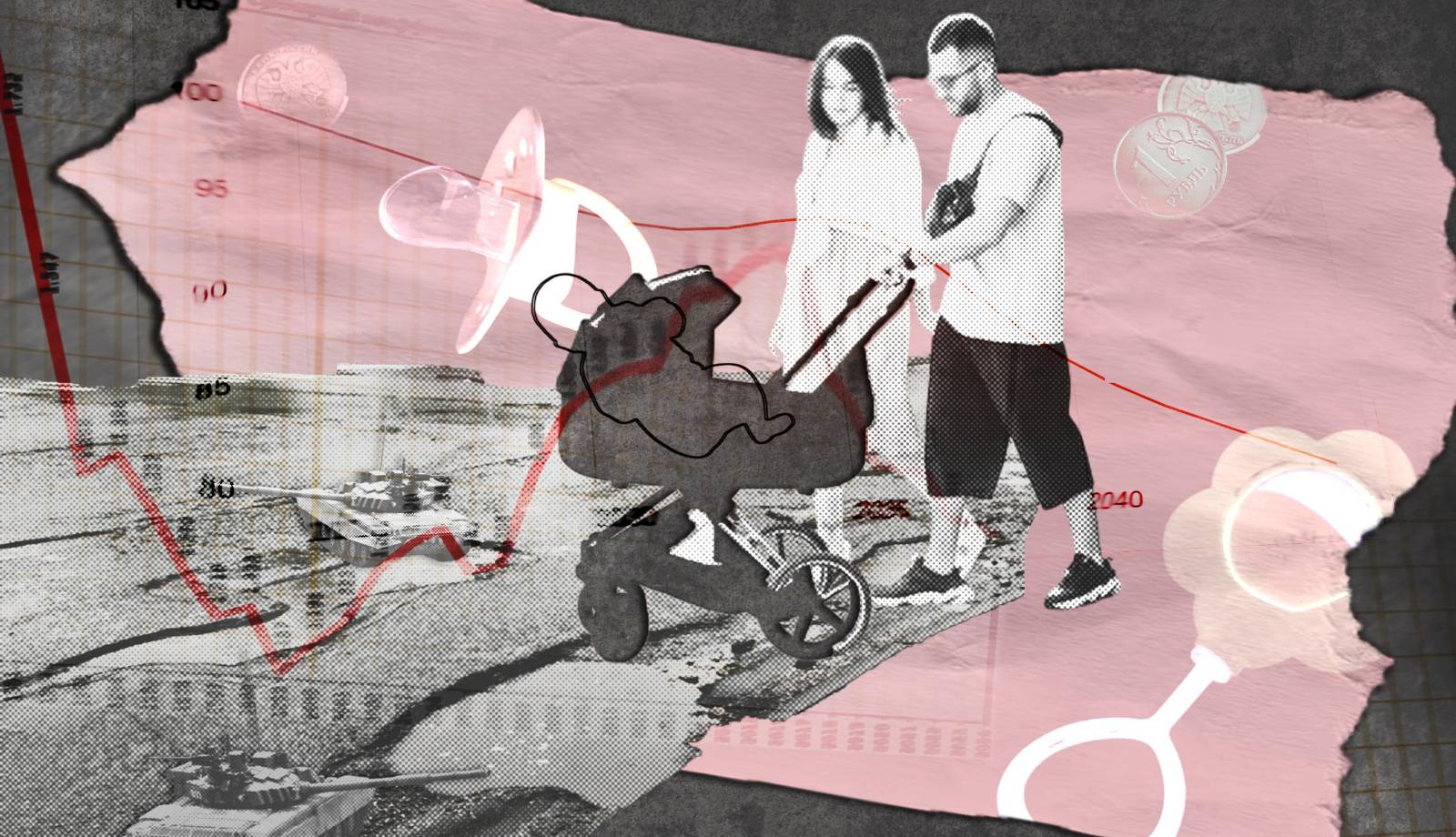
Why is the demographic crisis of the 2020s more dangerous than that of the 1990s? How exactly does war erode Russia’s demographic potential? What will a crackdown on immigration actually lead to? Demographer Salavat Abylkalikov analyzes inevitable depopulation and the performative nature of state socio-demographic policy
In recent years, demographics have once again become a central theme in state rhetoric. In this sense, Russia has largely returned to the discourse of the 1990s and early 2000s, when the country was described as experiencing a demographic catastrophe and the so-called “Russian cross” [editor’s note: The “Russian cross” refers to the visual pattern produced when the birth rate and death rate curves intersect on a graph — births falling, deaths rising — forming an X shape. In Russia this crossing point occurred in 1992, when deaths first exceeded births, marking the onset of sustained natural population decline. The term became a defining image of the post-Soviet demographic crisis]. Back then, the focus was primarily on how to halt depopulation, reduce mortality rates, offset the collapse in birth rates, and somehow stabilize the population size. Now, however, this agenda is increasingly framed around control, prohibitions, and security. The core concern remains the same, but the political language has changed.
Many believe that modern Russia’s primary demographic crisis occurred in the 1990s, a time defined by hyperinflation, rampant crime, and a sharp decline in the birth rate. However, the current crisis is far more dangerous. The number of births is plummeting due to a demographic trough, and the country is losing people to war. Simultaneously, Russia is destroying its own appeal to migrants — the single most important factor that had partially stalled depopulation for decades.
In the 1990s, Russia experienced a severe socioeconomic and demographic decline, which is still considered a major catastrophe. That period saw a drop in real household incomes and the disintegration of the old way of life. At the same time, the number of births plummeted while the number of deaths surged, plunging the country into a prolonged period of steady natural population decline.
That crisis had one crucial feature. The large-scale return of the Russian-speaking population from former Soviet republics resulted in a significant net migration gain. Gradually, this influx grew, and other arrivals from post-Soviet countries began to play an increasingly important role.
Central Asian countries played a leading role, while a significant number of migrants also came from the South Caucasus, the Baltic states, Ukraine, and Moldova. These flows effectively offset the natural decline. In total, during the post-Soviet period, net migration gain compensated for three-quarters of the losses resulting from an excess of deaths over births.
Today, Russia is once again facing a severe demographic crisis, but the situation looks fundamentally worse. The current crisis is more dangerous than the previous one because it is driven by three intersecting factors that reinforce one another.
The first factor is the age structure. The smaller generations born in the 1990s and 2000s have now entered working age and their most active reproductive years. This simultaneously reduces the number of births — since there are fewer potential parents — and shrinks the supply of young workers in the labor market.
When the first demographic policy framework was adopted, there were just over 39 million women of reproductive age in Russia. Now there are about 34 million, and by 2046, only slightly more than 27 million will remain. This deficit is becoming entrenched and is difficult to mitigate through current policy measures.
The second factor is war. It increases the number of deaths both through direct casualties and indirectly: through deteriorating access to medical care, rising behavioral risks, and a decline in the value of human life. This is particularly dangerous because the war is superimposed on an already vulnerable mortality regime. Before the pandemic, Russia was rapidly narrowing the gap with developed countries in life expectancy: while the gap with the EU was approximately 13 years in the mid-2000s, it had shrunk to 8 years by 2017. The pandemic, and subsequently the war, reversed this trajectory. Excess mortality in Russia for 2020–2021 exceeded one million people.
In 2023, life expectancy stood at 68.1 years for men and 78.9 for women — a gap of nearly 11 years, roughly twice the EU average. This is one of the starkest indicators of deep excess male mortality, and the war is piling further losses — direct and indirect — on top of it, losses whose full toll will only be felt in the years ahead. The war is limiting people’s ability to plan for the long term: amid rising uncertainty, people delay having children, and for many people that postponement becomes permanent.
The third factor is migration. For decades, net migration has substantially cushioned the effects of natural population decline — but in the near term, that balance risks falling to zero or turning negative altogether.
Together, these processes converge on a single critical risk: with natural decline running high and net migration falling away, the country is sliding into sustained depopulation — this time, most likely, with no demographic cushion from international migration.
Demographic indicators are extraordinarily slow to shift. A government can change tax rates or rewrite the rules of the game in a single year, but it cannot conjure more people of working or reproductive age out of thin air. Those numbers were fixed by the birth rates of past decades — and, to a lesser extent, by migration.
This is precisely why the country has nearly returned to its 1999 low in absolute births — around 1.2 million children per year — even though the fertility rate per woman is now higher. The total fertility rate has been running at about 1.4 in recent years; in 1999 it fell below 1.2. The demographic consequences of upheavals like these stretch across decades and leave their mark on the generations that follow.
The Price of Historical Catastrophes
The scale of the current crisis comes into sharper focus when set against the long twentieth century. Russia — together with other territories of the former empire — lived through a succession of demographic catastrophes: two world wars, a civil war, mass famine, political terror, and forced population displacements that together claimed tens of millions of lives. Through a combination of high mortality rates and sharp declines in births, these catastrophes shrank entire generational cohorts and profoundly distorted the population’s age-sex distribution.
Data for the generations born between 1890 and 1926 — whose lifespans encompassed World War II — provide a striking example. According to estimates by Russian demographer Anatoly Vishnevsky, only 82.2% of women and 52.9% of men from these cohorts who were counted in the 1939 census survived to 1959. This loss affected a vast segment of society; in 1939, these specific generations constituted 58% of the male population and 57% of the female population in Russia. The gap reflects the scale of excess male losses caused by the war and its lasting demographic consequences.
Today’s demographic decline is unfolding against the backdrop of an already severely depleted population base. The catastrophes of the early twentieth century triggered a cyclical pattern, setting off fluctuating waves of small and large generations that recur roughly every 25 to 30 years. The result is that after each demographic collapse, the small generation it produced enters reproductive age a quarter of a century later. Even when fertility rates per woman remain relatively high, the absolute number of births inevitably falls — because there are simply fewer potential mothers. As this smaller generation reaches working age, it triggers a chronic and systemic labor shortage.
While the government is not powerless, its strategic options are severely limited. It can lower mortality rates through healthcare investment, expand family support infrastructure, and create conditions that enable people to fulfill their reproductive intentions. But the size of the generations that have already reached working age is set by past birth rates and shifts only very slowly. This is precisely why demographic policy can soften the consequences of a crisis, but cannot swiftly reverse a deeply entrenched deficit in the working-age population. No social policy, however carefully designed or generously funded, can change that parameter fast.
Russia is back in a demographic trough, as depleted generations reach reproductive and working age at the same time. The crisis is hitting on two fronts: falling births and a widening worker shortage. To make matters worse, this population dip has coincided with a major war that amplifies these downward trends through direct human losses and shattered planning horizons. While demographic waves unfold gradually over decades, war strikes rapidly and violently — a combination that places unprecedented pressure on population reproduction.
The Underestimated Role of Migration
In the 1990s, Russia’s demographic landscape was exceptionally bleak, characterized by severe natural population decline, plummeting incomes, and crumbling institutions. Yet, the demographic system remained functionally open: robust net migration partially offset the natural population deficit and continuously replenished the working-age population.
As the post-Soviet space grappled with the collapse of shared institutions, regional armed conflicts, and the fragmentation of national labor markets, Russia stood out as a relatively familiar haven for millions. Established channels for return migration, a shared linguistic environment that minimized adaptation costs, and deeply rooted diaspora networks all combined to facilitate the influx.
While it is commonly assumed that a massive influx of migrants from the newly independent states characterized the entire post-Soviet decade, the migration boom actually peaked in 1994, when net gains approached one million. Surprisingly, total immigration to Russia between 1991 and 2000 was lower than in the preceding decade, dropping from roughly 9 million to 7 million. The higher net demographic gain during the 1990s was primarily driven by a collapse in outward migration, as the number of people leaving Russia for other former republics plummeted from 7 million to just 3 million.
This historical baseline is critical for any comparison with the current crisis. Ahead lies the risk of a dangerous combination: high natural population decline occurring alongside net migration dropping close to zero. While migration offset a substantial share of natural decline in the 1990s, between 2020 and 2023 it could cover no more than a quarter of population losses. Without migration acting as a safety valve, these demographic trends become far more severe and harder for policymakers to control.
War and the Brain Drain
Today’s warfare yields both direct and indirect demographic losses. An additional complication is the growing scarcity of official data: since 2025, Rosstat has substantially curtailed the publication of detailed demographic statistics, forcing researchers to rely on independent estimates and indirect indicators.
Direct casualties are reflected in the rising death toll from combat. Official figures are not available, but indirect data allows for a lower-bound estimate. According to calculations by Mediazona, in collaboration with the BBC and Meduza, at least 213,900 service members had been confirmed by name as of April 24, 2026. This is a conservative figure, as it includes only cases confirmed through open sources.
Indirectly, mortality is rising because it is becoming harder for people to get medical care and look after their health. War, isolation, and sanctions have restricted access to healthcare and advanced medical treatments. Amid mounting chronic stress, public health risks are escalating — including alcohol abuse, injuries, domestic violence, and crime — while the societal value placed on human life and health continues to erode. Together, these factors will drive mortality rates upward in the near term and over the medium and long run.
An additional factor that is frequently overlooked in this analysis is emigration. In terms of its composition, the current wave represents the largest brain drain in at least two decades. Hundreds of thousands of young, highly educated individuals of working and reproductive age are leaving the country.
According to estimates by The Bell, roughly 650,000 Russians permanently emigrated between the start of the conflict and mid-2024, with the majority aged 20-40 and about 80% holding university degrees. While representing only 0.85% of the total workforce, this emigration removes a critical segment of human capital essential for innovation and entrepreneurship.
The demographic fallout is twofold. First, the reduction in the number of potential parents remaining in the country inevitably lowers the expected birth rate in the coming years, all else being equal. Second, the departure of young professionals who drive innovation and create job opportunities shrinks the tax base and severely dampens prospects for long-term productivity growth.
While emigration was a defining feature of the 1990s, the current departure wave is unprecedented in both its rapid pace and the composition of those fleeing. It is driven entirely by the political shock of the war and a sudden shift in how people view their personal safety.
The Loss of Migratory Appeal
Long-term migration, together with fertility and mortality rates, is one of the principal pillars determining how a country’s permanent population evolves.
Throughout the post-Soviet period, Russia remained the primary destination for migrants from neighboring countries. Economic incentives fluctuated, but other factors held: a shared linguistic environment, educational and family ties, and established diaspora networks that kept the costs of relocation low.
The momentum of these channels sustained a steady flow of new residents even during difficult economic periods. From the early 2000s, net migration was adding hundreds of thousands of people to Russia’s population each year; between 2011 and 2019 the figure ranged from 150,000 to 300,000 annually, drawn almost entirely from working-age groups.
The war has altered conditions across several dimensions at once. Economic prospects have darkened: sanctions have cut off access to technology and international financial resources, and risks to income and employment have grown. The social mood has deteriorated sharply. Xenophobic rhetoric has intensified under the pressures of the war, turning migrants into easy targets for public scapegoating and performative displays of government control. Following the terrorist attack at Crocus City Hall in the spring of 2024, mass raids against Central Asian migrants surged across Russia, frequently accompanied by violence.
Concurrently, administrative pressures intensified. In mid-2024, amendments to the law on foreign nationals expanded police powers to deport individuals without a court order and created a ‘surveillance registry’ — a shift closely tracked by groups like Human Rights Watch. There are documented cases of hundreds of legally resident migrants having their bank accounts frozen due to technical failures in the registry after the changes took effect in February 2025. When legal status grows more precarious, long-term migration plans tend to be reconsidered even when the economic pull factors remain in place.
The government has formally enshrined this political course in the new “Concept of State Migration Policy of the Russian Federation for 2026–2030,” approved in October 2025. The document’s central thrust is tighter control, explicitly prioritizing national security concerns over population replenishment.
Security Council representatives have stated explicitly that the new framework rules out treating migration as a tool for addressing demographic deficits. Additional restrictions are being introduced, targeting, among others, the non-working family members of migrants. At the level of official doctrine, migration has ceased to be regarded as a compensatory mechanism.
The demographic consequences of this political course run directly counter to its stated aims. Because migration flows are heavily concentrated within working-age groups, they directly determine the size of the very cohorts that will go on to form families and bear children. Losing Central Asia as the principal source of net migration — given that Russia has virtually no other viable alternatives for long-term influx — means that the compensatory mechanism which has cushioned natural population decline for decades is gradually ceasing to exist.
Labor Shortage
The demographic trough makes itself felt in the labor market because the generations now reaching working age are small in number. The effect on labor supply is immediate. The shortage is most acute among young workers — these are the first groups to thin out as the generations born in the 1990s and early 2000s move through the system.
This shortfall cannot be fixed quickly. Raising the retirement age yields only a time-limited effect, and Russia has already largely exhausted that option. Improving labor productivity requires sustained investment and access to technology — both difficult under political isolation. Redistributing workers across sectors typically moves the shortage around rather than resolving it.
Falling net migration makes things worse. Since migration has traditionally been concentrated in working-age groups, its decline hits precisely where the shortage is already embedded in the country’s demographic profile. What begins as a headache for individual employers becomes a problem for the entire public finance system. As employment shrinks, tax revenues and social insurance contributions fall, and the burden on each person still in work grows heavier — the standard arithmetic of an aging population with a shrinking contributor base.
Official projections from Russian government agencies underscore the scale of this problem. In 2025, Labor Minister Anton Kotyakov stated that 10.9 million people would need to enter the workforce by 2030 — 10.1 million to replace those retiring and 800,000 to fill new positions.
Government officials and business leaders are increasingly talking about bringing in workers from India, Bangladesh, and African countries as a substitute for Central Asian migrants. But in the foreseeable future this approach is unlikely to deliver comparable numbers. The logistics are more complicated and the costs higher: in the early years at least, workers have to be recruited through organized channels, transported, documented, and housed, which significantly raises the cost per worker and will likely make hiring them considerably more expensive and cumbersome than hiring Central Asian labor. The model suits large-scale projects and major companies better than small and medium-sized businesses. Rather than the millions the labor market needs, this route is likely to bring in hundreds of thousands at most.
Current migration policy, meanwhile, treats these workers primarily as a temporary and controlled labor supply rather than as future permanent residents. Although some of these migrants might eventually settle in Russia and bring their families, the state appears to be moving toward a Dubai-style model: drawing on labor without integration and without any meaningful path to naturalization.
Performance Instead of Policy
The constraints imposed by the age structure and net migration make clear that real demographic policy is being replaced by symbolic gestures. Sustaining a population requires resource-intensive and consistent support for families — to lower the barriers to having a second or third child and to help people act on the reproductive intentions they already hold.
The specific conditions involved are well understood: affordable housing, predictable income, nursery and preschool places within walking distance, schools nearby, a functioning healthcare system, the ability to combine work and childcare without risking a drop in living standards, and measures to tackle poverty among families with children.
International comparisons indicate what levels of spending are required. According to OECD data for 2021, member countries allocated an average of 2.35% of GDP to family benefits and related services. In the Nordic countries, Germany, Austria, and France this figure exceeds 3%; in Iceland and Poland it tops 3.5%. Russian figures for the second half of the 2010s were estimated at between less than 1% and 1.5% of GDP, even when maternity capital payments are included. By the standards of developed economies, this is an extremely low level of public support for families.
In Russia, rather than expanding this infrastructure, the government has reached for restrictive and symbolic measures. These cost far less but create the appearance of vigorous action. Their demographic effect is negligible: the gap between the number of children people want and the number they actually have is determined not so much by the moral climate as by the planning horizon. Under conditions of high uncertainty, that horizon shrinks, having children gets pushed back, and many of those plans never come to anything. With small reproductive generations, this postponement means additional lost births and deepens the demographic trough.
Long-Term Consequences
The UN’s 2024 demographic projections show where the current demographic trajectory leads under different scenario assumptions. Assuming net migration holds at roughly 300,000 people per year, the medium scenario puts Russia’s population at 126.4 million by 2100. That assumption, however, looks increasingly unrealistic given the expected decline in migration flows. By my own calculations, with zero long-term migration the same medium scenario falls to 89.7 million. Should unfavorable fertility trends become entrenched, the pessimistic variant predicts a population of 58.3 million instead of the baseline 89.6 million.
The ability to track any of this is also deteriorating: in 2025, Rosstat stopped publishing detailed data on births, deaths, and migration, stripping researchers and policymakers of their basic analytical tools.
Behind the population projections, however, lies more than a question of how many people will inhabit the country. Alongside numeric decline, the population is growing considerably older. As of early 2024, the share of Russians aged 65 and over stood at 17.1% — nearly level with the proportion of children under 15. The working-age share is shrinking; the elderly share is growing.
Under the UN’s 2024 medium projection, by 2032 the old-age dependency ratio will exceed 341 people aged 65 and over per 1,000 people aged 20–64; by 2050 it will reach 428. Pension and healthcare systems will face mounting pressure as the tax base narrows. In remote and rural areas the picture is already stark: the young have left, and the infrastructure was built for a population that no longer exists.
Demographers have estimated that, had the catastrophes of the twentieth century not occurred, Russia’s population today could be as high as 250–270 million rather than the current 140-odd million. Such estimates are hypothetical, but they point to something important: Russia is entering the current crisis with a demographic base already eroded by previous catastrophes. There is reason to believe that the losses now accumulating will echo through future generations with comparable depth and weight.
A particular danger lies in the possibility of self-reinforcing dynamics. Fading appeal as a migrant destination, combined with economic stagnation, can set off a feedback loop: a stagnant economy discourages migrants from coming and incentivizes those already in the country to leave, while the shrinking working-age population further stifles economic growth.
This crisis can no longer be described as a temporary decline in population numbers. The country is simultaneously losing people, aging, and narrowing its own capacity for demographic and economic renewal. In terms of its long-term consequences, it risks being comparable to the demographic catastrophes of the first half of the twentieth century.

Мы намерены продолжать работу, но без вас нам не справиться
Ваша поддержка — это поддержка голосов против преступной войны, развязанной Россией в Украине. Это солидарность с теми, чей труд и политическая судьба нуждаются в огласке, а деятельность — в соратниках. Это выбор социальной и демократической альтернативы поверх государственных границ. И конечно, это помощь конкретным людям, которые работают над нашими материалами и нашей платформой.
Поддерживать нас не опасно. Мы следим за тем, как меняются практики передачи данных и законы, регулирующие финансовые операции. Мы полагаемся на легальные способы, которыми пользуются наши товарищи и коллеги по всему миру, включая Россию, Украину и республику Беларусь.
Мы рассчитываем на вашу поддержку!


To continue our work, we need your help!
Supporting Posle means supporting the voices against the criminal war unleashed by Russia in Ukraine. It is a way to express solidarity with people struggling against censorship, political repression, and social injustice. These activists, journalists, and writers, all those who oppose the criminal Putin’s regime, need new comrades in arms. Supporting us means opting for a social and democratic alternative beyond state borders. Naturally, it also means helping us prepare materials and maintain our online platform.
Donating to Posle is safe. We monitor changes in data transfer practices and Russian financial regulations. We use the same legal methods to transfer money as our comrades and colleagues worldwide, including Russia, Ukraine and Belarus.
We count on your support!
другие тексты


.webp)
другие подкасты


Политический дневник #53: Империализм и идеология special

«Это Базис». Как нас подводит здравый смысл и что об этом говорил Грамши

Политический дневник #49: В ожидании наступления, скандалы в оппозиции, турецкие выборы
SUBSCRIBE
TO POSLE
Get our content first, stay in touch in case we are blocked

Еженедельная рассылка "После"
Получайте наши материалы первыми, оставайтесь на связи на случай блокировки


.svg)

