

НАСТОЯЩИЙ МАТЕРИАЛ (ИНФОРМАЦИЯ) ПРОИЗВЕДЕН, РАСПРОСТРАНЕН И (ИЛИ) НАПРАВЛЕН ИНОСТРАННЫМ АГЕНТОМ ПРОЕКТОМ “ПОСЛЕ”, ЛИБО КАСАЕТСЯ ДЕЯТЕЛЬНОСТИ ИНОСТРАННОГО АГЕНТА ПРОЕКТА “ПОСЛЕ” 18+
Trolls on the March on Kremlin’s Orders
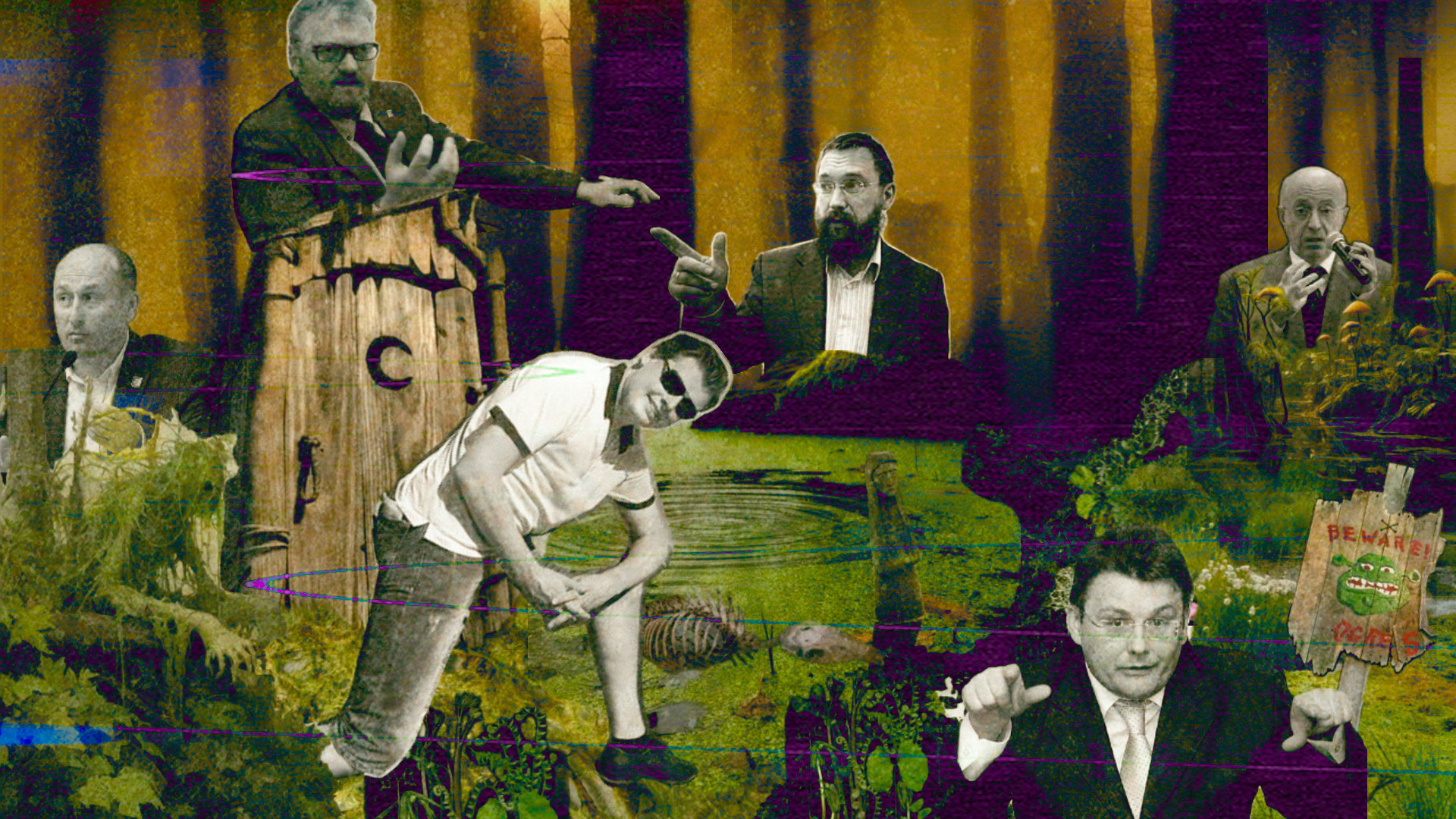
Where do online provocateurs come from? What makes the trolls popular? How do the eccentric antics of laughable media personalities undermine politics to the benefit of the regime? Evgeny Kazakov returns with an article about online trolls and their role in Russia’s political system
To many, partisan politics in Putin’s Russia is an unimportant subject; elections that do not express any real power struggle seem unworthy of attention. All political movements, be they conservative, liberal or left, are divided into supporters and opponents of Putin, sometimes using incompatible proof-points to assert their loyalty. In such a climate, eccentric speakers often find themselves in more demand than fraction leaders or other more formally important politicians.
The emergence of online trolls of various stripes is therefore not accidental: there is a reason why they are allocated airtime and given opportunity to comment on latest events, filling the niche that is claimed, in “uncontrollable” democracies, by political leaders. However, they remain out of the struggle for power and persuade their public to do the same.
Their place within Putin’s apparatus of power seems to be little understood. We may laugh at the “clowns” but that doesn’t explain why some of them remain fixtures of state television shows. The public tends to forget such characters pretty quickly, but comparing their careers reveals that there is much in common.
It would be wrong to assume that all of them belong to the same part of the political spectrum. Nikolai Starikov, Sergei Kurginyan, German Sterligov, Evgeny Ponasenkov, two members of the Duma — Evgeny Fyodorov and Vitaly Milonov, as well as the comparatively less controversial Nikolai Platoshin: all these men have different views but similar styles of public activity. It is essentially analogous to the behavior known online as “trolling,” i.e., conscious inflaming of conflict, usually by blatant disregard of the rules.
Uncle Meme
This mode of conduct in Russian politics can be traced back to Vladimir Zhirinovsky who established himself as a politician who “leaves nobody indifferent” already in the last Soviet years. You didn’t have to agree with him to find him entertaining. Zhirinovsky was a news item in and of himself who remained for decades one of the most famous politicians in the country without ever participating in governing. His target audience was the part of the public resentful of the existing powers. All that said, Zhirinovsky was still the leader of a party who ran for elections, even if it was for show.
The modern meme politicians tend to avoid this. Although Starikov did create the “Great Fatherland Party,” its popularity never came near his own. Tellingly, his career in punditry dried up after he joined the leadership of the parliamentary party A Just Russia [editor’s note: this is a left-conservative party, part of the so-called “systemic opposition”; it is represented by a faction in the Russian State Duma]. Milonov and Fyodorov to an even larger degree both promote their own agenda without trying to claim a higher status within the ruling party United Russia.
What do they have in common?
It’s about time we define this phenomenon. The term “propaganda” would serve little purpose: there is a difference between the trolls and the state media anchors. However outrageous their behavior, Vladimir Solovyov and Margarita Simonyan are not a part of this group. A troll doesn’t even have to promote the pro-government agenda.
Importantly, the trolls are not journalists, they are the subjects of the news. They are the speakers, not the interviewers. And they may appear on any platform, pro-government or otherwise.
Almost all the trolls are militant amateurs. They claim expertise on the subjects far removed from their working or educational experience. Which is why various pro-Kremlin speakers holding real degrees in social or economic studies, such as Mikhail Delyagin or Sergei Glazyev, should not count as trolls either, even though some of them may also appeal to dissenters. The former diplomat Nikolai Platoshkin provides a rare exception: he does have a background in foreign policy.
The media trolls are professional trolls. The reason why they are famous is precisely because of their provocations. This is why we exclude popular professionals in various fields who have become also known for provocative commentary, such as designer Artemy Lebedev, singer Yulia Chicherina, translator Dmitry “Goblin” Puchkov or game show star Anatoly Vasserman.
The trolls tend to have a social following but, as already mentioned above, none of them are primarily involved in party politics. Evgeny Fyodorov may be a legislator, but even in this capacity he campaigns for the extraparliamentary National Liberation Movement rather than for his party, United Russia.
Kurginyan established the movement “The Essence of the Time” as competition to the Stalinist parties but never made an effort to transform it into a real political force.
Sterligov has run for elections as an independent; his engagement with his followers has been rather limited to business activities. Platoshkin had himself involved in partisan politics for a while. But his “Movement for a New Socialism” never ran in an election. The movement quietly dissipated as Platoshkin remained in the public eye. Just like Starikov’s Great Fatherland Party, it was a one-man act.
The trolls are permitted to pull off things that would carry grave consequences for others. German Sterligov has openly called for violence and civic disobedience but he never really suffered for statements like “kill the wizard scientists.” For years Evgeny Ponasenkov was given a free pass on the subjects of “distortion of history”, “discreditation” and “LGBT propaganda.” But the trolls have no insurance against real oppression. In 2020, Platoshkin found himself under house arrest and was sentenced to five years on probation, while Ponasenkov was named “foreign agent” in 2022.
Who are they?
Although we do not claim to create an exhaustive list of trolls, here is a brief overview of several personalities planned around basic parameters of their careers: where they came from, what made them notorious, how they disappeared from the spotlight. The overview is organized chronologically, in the order of their emergence as media celebrities.
Nikolai Starikov: A Stalinist against the Windsors
Nikolai Starikov, born 1970, received an education in engineering economics; until 2021 he worked as the commercial director of the Channel One in Saint Petersburg. After 2006 he became increasingly popular for his books on history and economics. As of 2026, Starikov’s YouTube channel has meager 1770 subscribers: a very modest figure for a man who kept a high profile in the media for a decade after he became a public personality in 2005. Starikov was not unique as a popular amateur historian in a post-Soviet Russia, but his rise to prominence was sudden and saw Starikov become a chief supporter of Stalin in various TV shows.
The country had at least dozens of Stalinist Communist organizations; many of their leaders had been familiar to the public since perestroika (like Viktor Tyulkin, Nina Andreeva or Viktor Anpilov; the latter two were still living at the time); but it was the obscure Starikov who was suddenly granted all the airtime. Granted, conspiracy theories had become more popular with the audience than those of dialectics and materialism, but conspiracy theories had no shortage of proponents, either.
Yuri Mukhin — a name that barely registers now — was not on TV, even though he was the author of several popular books, publisher of the newspaper Duel (banned in 2009 while Starikov was still rising in popularity), and the leader of his own movement. The difference? Mukhin was a staunch opponent of Putin’s, while Starikov drew parallels with the “color revolutions.” “Stalin was good, and Putin is today’s Stalin” was Starikov’s keynote idea.
Starikov annoyed a great deal of people: liberals, anti-Soviet nationalists, Stalinist hardliners. He was accused of incompetence, academic ineptitude, conscious errors and omissions. Starikov was widely derided; long articles were published to debunk his writings.
But he was so much present in the media that it was difficult to just ignore him. His disappearance was not as sudden as his emergence. It was another supporter of Stalin who gradually won over the airtime: former geophysicist and theater director Sergei Kurginyan, who has also since then turned into a has-been.
Starikov, who openly admitted never reading archival sources, viewed Russian history as a succession of conspiracies. Unlike most speakers of this variety who found the root of evil in the USA or Israel, Starikov saw the British royals as the arch-enemy. His ideas about the secret influence of the British queen or about Germans in disguise taking the Winter Palace in 1917 were novelties in the conspiracy market at the time; the older clichés “Lenin was a German spy” and “Jews, Masons and Americans are behind this” already felt tired.
Starikov was ever happy to draw parallels with the present day as he compared every revolution and uprising to the Maidan. Thus he updated the conspiracy theories of authoritarian Stalinists to Putin’s worldview. In addition to historical subjects, he widely commented on economics; since 2020 he hasn’t published new books and largely disappeared from television. He is a member of A Just Russia’s party council.
Vitaly Milonov: Learning from the Western Lessons of Fighting for Christian Values
Vitaly Milonov was born in 1974 and studied public administration in the North-Western Academy of Civil Service. A member of various liberal parties in Saint Petersburg since he was a young man, in 2011 Milonov turned his attention to fighting homosexuality. Milonov was only a city legislature member in Saint Petersburg when he achieved international notoriety and even received a personal visit from the actor Stephen Fry in bid to change his mind.
Milonov is hardly an Eastern Orthodox fundamentalist. His methods of fighting “sodomites” were mostly borrowed from the American Christian right. Lobbying against the evolution theory in schools and claims to the “believers’ rights” are Western tactics; and we cannot speak with any certainty of any close ties between Milonov and the conservative fraction of the Orthodox Church. Milonov may be the most notable Russian homophobe, but that can’t be enough for true Orthodox fundamentalists. To the religious Christian right, Milonov is as alien as Starikov is to the communists.
Milonov has become a member of the State Duma in 2016; he is keeping down the same line but in contemporary Russia his ideas aren’t as unusual as they used to be.
German Sterligov: The Right-Wing Hipster
Born in 1966, German Sterligov studied at the Moscow University’s Department of Law but never graduated. Unlike the two men discussed above, he had already had some experience as a public figure. In 1990, he co-founded Alisa Board of Trade as well as the “Young Russian Millionaires Club.” The businessman also dabbled in nationalist politics in 2000 but didn’t find much success.
Sterligov rose back to fame due to the extensive media coverage of his “sloboda,” so named after a traditional Russian type of commercial settlement. The former urbanite presented himself to the audiences as a proponent of abandoning electricity and practicing traditional agriculture, as well as a religious conservative. He openly professed violence against wives and children, called for giving out land plots to citizens and for teaching history according to Ivan the Terrible’s chronicle. Sterligov proposed theories equating the Scots with the Slavs, refused entry to his stores to men without beards and to women in short skirts, demanded death penalty for homosexuals and advocated restoration of the monarchy, all the while cautiously avoiding openly antisemitic or islamophobic remarks.
In the later part of the 2010s Sterligov made the news by launching a chain of “organic grocery boutiques.” A kilo of bread cost 1650 rubles [about 25€ at the time]. Sterligov toured across Russia, using launches of new stores to promote his ideas. To his opponents he was an obscurantist and a paleoconservative, but Sterligov’s activities neatly conformed to hipster trends: craft made food, conscious consumption etc., justified in this case by Christianity and tradition.
Sterligov was investigated several times. He was once accused of fraud; his connections to the far right violent group BORN have been questioned but not in court. Sterligov remains active but not as much a media presence.
Sergei Kurginyan: The Super Scientist
Sergei Kurginyan (b. 1949), a man of a great many interests, has been active in public life since perestroika, like Sterligov. Back then he was one of the multitude of enthusiasts proposing their ideas without success. In the following years, his creative and theoretical works drew little attention from the media. Since 2010, however, he has been increasingly prominent as an opponent of liberals on television and established his own movement “The Essence of Time” the following year.
Whereas Starikov and Sterligov could be described as “anti-scientists” as they put layperson’s and religious thinking against theoretical abstractions, Kurginyan is rather a “super-scientist” who sees through the world’s hidden patterns and pays no attention to differences between individual areas of knowledge.
Kurginyan poses as a Marxist but his preachings rather form an esoteric knowledge. He is always keen to decipher “authentic meanings” and warns the disaffected against trusting the opposition. Kurginyan had dropped out of the pool of media celebrities before the war broke out in 2022.
Evgeny Fyodorov: Resisting Occupation in the State Duma
Evgeny Fyodorov (b. 1963) studied engineering in the Leningrad Higher Academy of Military Engineering and Construction. He was an average legislator who represented centrist parties in the 1990s before joining United Russia; in 2011 he founded the “National Liberation Movement” (NLM) and gained nationwide attention.
Fyodorov’s core tenet: Russia lost independence in 1991 and has since remained a colony governed by collaborators with occupying forces. President Putin and the NLM are the only ones fighting for independence. The idea of mistrusting the government is seen by other patriots as offensive and detrimental. Fyodorov is also notorious for informing the police on his opponents and competitors; he claims that Nikolai Platoshkin’s arrest resulted from his report.
Evgeny Ponasenkov: A Parody of a “Westernizer”
Evgeny Ponasenkov was born in 1982. He dropped out of the Moscow University’s Department of History. Ponasenkov differs from the other trolls in that he avoids subjects that are explicitly political. His sole focus is the opposition to the “patriotic” myth of Russia’s war against Napoleon in 1812.
Ponasenkov’s own image is a parody of a pro-Western liberal, a bogeyman for conservative patriots: he derides everything Russian, raves about enlightened Europe represented by Russia’s enemies, emphasizes his elitism and hints at his homosexuality. He is very pushy in drawing professional historians into discussing his scribblings. After provoking an understandable backlash he poses himself as a victim to censorship. Like Starikov to Stalinists and Sterligov to conservatives, Ponasenkov is an unwanted ally to liberals.
Nikolai Platoshkin: Stalinist Reformer
Nikolai Platoshkin (b. 1965) graduated from the Moscow Foreign Relations Institute. A former diplomat, he rose to media prominence in 2017-2018 criticizing Putin as a partyless leftist. Platoshkin’s condemnations were notably similar to the objections made by liberals: he spoke of lawlessness, the absence of political competition, etc. Platoshkin criticized the 2020’s referendum to keep Putin in power and faced oppression while serving as an alternative to the Kremlin-controlled Communist Party of the Russian Federation (CPRF). He promoted a “new socialism” that would be democratic while recognizing and incorporating the legacy of the USSR. He showed that you could support social democracy and respect Stalin at the same time, while avoiding the CPRF’s conservatism and xenophobia. This annoyed Stalinist hardliners just as liberals stayed wary.
After Russia’s invasion of Ukraine, Platoshkin completely abandoned his criticism of the CPRF and Putin and adopted a loyal stance.
Conclusion: Why Are these Trolls Dangerous?
We have reviewed six cases. All of these “trolls” are men; all are ethnic majority (except Kurginyan, who is Armenian); all except two were born in Moscow or Leningrad or near the two biggest cities; all except Ponasenkov and Sterligov are university graduates. These people are hardly social outcasts.
While Milonov and Fyodorov were already legislators at the time of their celebrity, the others rose to prominence in a sudden way. Those who eventually had their own organizations became celebrities first and only then had leadership positions. Leaders of legitimate movements, however, would often find it difficult to get onto television.
All of the above-mentioned speakers were interviewed many times by the news agency National News Service, which thus played a large part in the development of their careers. Most of the trolls became prominent after the protests of 2011-2012. They may self-identify as “bloggers” but it’s the traditional media where they thrive.
The trolls aren’t merely trolling their political opponents but also corrupt the camp that is supposedly their own. Starikov and Kurginyan are as detrimental to the Stalinist cause as they are to liberals whom they vehemently criticize. The trolls’ behavior in general is directed at hampering political opposition in subtle ways.
Their antics serve as proof to the disaffected public’s worst fears: without Putin, the power would be taken up by lunatics. Those who don’t sympathize with the troll but rather see him as representative of their ideological enemy become even more convinced that all socialists dream of restoring the Gulag and taking away all property, that all liberals detest working people, and so on.
This is important, because individual groups critical of Putin more often find themselves at odds with each other rather than with Putin. “Putin is bad but at least he respects the USSR” or “Putin is bad but the Stalinists are even worse” are the premises that lead to seeing Putin as a lesser evil.
The trolls suddenly get a lot of media attention before disappearing just as suddenly; they earn over some of the potentially unhappy public; they sometimes face oppression but obviously act with the approval of the government. Reacting to their statements is time and energy consuming. Hours of online videos are dedicated to debunking their theories even though they have no real political weight (even if some of them have established their own parties and movements).
Sometimes the “trolls” wage conflicts between each other, drawing other speakers of various camps to engage. They could never attract a majority but they are far from being harmless. The existence of such personalities would be unthinkable in an ideologically monolithic system, but in Russia they are a factor of depoliticization.
They are supposed to be a proof of pluralism within modern Russia. But in Putin’s Russia, competition of ideas, power struggle and democracy are completely separate things. Diversity of opinions has nothing to do with the struggle for legislature seats or government offices. Presidential elections are very important but there is no connection, either, to the differences between political ideas. The scramble for power is untied to electoral procedures.
A true Marxist-Leninist, social democrat, liberal or critical conservative will not be interviewed on television. But there will always be a bogeyman imitation who will speak in controversies, scaring and disappointing into disillusion.
The trolls function as a political Ponzi scheme. There always comes the turn to the logic of keeping the system stable. Their activities undermine any trust in political action, while making the head of state look like an example of reason and moderation in comparison.

Мы намерены продолжать работу, но без вас нам не справиться
Ваша поддержка — это поддержка голосов против преступной войны, развязанной Россией в Украине. Это солидарность с теми, чей труд и политическая судьба нуждаются в огласке, а деятельность — в соратниках. Это выбор социальной и демократической альтернативы поверх государственных границ. И конечно, это помощь конкретным людям, которые работают над нашими материалами и нашей платформой.
Поддерживать нас не опасно. Мы следим за тем, как меняются практики передачи данных и законы, регулирующие финансовые операции. Мы полагаемся на легальные способы, которыми пользуются наши товарищи и коллеги по всему миру, включая Россию, Украину и республику Беларусь.
Мы рассчитываем на вашу поддержку!


To continue our work, we need your help!
Supporting Posle means supporting the voices against the criminal war unleashed by Russia in Ukraine. It is a way to express solidarity with people struggling against censorship, political repression, and social injustice. These activists, journalists, and writers, all those who oppose the criminal Putin’s regime, need new comrades in arms. Supporting us means opting for a social and democratic alternative beyond state borders. Naturally, it also means helping us prepare materials and maintain our online platform.
Donating to Posle is safe. We monitor changes in data transfer practices and Russian financial regulations. We use the same legal methods to transfer money as our comrades and colleagues worldwide, including Russia, Ukraine and Belarus.
We count on your support!
.webp)

другие подкасты


«Это Базис»: Учиться, учиться и ещё раз учиться: образование в России

Политический дневник #53: Империализм и идеология special

«Это базис». Дебаты: что делать с бездомными животными?
SUBSCRIBE
TO POSLE
Get our content first, stay in touch in case we are blocked

Еженедельная рассылка "После"
Получайте наши материалы первыми, оставайтесь на связи на случай блокировки


.svg)

