

НАСТОЯЩИЙ МАТЕРИАЛ (ИНФОРМАЦИЯ) ПРОИЗВЕДЕН, РАСПРОСТРАНЕН И (ИЛИ) НАПРАВЛЕН ИНОСТРАННЫМ АГЕНТОМ ПРОЕКТОМ “ПОСЛЕ”, ЛИБО КАСАЕТСЯ ДЕЯТЕЛЬНОСТИ ИНОСТРАННОГО АГЕНТА ПРОЕКТА “ПОСЛЕ” 18+
Mamdani: The First Hundred Days. An Interview with Rossen Djagalov
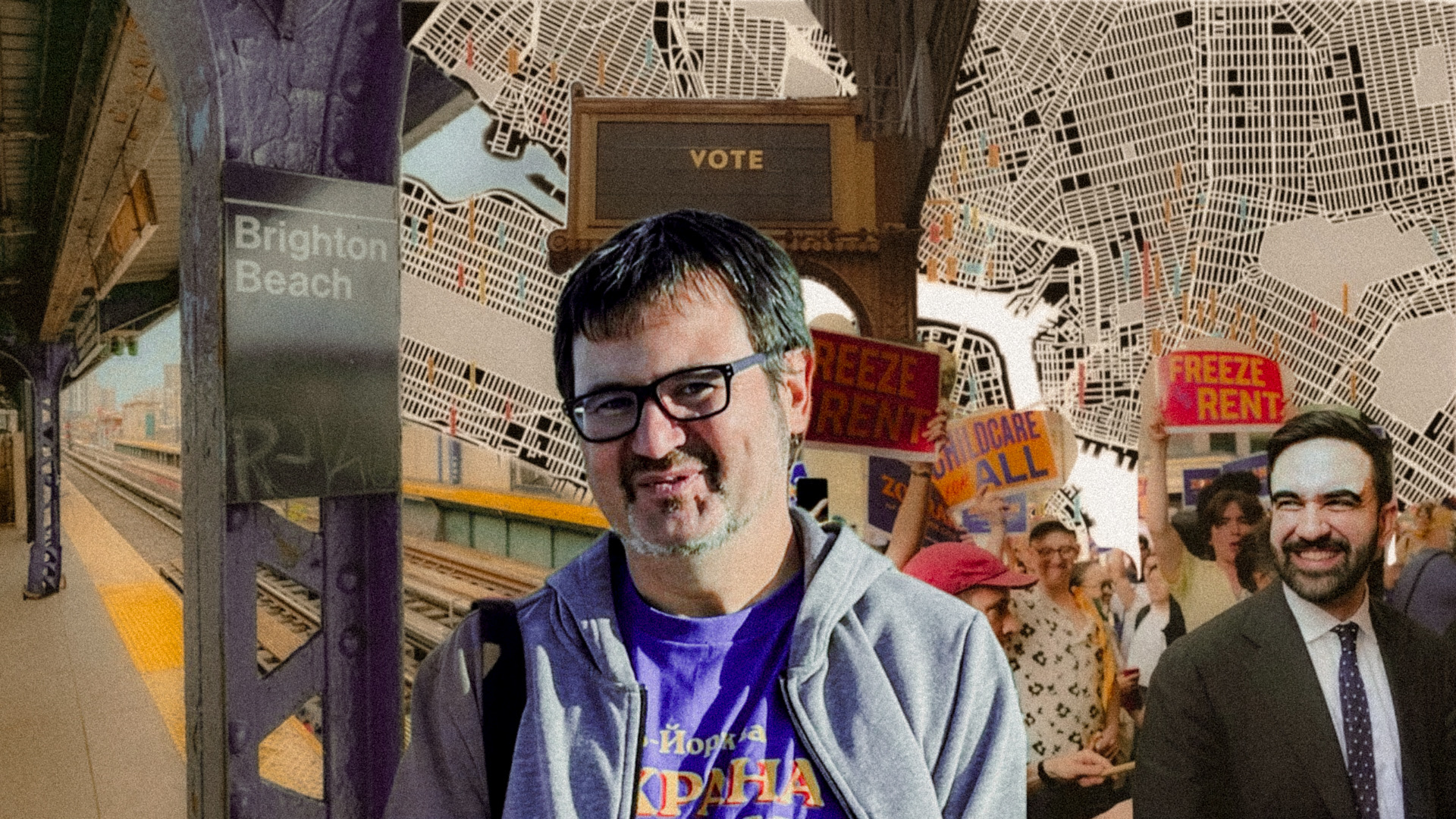
What did Zohran Mamdani’s campaign and victory mean? Why do so many immigrants from the former Soviet Union in the United States continue to lean rightward at the ballot box? And what can be said about the first three months of a socialist mayoralty in New York City? Rossen Djagalov — a scholar and a participant in Mamdani’s campaign in Brighton Beach — reflects on the political anxieties and aspirations of local residents in conversation with the sociologist Aleksandra Zapolskaia
— Zohran Mamdani’s campaign attracted considerable attention well beyond New York — not only for its outcome, but also for the logic and practice of political mobilization it represented. Campaigns like this one are closely followed around the world, with people rooting for them even when they have no way of voting — whether in New York, Moscow, or any other capital city. I want to start there: how would you describe its significance?
— I would start with its significance for the left. After several months of repression and bleak news, there has been something of a lift in spirits; reasons for hope have reemerged. Trump has now been in power for thirteen months, but this is not, in fact, the most difficult moment for the American left.
To be sure, some sectors have been hit hard. The labor movement, for the most part, remains in a weakened position, and the Palestinian solidarity movement has faced severe repression. But overall, there are still a number of visible campaigns and mobilizations — at least in the circles I move in.
Our faculty union, for instance, has grown five- or sixfold since November 2024, in the space of a single year. Protest participation has increased noticeably, and the Democratic Socialists of America (DSA) has reached record membership levels. Although the Biden years (2020–2024) were disorienting for the organization, marked by declining membership and waning engagement, it is now growing again — particularly in the wake of Mamdani’s campaign.
Zohran Mamdani represents both the culmination of left-wing mobilization and a tangible victory for the left. And given the somewhat tautological logic of social movements — namely, that the more you win, the more you win — I hope that this success will propel us towards further victories. This is especially significant given that Mamdani ran an important and high-profile campaign, but not an isolated one.
In Seattle, democratic socialist Katie Wilson was elected mayor, and in Minneapolis, democratic socialist Omar Fateh narrowly missed out on winning the mayoral race.
What I find most striking about Mamdani’s victory is the coalition he was able to build — bringing together progressive left-wing forces and liberal-left constituencies, people broadly aligned with Bernie Sanders, and what is known in English as the multiracial working class. In New York, that is perhaps easier, since the working class there can hardly be described as anything other than multiracial. It is this coalition between the working class and the left that I find particularly promising. Unfortunately, that is not something commonly seen in the United States.
Here, as in all Western societies, there is a historically entrenched divide between the left and the working class. Mutual distrust and disagreement have at times even led to open clashes, the most memorable of which was the so-called “battle” between the hard hats — that is, construction workers wearing hard hats — and the soft heads, meaning student protesters opposing the Vietnam War in the 1960s.
Of course, Mamdani is not entirely unique in this respect. This line of politics also runs through Bernie Sanders and others. But in Mamdani’s case, the bridging of the gap between hard hats and soft heads was marked by an electoral victory.
— In my experience, participating in electoral organizing often becomes an experience that extends far beyond the election itself — shaping new connections, expanding activists’ political imagination, and sometimes even changing their lives. You’re part of a union and were involved on the ground — how did this play out for you? When and how did Mamdani first come onto your radar, and at what point did you begin to take him seriously?
— As an activist, I got involved in the campaign quite late and in a fairly limited way. But in general, I had supported him from the very beginning, when Mamdani was still a statistical blip in the polls, because many of my comrades in the DSA had been involved from the beginning. Through them, I understood that Mamdani was not a random candidate or someone who had simply stumbled into politics, but rather someone who was ideologically grounded and had serious organizing experience. At the same time, I didn’t really expect him to win.
I was invited to take part in canvassing in the Brighton Beach area by young left-wing organizers from the Russian-speaking community in Brighton Beach and New York — essentially the children and grandchildren of the people we were going door to door to speak with. If there is anything positive in my experience, it is precisely meeting these people. As you might expect, my attempt at campaigning in Brighton Beach was a catastrophic failure. The people we spoke to, the doors we knocked on, were, for the most part, extremely hostile to us. But simply getting to know the people who organized the canvassing — and who, in fact, were more successful at it than I was, since they had been doing it longer and knew the neighborhood better — was the most positive part of the experience for me.
— Who are these young people in the context of the campaign? How would you describe them in terms of their social and political backgrounds, their motivations, and the ways in which they became involved? What, in the end, do they take from this experience?
— The group wasn’t very large — about twenty people, at least among those I personally saw. Most of them were between 20 and 30 years old. A few of the activists were LGBTQ, which probably also placed them outside what you might call the dominant Brighton Beach discourse. So I think this is really a question of moving out from one social environment and to another, a left-wing one. Some of them were members of the Democratic Socialists of America, and they all identified as left-wing. Some had done this kind of work before, having first joined Bernie Sanders’s 2020 campaign.
They didn’t want their community to be so reactionary, and they wanted to push back a little, despite the sense that it was, in a way, a hopeless endeavor. It’s this generational divide that gives some reason for hope, although, of course, you can’t rely entirely on generational processes. Nevertheless, I believe that through this kind of activism, it is possible to encourage people to move away from the current dominant positions in the area.
— And if we think of Brighton Beach — as a setting where you were canvassing — what did you encounter there? What kind of community is it politically, and what arguments or issues did you use to try to reach it despite it feeling like a losing battle?
— At its core, this is a question of generations — a vast generational divide in political preferences. The backbone of Brighton Beach is made up of immigrants from the Soviet Union who arrived in the 1970s. The first wave was predominantly Jewish. People were leaving the Soviet Union for political and ideological reasons; for many, it was also an escape from antisemitism. So it is easy to see how their later political life became strongly tied to anti-communism. As a result, the oldest generation — the people we spoke with most often — saw Mamdani as a communist who hates America, an Islamist, and an antisemite. It was very difficult to change these perceptions in any meaningful way. For them, any mention of the Soviet Union is a reference to absolute evil.
Of course, there were attempts to steer the conversation away from purely ideological matters and towards related issues. For example, I would ask how they felt about the idea of free daycare — whether that was good or bad. This was one of the programmatic points of Mamdani’s campaign, and it allowed for a more grounded discussion, even if it sometimes only slightly unsettled people’s positions. But by the time we started knocking on doors, people were already very well-informed about Mamdani, and we would sometimes hear things like, “I’d vote for the devil himself before I’d vote for this guy.” The canvassers in Mamdani’s campaign usually go out in pairs, so most of the hostility was directed at my partner. She would often be told, “I can’t believe it — a Jewish girl supporting an antisemite.”
— Did you later get the voting results for the district? Can those numbers tell us anything about the attitudes within the Russian-speaking community in Brighton Beach? And to what extent, in your view, did those attitudes change as a result of the canvassing?
— Yes, we did get the results, and they are not straightforward. It’s important to understand that although most of the population there is Russian-speaking, the neighborhood is ethnically diverse, and originally it was, in fact, an African American area. The story of how Soviet migration pushed African Americans out of the neighborhood is not a pretty one. Still, there are African Americans and Latino residents there, as well as relatively recent arrivals from the Caucasus and Central Asia. So the election results do not cleanly reflect the attitudes of the Russian-speaking community alone.
But even within that community, there is no uniformity. The main dividing line is generational, which becomes visible already in the second generation of immigrants, when political preferences start to merge with the American mainstream. By the third generation, you even see the emergence of left-wing views. So while Brighton Beach is still largely made up of an older population, there were nonetheless quite a few votes for Mamdani among younger residents.
There is also an ethnic divide: although they are not very numerous and for the most part are not yet U.S. citizens — and therefore cannot vote — people from Uzbekistan, for example, tend to be much more sympathetic toward Mamdani.
— I’ll allow myself a generalization here, but correct me if I’m wrong. Am I right in understanding that in this area Russian-speaking immigrants from the former Soviet Union tend to vote Republican? And how do you explain that?
— Yes, and this is linked to a traditional anti-communism, to Reagan. If you look at New York’s electoral map, you will see that the Democrats dominate everywhere during elections, and only Brighton Beach — and also Staten Island, though for different reasons — tends to vote Republican. The situation is such that the Democratic Party doesn’t even send representatives or canvassers to Brighton Beach, considering it a lost cause.
— But beyond ideological factors, there may also be more down-to-earth reasons. How do you see it — what else, besides anti-communism, shapes their political choices?
— Dovlatov, one of the central figures of Russian-speaking émigré literature in New York, has a line — it comes from one of his characters, but I think it applies to many: “Bomb the Bronx and increase welfare.” The American Dream, this drive for upward mobility, unfortunately creates a kind of pressure cooker in which new migrant groups end up opposing their interests to those of other migrant and racial groups.
There is also something somewhat irrational about this feeling. It stems from the lack of an adequate welfare system in the United States and from a very high level of precarity — much higher than in Europe. Politicians have learned to capitalize on this very effectively, and the Republican Party in particular sharpens these kinds of tensions.
In this pressure cooker of upward mobility, the main “ace in the hole” available to migrants from Eastern Europe is, in a sense, their perceived whiteness — which loosely connects them to the American mainstream. Consequently, so many Eastern Europeans sometimes behave or speak in ways that are hostile toward migrants of other racial backgrounds. Although both groups are precarious and both consist of migrants, unfortunately there is very little solidarity — at least on the part of Eastern Europeans. This is, of course, not only an American phenomenon.
And, of course, the anti-communism I mentioned earlier also intersects with these socio-economic factors. If they perceive left-leaning candidates as standing for racial equality or social justice, then they tend to oppose them accordingly. Unfortunately, that is how the situation often looks.
Here is another example. When we spoke to a woman in Brighton, she told us that her main concern was Mamdani's proposal to increase the city tax on the very wealthy by two percent — specifically, for those earning over a million dollars a year. This seemed very important to her, and she kept saying that it would drive all the doctors out of New York. It struck me that her son or daughter might be a doctor. And of course, it is clear that such taxes, if they are ever implemented — and that does not depend on Mamdani alone — would not actually apply to that specific doctor. But for this woman, who was clearly retired, there was a kind of projection at work: if not of herself, then of her children as successful, well-established American citizens who might be harmed by these taxes.
— In public discourse, there is often talk about noticeable hostility or racist remarks coming from some people from the former Soviet Union, including in the context of the BLM protests and the war in Gaza. How do you explain this? Do you see any connection to the Soviet experience?
— There is a particular type of racism that emerged within the dissident-intellectual milieu in the Soviet Union, at least in the RSFSR. After perestroika, this discourse was no longer taboo and gradually became almost mainstream. By the late perestroika period and into the 1990s, claims to “whiteness” became widespread, moving beyond a relatively narrow group of intellectuals who were probably the first to adopt such a self-positioning.
— Could you give some specific names or examples to clarify the circle you have in mind? And how homogeneous was it, given that there were also left-wing dissidents?
— Yes, there were left-wing dissidents, as well as principled human rights advocates for whom rights were universal and belonged to everyone. But unfortunately, they were a minority compared to the right-leaning, strongly pro-Western spectrum.
In one of my articles, I provided specific examples, such as Joseph Brodsky and his circle, as well as Vladimir Bukovsky. I would say that a significant portion of the anti-Soviet, pro-Western intelligentsia is susceptible to this kind of racism. These are the people who became liberals in the 1990s. Of course, not everyone, but the majority.
— After the 2022 invasion, new migrants arrived — Russians and Ukrainians. Has this wave of migration changed the attitudes and behavior of communities here in the United States?
— In the United States, far fewer migrants arrived after 2022 than in Europe. I occasionally hear a bit more Russian and Ukrainian being spoken, but it is still not comparable to how new migration from Russia and especially Ukraine has changed the character of some Western European cities. Possibly due to generational factors, new Russian migrants are not as focused on anti-communism; they are more oriented toward a Russian anti-war agenda rather than internal American politics. Most of them do not yet have US citizenship or the right to vote. To be fair, it should be acknowledged that the majority of people in Brighton Beach opposed the Russian invasion, although even that is, of course, quite complicated.
— From the way you describe it, anti-war activity in the United States seems to be different from what I see in Europe and Armenia, where more people are willing to participate in protests. Are there protests against the Russian invasion in the United States, and what are they like?
— Yes, there are fairly regular anti-war protests outside the Russian consulate, although their scale is not really comparable to similar protests in Europe. At the university where I teach (NYU), we occasionally provide space for writing letters to Russian political prisoners. The political spectrum is quite broad, but since very few of them are US citizens, they rarely go beyond a Russian anti-war framework. Overall, this is how I see new Russian migrants who arrived after 2022.
— To what extent has the Russian invasion become an issue for the American left, such as the Democratic Socialists or Mamdani? Do they address it in their initiatives?
— It is the Russian left who like to talk about Mamdani and Western leftists, but here in the US, priorities are somewhat different. One should not forget the national limitations of the American left, including the Democratic Socialists of America, who, beyond an official statement against the Russian invasion, seem to have done little else on this front. There were statements from individual members, but I fear that the war in Ukraine is not, at least compared to Israel and Palestine, a major issue for the American left. This is even more true of Mamdani’s campaign, which was highly disciplined, with four or five key demands agreed upon. He spoke very strictly within the framework of the affordability agenda for housing and basic services.
— Could we say that this agenda played a key role in his victory?
— Yes, it is precisely this kind of socio-economic agenda that people can understand. On the one hand, it is very limited; on the other, it challenges the interests of the city’s biggest players — businesses, real estate companies and construction firms, as well as the companies housed in those skyscrapers — who will probably have to pay that modest two percent tax. So while it is, in fact, a very constrained agenda, it does have a clear socio-economic focus. Of course, you can’t build socialism in a single city; the real question now is which parts of these minimal demands will actually be implemented.
— Thinking back, was there a moment when you first realized Mamdani actually had a real chance of winning?
— Fairly late, given the dynamics of the American electoral process. Specifically, it was when Mamdani, against all forecasts, won the Democratic primary in June. That was when he officially became the Democratic Party’s candidate. Since New York is a predominantly one-party city, his status and the likelihood that he would become mayor increased significantly. Although very few predictions had given him an edge in that primary.
— Honestly, I thought Mamdani might win when I saw his social media post saying they no longer needed donations, that they had raised enough money, and that they now needed volunteers. Based on my experience, this struck me as a sign of a possible victory. From your perspective, is that really how it worked?
— That’s also tied to the internal American dynamics, where there’s a limit to how much money you can raise through donations, and he had already reached that ceiling. But even before the primaries, a huge number of young people — and not only young — had participated in a remarkable surge of volunteerism, partly organized by the Democratic Socialists of America and other groups, often within ethnic communities. There was already an organizational core, which drew in a very large number of people — perhaps around 100,000 volunteers. This is unusual, a rare phenomenon. Volunteering is common in the US, but on such a scale it’s extremely rare. The question now is what will happen to these volunteers, whether they will become a lasting part of a future movement. Volunteering requires resources, time, and energy, and it’s not for everyone. The question is how long this momentum will continue and whether these 100,000 people will remain motivated to keep dedicating their time and energy.
— Tell me, how have the first hundred days of Mamdani’s mayoralty unfolded? Has he pleasantly surprised the residents of Brighton Beach, or, on the contrary, disappointed his supporters?
— You can’t build socialism in a single city. So far, Mamdani hasn’t disappointed many of his supporters, but his first three months in office have shown that the mayor’s position alone is insufficient for fundamental change, even within New York City. On a symbolic level, he remains a charismatic figure, consistently demonstrating that the public sector is the primary tool for improving people’s lives, rather than an inefficient drain on their taxes, as conservatives have persuaded a significant portion of the population over the past decades. His humanism, his commitment to the interests of all New Yorkers regardless of race or citizenship, and his work ethic stand in sharp contrast to the rhetoric coming from the federal government. And the platform of New York City’s mayoralty gives him the opportunity to speak to audiences across the country and even internationally.
At the same time, on a political level, his election as mayor has highlighted many of the limitations of the office. His income redistribution programme was blocked both by the governor of New York State, Kathy Hochul, who has the authority to raise taxes on the city’s millionaires, and by entrenched political interests within the city, represented by City Council Speaker Julie Menin. Police Commissioner Jessica Tisch, along with dozens of less prominent unelected officials in the city’s “deep state,” who never shared Mamdani's vision, also constrained Mamdani’s plans. Although most of them, like Mamdani, are Democrats, and New York is typically considered a one-party city, this illustrates the wide spectrum of political positions contained within a single party in the American system. Without ongoing grassroots pressure, without those 100,000 activists remaining engaged and growing in number and scope, Mamdani’s achievements will be limited. And achieving that is far from easy.
This, in turn, represents the main challenge for American leftists right now: despite an extremely grim political climate, where the agenda constantly shifts — yesterday it was ICE raids, today it’s war — and disorients us, there is also a moment of significant opportunity. But do the left have the energy and wisdom to seize it?
Returning to your original question, I don’t think the residents of Brighton Beach are particularly thrilled with Mamdani.
— Thank you so much for the conversation! Is there anything else you’d like to add — perhaps something that particularly stayed with you or made an impression?
— I do want to add one last thing, something that really stood out. I think the first time I saw Mamdani’s videos was right after the 2024 elections. These were interviews with African American and Latino voters. He approached people with a microphone and asked them who they had voted for. Many of them had voted for Trump — there had been a shift towards Trump in New York in 2024. They explained their votes by saying, “I’m getting poorer under Biden, life is getting harder.” In a way, this may have been his critique of the Democratic Party abandoning a social and economic agenda in the 2024 elections. The voters he engaged with were working people, and the fact that they then supported Mamdani in the mayoral race can be considered a success.

Мы намерены продолжать работу, но без вас нам не справиться
Ваша поддержка — это поддержка голосов против преступной войны, развязанной Россией в Украине. Это солидарность с теми, чей труд и политическая судьба нуждаются в огласке, а деятельность — в соратниках. Это выбор социальной и демократической альтернативы поверх государственных границ. И конечно, это помощь конкретным людям, которые работают над нашими материалами и нашей платформой.
Поддерживать нас не опасно. Мы следим за тем, как меняются практики передачи данных и законы, регулирующие финансовые операции. Мы полагаемся на легальные способы, которыми пользуются наши товарищи и коллеги по всему миру, включая Россию, Украину и республику Беларусь.
Мы рассчитываем на вашу поддержку!


To continue our work, we need your help!
Supporting Posle means supporting the voices against the criminal war unleashed by Russia in Ukraine. It is a way to express solidarity with people struggling against censorship, political repression, and social injustice. These activists, journalists, and writers, all those who oppose the criminal Putin’s regime, need new comrades in arms. Supporting us means opting for a social and democratic alternative beyond state borders. Naturally, it also means helping us prepare materials and maintain our online platform.
Donating to Posle is safe. We monitor changes in data transfer practices and Russian financial regulations. We use the same legal methods to transfer money as our comrades and colleagues worldwide, including Russia, Ukraine and Belarus.
We count on your support!
другие тексты


SUBSCRIBE
TO POSLE
Get our content first, stay in touch in case we are blocked

Еженедельная рассылка "После"
Получайте наши материалы первыми, оставайтесь на связи на случай блокировки


.svg)

