

НАСТОЯЩИЙ МАТЕРИАЛ (ИНФОРМАЦИЯ) ПРОИЗВЕДЕН, РАСПРОСТРАНЕН И (ИЛИ) НАПРАВЛЕН ИНОСТРАННЫМ АГЕНТОМ ПРОЕКТОМ “ПОСЛЕ”, ЛИБО КАСАЕТСЯ ДЕЯТЕЛЬНОСТИ ИНОСТРАННОГО АГЕНТА ПРОЕКТА “ПОСЛЕ” 18+
The Conservative Turn of Russian Rap
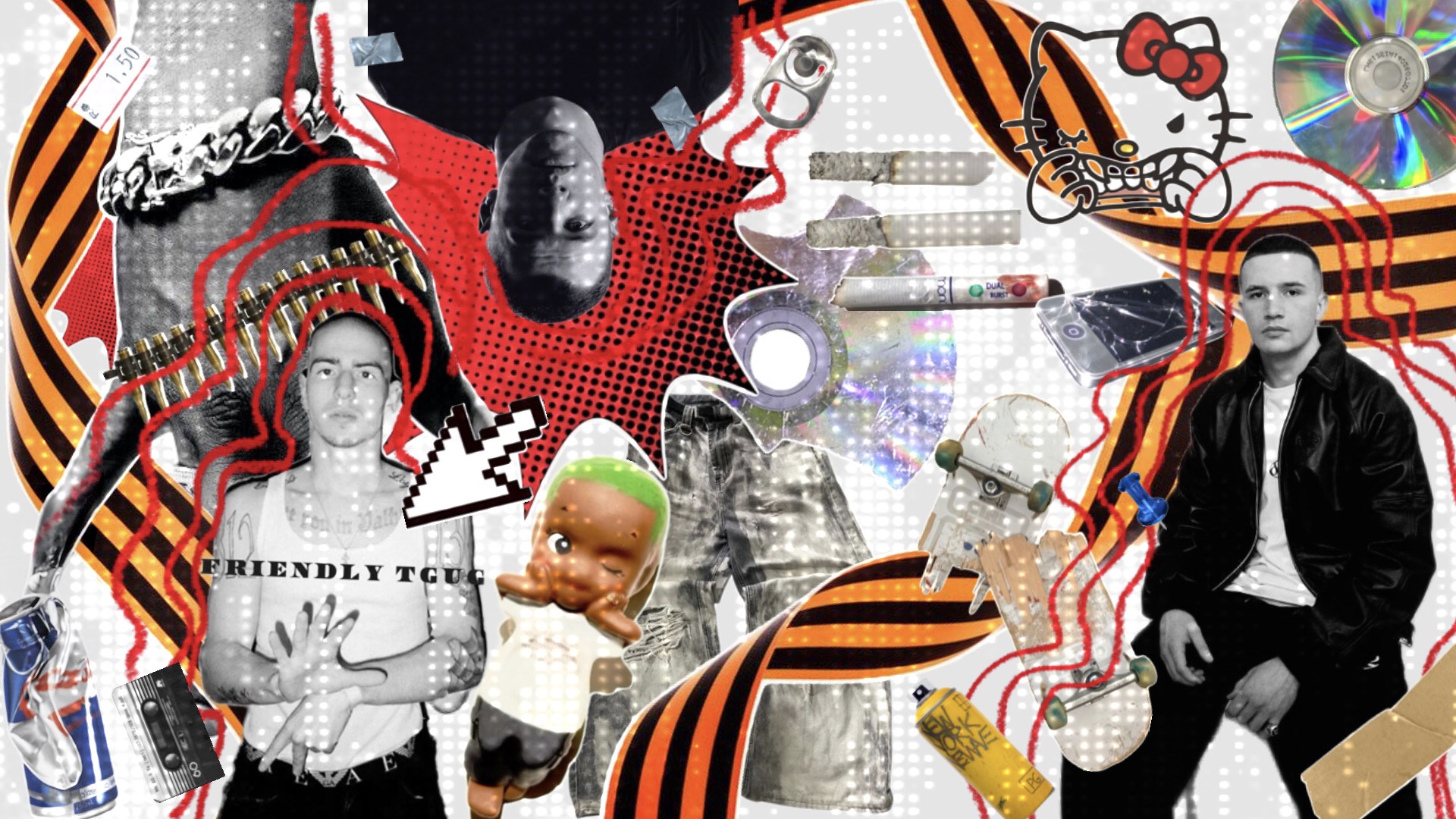
Why has Russian rap suddenly started to advocate traditional values and express its support for the security services and the state at large? How is this renaissance of “patsansky rap” (“street-guy rap”) connected to the war against Ukraine? Writer and journalist Vlad Gagin looks into the issue
In recent years, Russian rap has undergone an unexpected transformation. A genre once associated with outsider culture and anti-establishment attitudes has increasingly embraced the language of “traditional values” and professed loyalty to law enforcement and state power more broadly. The question is why, after 2022, did Russia witness a revival of so-called “patsansky rap” — “street-guy rap” steeped in hypermasculinity and criminal aesthetics — and how that revival became intertwined with the war in Ukraine?
Russian rap in the 1990s and early 2000s remained largely disconnected from the state. Looking back from 2026 — after many major artists openly supported the invasion of Ukraine and began rapping about patriotism, authority, and the security services — it appears that this distance was less the product of a deeply rooted countercultural ethos than the simple absence of any such demand from the state itself. Another factor was rap’s position within Russian culture at the time: although the genre was steadily gaining popularity, it had not yet become the dominant soundtrack for younger generations.
The rise of rap and the consolidation of authoritarian politics in Russia unfolded in parallel. One of the projects designed to push rap into the cultural mainstream was the television competition “Bitva za respekt” (“Battle for Respect”). The show brought together rappers from radically different stylistic backgrounds to compete before a panel of genre heavyweights such as Legalize — one of the pioneers of Russian rap — and the Rostov-on-Don group Kasta.
The project’s third season stood out in particular, both for its scale and for its brazen entanglement with state power. The final event was attended by Vladimir Putin, then serving as Russia’s prime minister. The winner, Roma Zhigan, shook Putin’s hand and performed a track denouncing “AIDS, drugs, and faggots.” Not everyone in the rap scene embraced the message. Soon afterward, two then-little-known rappers Oxxxymiron and Schokk released a response track with the refrain: “We disagree with your party line — // better to side with AIDS, drugs, and faggots.”
The trajectories of those artists would diverge sharply in the years that followed, as political divisions within Russian society deepened. After publicly opposing Russia’s full-scale invasion of Ukraine, Oxxxymiron was effectively forced into exile. Schokk, by contrast, endorsed the war and went on to release numerous tracks in support of the authorities. Roma Zhigan’s arc proved the most predictable: he continued moving in lockstep with the Russian state, recording patriotic songs and collaborating with far-right anti-immigration organizations.
Another revealing example of an early rapprochement between Russian rap and the state is the career of Timati. He first rose to prominence after appearing on the hugely popular television talent show Star Factory in 2004. By the early 2010s, however, Timati had clearly positioned himself as a cultural ally of the Kremlin, serving as an official campaign surrogate for Vladimir Putin during the 2012 presidential election. A few years later, he released the notorious single “My Best Friend Is President Putin.” In Timati’s case — businessman, celebrity entrepreneur, and close associate of Chechen leader Ramzan Kadyrov — the logic appears relatively straightforward: behind the ostentatious loyalty to the state lies a mixture of commercial calculation and political opportunism.
Far more puzzling is the case of the pop group Diskoteka Avariya, which rose to fame in the 2000s. The band was best known for lighthearted, often comedic dance tracks. Yet in 2006, it released the rap song “Evil” (Zlo), saturated with anti-Western resentment and nationalist rhetoric: “Will you remember, serving napkins to your masters, // The righteous sword bequeathed by your great ancestors? // Some things have been sold, some stolen away, // And some gather dust beside your great-grandfather’s medals.” In retrospect, the track anticipated many of the themes that would later come to define Russian state propaganda, including the increasingly militarized cult of May 9, the holiday commemorating the Soviet victory over Nazi Germany.
Still, despite these examples, overt support for the authorities among Russian rap artists remained relatively rare before Russia’s full-scale invasion of Ukraine. When it did occur, it was generally perceived less as an ideological trend than as an oddity or an embarrassing exception.
The Return of “Patsansky” Rap
“Patsansky rap” — a distinctly Russian strain of street rap rooted in working-class masculinity and provincial life — emerged organically from post-Soviet reality. It was only natural that young people growing up in gloomy provincial apartment blocks would rap about the world around them: stairwell hangouts, drugs, petty crime, and intensely local humor. Groups such as AK-47, Triagrutrika, and The Chemodan Clan romanticized a harsh but strangely charismatic provincial existence.
By the early 2010s, however, it seemed as though this style was fading into irrelevance. In 2012 — before streaming platforms had fully consolidated Russia’s music industry — the Ufa-based collective DOPECLVB demonstrated that rap from the Russian provinces could sound closer to early Kanye West than to traditional street rap.
The true turning point came in 2015, when three landmark albums effectively reshaped the Russian rap landscape. Skryptonite’s “House with Normal Phenomena” pushed intricate, atmospheric production to the forefront. ATL’s Marabu fused experimental electronic textures with highly idiosyncratic lyricism. And Oxxxymiron’s “Gorgorod” introduced mass audiences to conceptual, literary rap on a scale Russian hip-hop had not previously seen.
This wave stood as far from “patsansky rap” as possible — both sonically and ideologically. For a time, it seemed that rap about stairwells, neighborhood codes, and “realness” had disappeared for good.
Yet the genre eventually returned, albeit in an updated form. The sound evolved dramatically, absorbing contemporary production trends, but its thematic core remained surprisingly intact. Stories about crime or near-criminality and drug use remained foundational to the genre’s identity. Something else, however, had changed.
Earlier incarnations of “patsansky rap” were largely indifferent to state politics and occasionally even hostile toward them. The revived version, by contrast, increasingly embraced patriotism and displayed a striking affinity for law enforcement and the security apparatus. At its most moralizing, the old street-rap scene merely grumbled about younger rappers trading oversized jeans for skinny fits — a generational subcultural complaint rather than an ideological position.
One of the first artists to restore a sense of “street sincerity” to Russian rap was Friendly Thug 52. As a teenager, he became involved both in the drug trade and in Russia’s far-right youth subculture. While Friendly Thug now tends to describe the latter as little more than a youthful indiscretion, his experience dealing drugs is, without exaggeration, the foundation of his music.
His songs revolve around more or less the same themes: moving "bags of dope while my homeboy only moved a cursor," abandoning crime, and ultimately achieving success through rap. But equally central to Friendly Thug's image is a consistent set of values that runs from track to track — loyalty to his wife and friends, belief in God, and love of his country, framed in opposition to a Western orientation. "Why did we want to go to the U.S. so badly when we were kids?" he asks in one song.
Yet despite his patriotism and his background in right-wing subcultures, Friendly Thug has not publicly endorsed the war in Ukraine or openly aligned himself with the Kremlin’s broader political agenda — unlike some of the other artists discussed later in this article. Even so, a certain admiration for state power repeatedly surfaces in his lyrics. “This is the FSB — not the States, not the FBI,” he raps in one track, invoking Russia’s security services less as a source of fear than as a marker of national identity and masculine authority.
Presumably, what has made Friendly Thug — whose "52" references Mexico's international dialing code — resonate so deeply with listeners is not simply his command of language, but the constant stream of hyper-specific details drawn from the life of a former drug dealer, the kind of details that are impossible to fabricate convincingly. His ties to the criminal world are also visible in his visual aesthetic: in most of his music videos, crowds of men flex alongside him, many with their faces blurred or concealed behind masks.
And here it is necessary to address another issue essential to understanding the rise of this new patriotism within Russian rap: the intensifying censorship and pressure directed at artists deemed insufficiently loyal to the state.
Friendly Thug himself understands how precarious his position is in contemporary Russia. By his own account, he avoided giving interviews for years out of fear that he might accidentally say too much. That precariousness has even become a source of irony in his music. "Now I gotta defend myself: we never sold drugs," he raps in a recent video, crossing his fingers as he says it.
—
If Friendly Thug was embraced early on by established figures within the rap scene, another champion of “traditional values,” Macan, was for years treated with a degree of condescension by industry peers, who dismissed his music as simplistic and artistically unambitious. Mass audiences, however, saw things differently: Macan became a fixture at the top of the charts on VK, Russia’s dominant social media platform.
Macan subscribes fully to the moral universe of “patsansky” culture. One quote from an interview with the popular YouTube show “Vpiska” is enough to capture his worldview: “Bro, we stand for traditional values. I get it, I don’t want to suffocate anyone, ban anyone, or take opportunities away from people. But we’re in Russia, bro. Traditional values mean there’s a man, there’s his family, and the woman doesn’t stand next to him — she stands behind him. The whole family is under his responsibility, under his protection, including the woman.”
Yet adherence to “traditional values” did not shield the rapper from scrutiny by the authorities. On August 1, the Telegram channel Mash reported that Macan had ignored six military summonses and could face criminal charges for draft evasion. Shortly afterward, pro-war Z-bloggers attacked him for allegedly dodging military service. Their outrage intensified after the rapper set a BMW on fire onstage during a concert in Moscow. “The strange social contradictions of the era of the Special Military Operation,” the pro-Kremlin Telegram channel MIG Rossii remarked dryly.
Soon afterward, Macan became a brand ambassador for the car dealer Rolf and released a track of the same name featuring the line: “Slavs are in my DNA, Russia is in my passport.” He also publicly insisted that he had no intention of avoiding conscription and announced that he would enter military service on November 28. This turned out to be true. It later emerged that one of Russia’s most commercially successful artists would serve in Vityaz, an elite special forces unit within the National Guard.
The logic behind the episode remains unclear. It is difficult to believe that an artist of Macan’s stature could not have avoided military service without high-level political pressure. One possible explanation is that, despite his conservatism, he had not been sufficiently outspoken in support of the war — and that the spectacle of burning a BMW onstage only intensified official suspicion. Still, there appears to be little reason to worry about the rapper’s wellbeing. Since beginning his service, multiple media reports have pointed to his privileged status within the unit. One report claimed that commanders instructed fellow soldiers not to look directly at him because the rapper “doesn’t like it.”
ICEGERGERT, a labelmate of Macan at Gazgolder, has long cultivated an image deeply intertwined with crime and state power alike. By his own account, he was connected to the criminal world from early childhood. In an interview with The Flow, he said that both of his parents lost custody of him after running afoul of the law. He brought up the story while responding to persistent online rumors that he himself has ties to Russia’s security services, including speculation that his father was an FSB colonel.
In ICEGERGERT’s music, declarations of allegiance to the criminal underworld sit comfortably alongside lines such as: “I’m not a marginal, but my older brother’s a fed.” The fusion of outlaw aesthetics with admiration for state force runs throughout his work.
Russian media outlets have reported that the rapper studied at a Suvorov military academy and holds the title of Master of Sports in hand-to-hand combat. A widely circulated photograph shows the young cadet Georgy Gergert — the rapper’s real name — seated between Sergey Shoigu and Alexander Beglov at an official event. Gergert himself says the image was taken in 2019, when Shoigu, then Russia’s defense minister, allegedly visited a newly built academy facility during an inspection tour. According to the rapper, he attended the event as “one of the most decorated athletes” in his discipline.
Unlike Macan, whose rhetoric about traditional values tends to remain somewhat coded, ICEGERGERT is far more explicit. “Maybe we’re wrong, but there are a whole lot of right-wingers like us / This country is for straight people — Russia still has plenty of sane ones,” he raps in one track. His political messaging became even more direct by March 2025: “What about the liberals? (Fuck ’em.) We fucked NATO. / Übermensch, no homo gang — I’m moving to the right.”
That line may have contributed to his inclusion in Ukraine’s controversial “Myrotvorets” database the following month. Then again, the decision may simply have reflected the broader pattern surrounding the artist. The “Myrotvorets” entry reproduces the same photograph with Shoigu and Beglov and identifies Gergert as the author of tracks such as “Robber 78” and “Russian Thieves” — songs that make no explicit mention of the war in Ukraine.
Far from damaging his popularity, ICEGERGERT’s image as a grim right-wing provocateur only strengthened his mainstream appeal. By 2025, he had achieved something close to nationwide recognition. His punchlines became internet memes, his tracks dominated TikTok and Instagram reels, and schoolchildren reportedly danced to his songs at Teachers’ Day celebrations.
“State-Aligned” Rap in the Shadow of War
The trend toward right-wing patriotism in Russian rap is still gaining momentum. Much of that momentum stems from the fact that the artists discussed above each demonstrated, in their own way, that “traditional values” can be seamlessly fused with commercially successful music. Friendly Thug 52 alone — by slightly modernizing the familiar street-rap formula with elements of minimalist G-funk — spawned dozens of imitators. Where “patsansky rap” was once associated with monotonous drum patterns and tired keyboard loops, it has now become clear that conservative messaging can be effectively commercialized when packaged in contemporary aesthetics, whether the melodic pop sensibility of Macan or the cold trap production favored by ICEGERGERT.
But shifts in sound alone cannot explain the popularity of this new wave of street rap. Its rise would likely have been impossible without the war, which intensified ideological fractures within Russian society. Against that backdrop, rappers who once positioned themselves as apolitical have increasingly begun “engaging with politics” — often in ways that verge on the surreal.
One striking example is Boulevard Depo, who claimed that The Gulag Archipelago had been produced at the behest of the West in order to lay the foundations for anti-Soviet ideology, which later evolved into what he called a broader “anti-Russia cult.”
Boulevard Depo’s turn toward overtly political themes had already become visible on his most recent album, FUTUROARKHAIKA, whose cover features the rapper’s portrait stamped with the Russian coat of arms. On the record, the Ufa-born artist — originally associated with the experimental collective DOPECLVB — repeatedly references drones, cyberwarfare, and information conflict. In one track, he pays tribute to the pro-Russian hacker group Joker DPR: “Data security means nothing — Joker DPR is a machine. […]
We move through their big data like we own the place, because brother stands for brother.”
At the same time, FUTUROARKHAIKA is arguably the softest and least conventionally “rap” record of Boulevard Depo’s career. On several tracks, including “NII and Ya + Svayal”, he abandons rapping almost entirely in favor of subdued love songs. Because of that tonal shift, references to Joker DPR could initially be interpreted less as ideological commitment than as a vague fascination with the atmosphere of Russia’s “dark twenties.”
But after the album’s release, Boulevard Depo appeared on YouTube and elaborated more openly on his worldview, repeating conspiracy theories about Solzhenitsyn’s book and speaking in far more concrete terms about contemporary Russia: “It’s an incredibly перспективное and remarkable time. […] There are certain difficulties, but there are also certain opportunities. Our situation is far more positive than almost anywhere else, even if there is, yes, a certain conflict. Once the conflict ends, everyone will breathe easier, and everything will begin to bloom and flourish.”
Soon afterward, wearing a khaki cap, the rapper appeared on a pro-war blogger’s show to review fellow musicians’ tracks. Discussing the pop singer Dora, he remarked approvingly: “Dora’s like the Holy Spirit at the front — she keeps the boys energized.”
Listening to Boulevard Depo’s music today, it is easy to forget that more than a decade ago he released the now cult-status album “Otritsala”, which included a track titled “Banner of Peace”, where he rapped — “like Roerich” — about being exhausted by “lies and violence.” “Otritsala” was arguably the first Russian rap release to immerse itself fully in internet culture: vaporwave aesthetics, web-punk, glitch art, and the fragmented visual language of the online era.
Judging by Boulevard Depo’s recent work, that fascination with internet culture has not disappeared. But the “banner of peace” has clearly been set aside. If internet aesthetics once implied a kind of openness to the globalized world, the universe of today’s Boulevard Depo — a thirty-something family man living outside the city and investing in domestic crypto ventures — has narrowed toward the smallest possible social unit: the family. Beyond that intimate circle, he increasingly presents himself as cold, pragmatic, and professionally detached.
Trap Intellectuals
Among the rappers now speaking the language of “traditional values” are artists who also aspire to intellectual reflection on modernity, Russia’s future, and the broader state of the world. One example is the trap artist John Garik, who has described Netflix as a weapon of Western influence and raps in the track “VODKA3”: “Young Oreshnik, I hit launch just to blow you apart. I shouted: ‘Free Kursk and all my brothers.’”
By the fourth year of the war — increasingly experienced inside Russia as a kind of new normal — it became clear that large segments of the audience no longer perceived lines about “Oreshnik” as inherently disturbing. Garik himself explains the mutation of trap music from hedonistic escapism toward discussions of values as a consequence of “the entire socio-political situation.” In his view, listeners have grown tired of endless lyrics about drugs and sex and now crave something “emotional, Russian, soulful.”
The music critic Danya Pornorep argues that Russian audiences across the political spectrum have “stopped caring” about aggressive or militaristic lyrics. Speaking to Posle, Pornorep referenced a post by the émigré music journalist Alexander Gorbachev, who suggested in the comments that Garik’s “Oreshnik” bars should be interpreted “in the context of battle rap,” where “any degrading metaphor” is fair game. Gorbachev concluded that the rapper did not come across as a genuine patriot so much as someone fundamentally indifferent. “If even émigré journalists are rationalizing Garik’s ‘Oreshnik’ lines,” Pornorep observed, “then what can you expect from audiences inside Russia?”
But perhaps the explanation lies not in émigré sensibilities at all. John Garik makes stylish, unconventional rap, and listeners whose views on the war radically differ from his may simply struggle with the cognitive dissonance of admitting that a political opponent is capable of producing compelling art. Canceling Garik over a few inflammatory punchlines is likely even harder.
Garik’s interest in culture is not merely performative. He studied cultural theory at university and casually references Jacques Derrida in his lyrics alongside standard rap tropes about women and drugs. In many ways, John Garik is himself a product of postmodern culture and its logic of bricolage: the son of a priest, a former drug dealer, an artist who combines hedonistic imagery with genuine attempts to articulate something spiritually or philosophically meaningful.
Occasionally, he succeeds. In the track “Shine”, Garik raps with striking sincerity about spiritual crisis and rebirth: “Bro, I was broken — I prayed before sleep. I felt that battle with evil inside me. I walked the valley of the shadow of death like Psalm 22. Swapped wheels for guys like a car dealership. Rebelled against my father like Absalom.”
The raw vulnerability of a song like “Shine” sits awkwardly beside bloodthirsty lines about “Oreshnik” or deliberately provocative bars such as: “My album’s legendary, bro — The Flow will write about it. I’m a patriot rapper, bro — I got that Z-flow.”
What makes Garik’s patriotic lyrics interesting is precisely that they rarely function as sincere ideological declarations. They do not genuinely attempt to affirm a coherent political worldview. More often, they operate as a rhetorical device, a reliably effective mechanism for attracting attention. There is another “trap cultural theorist” currently rapping about devotion to the state: Zangezi, the stage persona of music journalist Daniil Kiberev. In some respects, Zangezi’s work resembles Garik’s use of patriotic one-liners: “I made this album and saved Russian culture. Opened up new territories for it — like Kharkiv and Donbas.”
But Zangezi’s ambitions as a cultural theorist are far broader. On his album “Sovereign Radiance”, he attempts to reinvent trap music as a genre by injecting it with values beyond the standard triad of “women, money, drugs.”
The result is, at the very least, inventive rap made by someone who clearly delights in language itself. At the same time, listening to the album often produces the impression that its barrage of Z-symbolism functions almost like AI-generated ideological sludge, material seemingly designed to provoke endless essays from theorists of the neo-reactionary right. Beneath all the references and provocation, however, there appears to be something simpler: a nihilist and cynic disoriented by a world in which: “The electric bus keeps moving, kids keep playing Roblox, and everything proceeds exactly as it should — in giant steps toward the abyss.”
Zangezi’s strongest songs emerge precisely from this sense of exhaustion and longing for grand narratives. As he raps in one track: “Do what you want — I’m heading underground like Korney Korneich. The only thing I really have to say: the grass used to be greener.”
In comments to Posle, Zangezi acknowledged that Sovereign Radiance was, at least “formally,” conceived as an attempt to reinvent and renew the genre. At the same time, he admits that the effort was only partially successful: “I don’t think this album demonstrates some fundamentally new aesthetic. It’s more that I refined the project I’d already been developing on earlier releases. Here I simply managed to give it a form more adequate to the present moment — and in some respects, like on the track “Chastity”, push even further in dismantling this trap-hedonist ethos. But what’s truly convincing here is probably the destructive impulse itself. I’m fully aware that what I’m doing is transitional — that this still isn’t a genuinely new culture, assuming such a thing is even possible.”
What is also striking is the way Zangezi appropriates elements traditionally associated with counterculture and protest movements, comparing himself at different moments to the Beat Generation and to Public Enemy: “Hip-hop is Public Enemy and their war to the very end,
battling Babylon for the hearts of the young.”
Yet if “Babylon” in Zangezi’s worldview appears associated with images like “Archangel Michael draped in LGBTQ colors,” it becomes far less clear what exactly constitutes the alternative he imagines. That ambiguity, however, does not prevent the rapper from feeling aligned with broader social sentiment. “I’ve been out on the streets — there’s a car with a Z-symbol in every neighborhood,” he raps.
How any of this meaningfully connects to the historical Beats or to Public Enemy remains difficult to determine. Perhaps the explanation lies in Kiberev’s own intellectual formation — one shaped long before “cars with Z-symbols” became part of Russia’s public landscape.
For Kiberev, counterculture is not an empty label. One of his theoretical essays is devoted precisely to the question of whether a new Russian counterculture can be invented at all. He attacks Western modernity for its alleged spiritual emptiness, while seemingly overlooking the extent to which his rhetoric ultimately converges with the dominant ideological language of the Russian state itself.
Zangezi partially acknowledges this overlap. In his view, the state has in some ways moved closer to his own cultural ideal during the years of war: “I don’t think Russia currently has any genuinely competitive hegemonic culture — unless we’re supposed to count the film “Cheburashka” or the rise of patsansky rap. To me, it feels more like parallel imports. But the atmosphere has undeniably shifted over these years — I can’t ignore that. At the same time, I can’t say I’m optimistic. It’s just that before, I didn’t see any place for myself in this cultural process at all, whereas now it’s at least possible to live and work more or less спокойно.”
Kiberev added that, under these new conditions, he no longer feels particularly attached to the term “counterculture” itself: “In the 1990s, Russia already had a counterculture rooted, among other things, in ideas of a strong state and empire. It’s just that those ideas weren’t especially supported by the authorities at the time. But I don’t think state support — or the lack of it — actually changes anything essential. There are simply certain moral, value-based, ideal principles. Maybe it’s difficult to call that ‘counterculture’ now, but I don’t feel that what I’m doing is mainstream in any meaningful sense. You could just as easily call it underground culture, marginal existence, or something else entirely. I’m not attached to the word ‘counterculture.’”
Pathos or Art
The more artistically convincing this new traditionalist rap becomes, the less room it seems to leave for overt ideological messaging — whether about “conservative values” or the justification of war. One could imagine a spectrum whose poles are, on the one hand, Zangezi’s Sovereign Radiance, and on the other, the compilation “Rap Platoon” — billed in promotional materials as “the first rap compilation for fighters of the Special Military Operation.”
“Rap Platoon” is pure state-commissioned culture. Yet from an album uniting many veterans of the genre under a single banner, including the aforementioned Roma Zhigan, Negativ of Triada, and 25/17, one might have expected at least something aesthetically compelling. Instead, “Rap Platoon” is simultaneously bombastic and technically clumsy. Most of its tracks amount to little more than clichés, hollow slogans, and frontline reportage narrated in the first person — often by performers who have never actually seen combat.
Music critic Dania Pornorap likewise argues that the more directly artists address political themes, the more the artistic dimension of the music deteriorates. Speaking to Posle, he noted: “As for ‘rap for Donbas,’ it remains marginal. Popular artists like Macan and ICEGERGERT avoid addressing the subject head-on, but they still play on imperial and militaristic emotions through coded imagery. Any overtly propagandistic rap inevitably suffers artistically because of its politicization.”
Documentary Rap From the Front
Russian rappers writing about the war rarely combine the role of artist with that of soldier or even eyewitness documentarian. The closest figure to doing so is perhaps Husky, who has spent significant time in or near the war zone since as early as 2014 and directed a documentary about musicians from Luhansk who went to the front.
Even so, Husky’s 2025 album “Partisan” approaches war in largely abstract terms. Its documentary quality emerges instead through the accompanying videos. In the clip for “Living Water,” a young couple wanders through the ruins of Mariupol; in the video for the title track, the central figure is poet and soldier Oleg Mironov, whose verses interrupt the rapper’s delivery. In both works, Husky avoids moral clarity. The lovers moving through a devastated and occupied city appear, at first glance, to symbolize renewed life in the occupied territories. Yet at the end of the video, the rapper’s voiceover remarks: “There used to be hookah rap here, people danced, drank warm beer. Officially, this is now the afterlife.” Mironov’s poetry, meanwhile, conveys despair and disillusionment — the voice of someone who entered the war with sincere convictions only to find himself spiritually broken by it.
The situation in Ukrainian rap looks markedly different. In Ukraine, several well-known artists have directly participated in combat. Their music is often aesthetically straightforward, even crude. Rapper Otoy, for instance, delivers openly declarative lines such as: “I’m from Ukraine — we’ve been cutting down swine all along,” or “Bandera is our father, Ukraine our mother.” The clearest example of this highly politicized and deliberately simple style is Yarmak, who joined the front at the very beginning of the war and whose tracks now accumulate millions of streams.
What is striking is that before the Russian-Ukrainian conflict, Yarmak advocated unity between Russians, Ukrainians, and Belarusians, on the basis of the same conservative values, or more precisely, a shared hostility toward LGBTQ people.
Yet writing convincing rap about war in Ukraine does not necessarily require direct participation in combat. The rapper Palindrom criticizes draft dodgers smoking hookah in cafés while simultaneously admitting his own fear of military recruitment officers. The track in question is titled “I’m Afraid” — the same title as the opening song on Husky’s “Partisan”. This accidental rhyme offers a revealing comparison between life in the two warring societies. Husky’s song unfolds as an expansive catalogue of fears, where the ambitions of a major artist intersect with anxieties about marriage and intimacy. In Palindrom’s work, by contrast, there is scarcely any room left for echoes of ordinary civilian life at all.
War changes people, and Ukrainian artists are no exception. Alyona Alyona — one of Ukraine’s most technically gifted rappers, previously known for upbeat, Western-oriented hip-hop — now writes about occupied Mariupol, faith in God, and a transformed perception of the Azov Brigade regiment.
There is also an enormous volume of far less polished frontline rap, which at times proves more compelling than the bombastic work of artists like Yarmak. The collective Nord Division, for example, raps about clashes with Wagner fighters in what is essentially a freestyle format where serious, insulting, and absurd lines coexist chaotically.
In its rawness and juvenile humor, Nord Division resembles a project from the opposite side of the front: Makeevskoe SIZO, created by far-right militant and propagandist Yevgeny Rasskazov. Topaz fought against Ukraine as early as 2014 as part of the neo-Nazi sabotage unit Rusich. During the full-scale invasion, he joined another formation composed largely of Russian football hooligans and far-right activists: the Española Battalion battalion. In the track “Trench Rave,” released by Makeevskoe SIZO, Topaz monotonously recites primitive lines over a pounding four-on-the-floor beat: anti-tank missiles, artillery fire, and war reduced to empty rhythmic slogans.
Conservative Russian Rap as Part of a Broader Trend?
Earlier in this article, I discussed how Russian rap has been shaped by Russia’s protracted war against Ukraine. But what if this turn toward conservative values is part of a much broader shift, one tied to the broader collapse of the globalist neoliberal project itself?
One of the pioneers of the new “street rap,” Friendly Thug 52, has a line that goes: “SoundCloud heroes / black flag is my aura” — a lyric pointing to the pirate ethos and fiercely independent spirit behind his music. And indeed, Friendly Thug’s roots are inseparable from SoundCloud, a platform built around the free uploading and circulation of music and a more direct relationship between artists and audiences.
But SoundCloud evokes more than legalized piracy. It also carries associations with radical experimentation, independence from major labels and television gatekeepers, and an internet culture that, until very recently, promised an unprecedented freedom of information and artistic circulation. One of the earliest icons of this SoundCloud experimentalism was Yung Lean — a Swedish teenager who unexpectedly captivated global audiences with strange yet hypnotic English-language rap. Through the internet, Yung Lean escaped the musical periphery of Northern Europe and achieved worldwide fame. He was a child of late-MTV liberal-utopianism, with its dream of a borderless and inclusive global culture, as well as of early Kanye West, whose innovations in sound would shape young artists across the world — from the SoundCloud wave itself to the rappers of DOPECLVB in Ufa, who effectively hammered the first nail into the coffin of old-school “street rap.”
Who could have predicted that, a decade into his career, the usually apolitical Yung Lean would publicly distance himself from Kanye West over the latter’s antisemitic statements?
Friendly Thug is interesting precisely because he embodies this contradiction: he combines the anti-establishment ethos of the SoundCloud generation with isolationist lines such as “Why the fuck did we want to go to the U.S. so badly as kids?” — a sentiment that may mark the symbolic end of Western orientation for an entire generation of musicians. One could place Boulevard Depo within the same trajectory: an artist who retained his fascination with internet drift and digital subcultures, yet replaced the peace banner with the Russian state emblem on his album cover.
In this context, Husky’s diss track aimed at Kanye West becomes especially revealing. Husky opens the song with the line “You’re probably in L.A. / I’m in Donetsk today,” and closes with imagery of the Somali Battalion arriving in Beverly Hills. The track feels less like a diss than a strange form of fraternal communication.
Much as Russian officials, borrowing the vocabulary of decolonial discourse, denounce the unipolar world and American hegemony, Husky attacks Kanye — along with fellow rappers whose politics remain sonically progressive and globally oriented. Yet looking at the diss single’s cover art — a joint photograph of Husky and Kanye — it becomes difficult not to extend the analogy further, recalling how those same officials celebrated meetings between Vladimir Putin and Donald Trump in Anchorage.
Yes, Kanye West did much to globalize popular music. But he also played a role in undermining faith in that very globalism. And Husky — with his punchlines about the Somali Battalion — seems less interested in resisting that collapse than in welcoming it.

Мы намерены продолжать работу, но без вас нам не справиться
Ваша поддержка — это поддержка голосов против преступной войны, развязанной Россией в Украине. Это солидарность с теми, чей труд и политическая судьба нуждаются в огласке, а деятельность — в соратниках. Это выбор социальной и демократической альтернативы поверх государственных границ. И конечно, это помощь конкретным людям, которые работают над нашими материалами и нашей платформой.
Поддерживать нас не опасно. Мы следим за тем, как меняются практики передачи данных и законы, регулирующие финансовые операции. Мы полагаемся на легальные способы, которыми пользуются наши товарищи и коллеги по всему миру, включая Россию, Украину и республику Беларусь.
Мы рассчитываем на вашу поддержку!


To continue our work, we need your help!
Supporting Posle means supporting the voices against the criminal war unleashed by Russia in Ukraine. It is a way to express solidarity with people struggling against censorship, political repression, and social injustice. These activists, journalists, and writers, all those who oppose the criminal Putin’s regime, need new comrades in arms. Supporting us means opting for a social and democratic alternative beyond state borders. Naturally, it also means helping us prepare materials and maintain our online platform.
Donating to Posle is safe. We monitor changes in data transfer practices and Russian financial regulations. We use the same legal methods to transfer money as our comrades and colleagues worldwide, including Russia, Ukraine and Belarus.
We count on your support!


другие подкасты


«Это базис»: От неолиберализма до феминитивов. Ответы на вопросы

«Это Базис»: Eat the rich: жизнь с неравенством и без него

Политический дневник #52: После Пригожина, национализм как мазохизм, горящая планета
SUBSCRIBE
TO POSLE
Get our content first, stay in touch in case we are blocked

Еженедельная рассылка "После"
Получайте наши материалы первыми, оставайтесь на связи на случай блокировки


.svg)

