

НАСТОЯЩИЙ МАТЕРИАЛ (ИНФОРМАЦИЯ) ПРОИЗВЕДЕН, РАСПРОСТРАНЕН И (ИЛИ) НАПРАВЛЕН ИНОСТРАННЫМ АГЕНТОМ ПРОЕКТОМ “ПОСЛЕ”, ЛИБО КАСАЕТСЯ ДЕЯТЕЛЬНОСТИ ИНОСТРАННОГО АГЕНТА ПРОЕКТА “ПОСЛЕ” 18+
A Utopia of Workers and Partisans
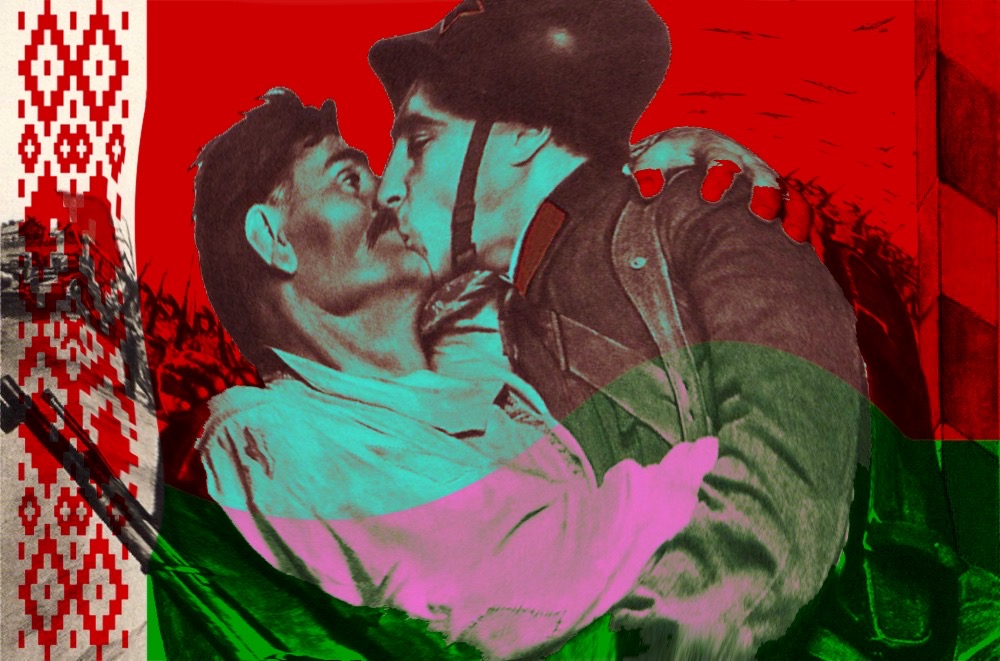
Who invents the national mythology of Belarus? What purposes do new narratives about the country’s past actually serve? Nationalism scholar Nadya Krupenkova examines the top-down search for Belarusian identity
Since 2020, Belarus has been experiencing yet another identity crisis — one that has gradually receded into the shadow of a more violent and material upheaval: Russia’s invasion of Ukraine. But does the displacement of a problem mean its disappearance? On the contrary. The ongoing crisis has triggered renewed reflection on Belarusian subjectivity and identity, now with doubled intensity. While the émigré community reflects on the defeat of the 2020 democratic uprising, the discursive vacuum inside the country has been quickly filled by ideological entrepreneurs loyal to the regime. The absence of dialogue predictably diminishes the originality and quality of their arguments, but not their analytical significance: in such conditions, the distortions and convulsions of state ideology become especially visible. One of the most telling examples is Alyaksey Dzermant, a Belarusian political scientist loyal to the Lukashenko regime.
Since 2020, Dzermant has headed the Center for the Study and Development of Continental Integration “Northern Eurasia.” He also has close ties to the Communist Party of Belarus. In the public sphere, he is a shape-shifter: by turns a political scientist, philosopher, and Eurasianist; a self-described “Russian Belarusian” who pounds his chest proclaiming “We are Scythians!”; a participant in Gumilev readings who nonetheless finds room to criticize Alexander Dugin. Yet beneath these shifting emphases, Dzermant consistently advocates for a union between Belarus and Russia, and his vision of the future largely aligns with that of the Lukashenko regime.
In this sense, Dzermant’s statements can be read as an attempt to give discursive form to that union on behalf of the Belarusian authorities — and to legitimize it in the eyes of ordinary Belarusians. Yet an analysis of these statements suggests that the meaning of this alliance cannot be reduced to the essentially imperial notion that Belarus is simply compelled to seek protection from a neighboring dictatorship flush with natural resources and nuclear weapons. The ideas of pro-government writers like Dzermant draw on precisely the opposite impulse: a desire for distinct identity, for cultural and political autonomy, and for limited space for citizens to participate in forging a new language of collective self-description.
In a series of programmatic essays published in the journal History and Modernity, Dzermant consistently mobilizes two popular archetypes — the Worker and the Partisan — while developing the concepts of “Slavic socialism” and the Eurasian “assembly point.” These texts are not a random collection of columns but a systematic elaboration of ideas he has long voiced on television and social media. What images of Belarusian identity does Dzermant propose? What myths and rhetorical devices make this discourse so familiar to a Russian reader? And how does nostalgia for a lost universalism push political thought toward the embrace of authoritarian alliances?
The Cradle of Slavic Socialism
In his article “Slavic Origins,” Dzermant disputes Soviet theories of the “genetic localization” of the Slavs, which assign an important role to contacts between the ancestors of Belarusians and Baltic tribes. What concerns us here are not the dry scientific nuances but the conclusions drawn from them. Purportedly drawing on genetic research, Dzermant advances the following claim: that Slavs possess a distinctive, anthropologically grounded capacity to “assemble” and assimilate heterogeneous ethnic groups.
He insists that because the Eastern Slavs historically formed “at the intersection of different natural and ethno-cultural worlds,” they developed a unique capacity to invent supra-ethnic forms of social organization — ones attractive to Balts and other neighboring peoples. Whether these circumstances are truly unique to the Slavs lies outside the scope of this discussion. What matters is something else: from speculation about the adaptability and progressiveness of proto-Belarusians emerges the myth of their special “capacity for gathering,” which finds its culmination in “Slavic socialism.” In Dzermant’s account, Slavic socialism is a kind of spontaneous property of ancient peasant communities — one that allowed them to incorporate outsiders into their cultural and economic arrangements on principles of equality and voluntariness.
In other words, freedom and equality — the two regulative ideals of socialism — are rooted in the primordial “Slavic habitus,” by which Dzermant means the distinctive way of life of our ancestors before the emergence of the state. The implication is that the Eastern Slavs were able to realize a far more complex, state-level form of socialism because geography and positive historical experience had already prepared them for it; all that remained was to scale it up. In this way, Soviet-style socialism appears not as the hard-won result of struggle and experimentation by countless real people across generations, but as an almost prehistoric inheritance that predetermined the events of the twentieth century. What we have here, quite plainly, is a pseudo-scientific discourse that lends an air of inevitability to an exotic version of Slavic socialism.
Despite its socialist sympathies, this style of reasoning is straightforwardly conservative. In the egalitarian picture of Slavic history that Dzermant paints, there are no historical actors and no forks in the road — no class struggle, no conflict of interests, no political choice. Dzermant tells us nothing about the socio-economic architecture of his universe in the long interval between antiquity and the twentieth century. Instead, he reaches for the seductive conservative myth of a natural order of things.
A Nation of Workers and Partisans
In the essay “A Nation of Workers and Partisans,” Dzermant continues to elaborate his eccentric mythology, this time drawing on the language of the German Conservative Revolution. Invoking first Ernst Jünger and then Carl Schmitt, he introduces onto the Belarusian stage two emblematic figures of modernity — the Worker and the Partisan. In his view, Belarus represents a model project of authoritarian modernity: the triumph of the Worker-laborer, who builds the country in a utopian Bolshevik fervor and is then tested by war and partisan struggle.
It is worth recalling that for Jünger, the Worker embodied a new type of human being forged in the technological age — one destined to sweep away the decaying liberal world. Transplanted onto Belarusian soil, the cult of labor, discipline, and service to the system that Jünger described echoes the heroic labor aesthetics of socialist realism and is then inherited, almost by inertia, by the official style of contemporary Belarusian power. Dzermant simply borrows a vivid concept from the German conservatives and puts it to work reviving the worn-out image of the Belarusian worker.
The partisan myth, in turn, remains morally charged for many Belarusians to this day — and here Schmitt is almost unnecessary. The partisan is not simply a propaganda construct but a lived experience, recognizable within one’s own family and community. The partisan movement during World War II was genuinely mass-based, as nearly the entire territory of present-day Belarus lay under occupation. After the war, it was former partisans who made up much of the managerial elite of the Belarusian Soviet Socialist Republic — a fact that cemented the partisan experience as a lasting source of political legitimacy for the local authorities. It is therefore no coincidence that the figure combining the worker and the partisan strikes Dzermant as a particularly resonant symbol for a broad audience.
Both figures — the worker and the partisan — seem as though they have stepped directly from one of the Soviet mosaics familiar to every Belarusian on the facade of a local House of Culture. These familiar, easily recognizable, and appealing images are meant to persuade Belarusians that they themselves are the creators of “strong state institutions” and the bearers of “planetary thinking.” Their disarming simplicity makes them a potential populist resource — in the positive sense of the word, if populism is understood as a form of living politics capable of assembling a collective “we.” Equally important, the worker-partisan image implies a rejection of an ethnic understanding of Belarusian identity. Here, Dzermant makes a clear polemical move against ethnonationalism: the ethnic framework is declared irrelevant, while the Soviet experience becomes the cultural foundation for the emergence of Belarusians as a political community.
At the same time, Dzermant dismisses interpretations of the Soviet legacy advanced by both nationalists and liberals. According to him, nationalists view Soviet modernization as the loss of the nation, while liberals seek to revise the heroic cult of resistance — replacing victory with collective trauma and questioning whether that victory was worth its price. Both sides, in his view, ask uncomfortable questions about the communist past, whereas the figures of the Worker and the Partisan inspire pride in the past and optimism in the present. They embody a romantic ideal of Belarusians as industrial creators, custodians, and heirs of the Soviet project, who carry the banner of “world-creating potential” more faithfully than their fellow Slavic peoples.
But what is the central problem with this flirtation with left-conservative imagery? To answer that, one must place the figure of the Worker within the post-Soviet dilemma of identity, at the heart of which lies a fundamental question: is the country part of Europe, or does it represent something fundamentally different? This dilemma could be approached by comparing the functioning of social institutions, but here we are dealing with the language of symbols. In order to distinguish itself from Europe, this kind of argument constructs an image of the Other as the bearer of a special, non-Western knowledge. In the Russian intellectual tradition, this role was long played by the figure of the peasant; Dzermant, however, introduces a different, more modern character — the Soviet Worker. Here, the Worker is opposed to Europe not as the bearer of tradition but as a symbol of modernity, which many post-Soviet conservatives believe Europe has since lost. In this framework, the romanticism of a strong technocratic state becomes a new unifying bond, a new mark of distinction. Anchored in the image of the Worker, Belarus appears as a space of “high,” almost Stalinist modernity — an alternative to a Europe that has supposedly abandoned the Enlightenment project.
For all its socialism and modernism, the contemporary Belarusian state, in Dzermant’s formulation, remains “committed to socially conservative principles and traditional values” and fulfills a “protective function against the liberal fundamentalism of the West.” Lukashenko, it would seem, fits perfectly into the role of the executor of these functions, while Belarus emerges as a model red-brown state. It is hardly surprising, then, that in his Telegram posts Dzermant systematically projects his conservative political ideals onto the Belarusian president. Lukashenko himself, paradoxically, appears to understand politics primarily as a form of technocracy: its purpose is to solve extraordinary labor tasks and maintain stability. At the same time, his rhetoric and manner often seem to echo the style of late-Soviet leaders — figures such as Pyotr Masherov or Mikalay Slyunkow.
Above all, Dzermant sees in the Belarusian regime a powerful anti-Western impulse and an opportunity to complete Belarus’s full pivot toward Eurasia. After 2020, Lukashenko felt betrayed by democratic Europe, and his cold war with the West effectively entered a new phase. In this context, the figures once developed by Jünger and Schmitt for entirely different purposes become a useful intellectual device — one that allows Dzermant to build a bridge between the Belarusian modernity of workers and the Kremlin’s contemporary vision of a global clash of civilizations.
Tuteishasts and Red Scythia
The claim that Belarusian identity formed and was realized as “outside nationalism” would strike any specialist as commonplace. All communities formed “outside nationalism” simply because nationalism is a relatively recent phenomenon. Every nation is a product of modernity — of industrialization and mass education — rather than an ancient form of collective life. Belarusians are no exception.
It is, therefore, no coincidence that contemporary scholars working within the framework of the new imperial history have even proposed abandoning the nation altogether as an outdated analytical category. By examining the many historical ways in which societies avoided nationalist mobilization, these researchers seek to challenge the established canon and demonstrate that the nation first became an international norm through violence and then, for a time, occupied a central place in theory and historiography — in the process excluding alternative paths of development.
Does this mean that Dzermant is saying nothing particularly remarkable? At times, behind his arguments, one can indeed discern a nostalgia-tinged desire to criticize nationalism in the name of Soviet internationalism, along with a genuine interest in drawing historical lessons and analogies. Familiar with the academic mainstream, he translates well-known ideas into language accessible to a broad audience. Yet in the pursuit of this accessibility, more subtle historical forms of Belarusian national indifference are lost — among them the idea of tuteishasts: a widespread way for Belarusian-speaking peasants to understand themselves through the place where they lived, derived from the word “tut,” meaning “here” — I live here, I am from here.
In the 2000s, many intellectuals were captivated by the paradigm of tuteishasts, devoting numerous essays to what they called the “strategy of not choosing between one’s own and the other”. Dzermant himself once invoked it. Yet none of the regime’s propagandists managed to instrumentalize this concept or put it in the service of the state. The very ambiguity that makes tuteishasts theoretically intriguing also makes it almost useless for practical politics. Moreover, the global political climate of the 2000s encouraged Belarus to pursue a policy of “non-alignment.” Today, amid Russia’s military aggression in Ukraine and mounting international tensions — not to mention internal ones — the non-aligned scenario has largely fallen off the table. And yet tuteishasts, as a form of local patriotism, undoubtedly retains significant potential.
It is telling that Dzermant replaces the possible reliance on tuteishasts or other autochthonous ideas with the myth of the Scythians. Historically, the Scythians were ancient nomadic tribes of Iranian origin. In some ways resembling the Pecheneg invaders so often invoked by Vladimir Putin, the Scythians are frequently used as a positive symbol of the harmonious unity of the many peoples of the Eurasian space. Scythianism also evokes a philosophical and political current that interpreted the October Revolution as an expression of an “Eastern elemental force.” By incorporating Scythianism into Belarusian identity, Dzermant effectively pulls it into the orbit of Eurasian history and tradition.
The Scythian myth is an obvious instrument of self-orientalization. On the one hand, the image of the Asian nomad is an alluring retro-fantasy and a convenient prelude to the thesis that Belarus is a crossroads of civilizations. On the other hand, the Scythian becomes yet another “native” anti-Western figure. It hardly matters that elsewhere in the texts we encounter the Worker and the Partisan — figures of ultra-modernity charged with associations of the industrial age and total mobilization. Now they are joined by a hero of Asian antiquity; apparently, every era requires its own historically appropriate bearer of opposition to the Western Other.
At first glance, the Scythian myth seems to echo the Eurasianism of Alexandr Dugin. Indeed, some elements of Dugin’s thinking do surface in Dzermant’s writings — among them the need to integrate within the borders of the former USSR and to oppose the “Anglo-Saxons.” At the same time, Dzermant regularly distances himself from Dugin, criticizing him for flirting with ultra-right ideas and Russian nationalism. It would therefore be more accurate to speak of a synthesis between left-wing Eurasianism and what is sometimes called “red patriotism.” Within this framework, Belarusian identity remains self-sufficient: although Dzermant views Belarusian culture as a local variant of Russian culture, he simultaneously treats Belarusianness as something entirely distinctive, presenting Belarus itself as a cultural crossroads and an Asian frontier.
In geopolitical terms, this argument concerns civilizational borders, which Dzermant locates precisely along the western frontiers of contemporary Belarus. The image of Scythia-as-borderland is politically convenient: when necessary, it opens a window for dialogue with the West — but until that moment arrives, the borders must be fortified. Reconstructing the migrations of the Indo-European ancestors of the Slavs, Dzermant concludes that ancient civilizational boundaries are more relevant than ever, and that they define the framework of a strategic choice in favor of alliance with eastern neighbors at the expense of western ones. One passage is worth quoting directly, in which the geopolitical orientation of the Belarusian state is once again rooted in quasi-natural history and the distant past: “An eastern orientation is natural and organic for Belarusian culture; therefore, the ruling class, which emerges from the people and identifies with them, as a rule chooses the eastern vector of integration.”
Dzermant’s sympathies, then, unmistakably lie with the Belarusian authorities. What remains less clear is whether this reflects a deep ideological convergence or merely a situational political alignment. It is entirely possible that all these theoretical and historiosophical constructions simply happen to coincide neatly with the current orientation of the Belarusian regime. The Eurasian myth, together with the Scythians, the Slavic socialists, and the archetypes of the Worker and the Partisan, occupies its appointed place in the glittering showcase of carefully selected characters and narratives designed to mobilize solidarity with the regime. In the presence of even a semblance of public debate, these images might have endowed Belarusian identity with a range of liberating meanings. In today’s circumstances, however, they bind it tightly to obedience and silence.
A Reserve of Stagnation?
The ideas and myths about Belarus described above form a strange hybrid composed of heterogeneous yet recognizable elements. Dzermant borrows language and symbols from the German Conservative Revolution, his romanticism of the strong hand and loyal submission from late Stalinism, and his overall tone from nostalgia for the Soviet utopia — all delivered with the seriousness and pathos characteristic of modernity. The hybrid, synthetic — even syncretic — character of such ideological constructions is, in many ways, a hallmark of the age. It can be observed in the rhetoric of Putin’s ideologues as well as in the arguments of many European intellectuals. But there is a crucial difference: the tone and style of Belarusian propaganda.
In Dzermant’s case, we are drawn into the dusty, viscous prose of Brezhnev-era stagnation — a style that perfectly illustrates the clichéd image of Belarus as the last Soviet nature reserve. This tone betrays a longing for the twentieth century’s great Enlightenment project in Belarus, in a country that more diligently than other successors of the USSR continues to measure its political style against the pre-perestroika era. Here, somewhat paradoxically, the form of expression mirrors the content: the language used to describe an imagined Belarusian identity is tediously old-fashioned, devoid of irony, and intolerant of doubt or distancing gestures.
It is worth noting that after 2020, following the outbreak of mass protests in Belarus, Dzermant’s position became more openly partisan. It was then that he began systematically adjusting and reshaping the language that legitimizes the new status quo: Lukashenko’s victory and resentment toward the West. It is therefore no surprise that the quasi-historical texts discussed above conclude with a call for the merger of Belarus and Russia and with support for the project of Eurasian hegemony. Now in the fourth year of the war in Ukraine, while Belarus provides its territory either as a launching ground for attacks or as a place of respite for Russian troops, Dzermant stands guard on the symbolic front line of the battle with the West. Armed with the Scythians, the Worker and the Partisan, and other ideological motifs, he constructs the image of a modest provincial Belarusian who faithfully adheres to the anti-Western line of Putin’s regime.
At times, one gets the impression that Dzermant, generously scattering his arguments, is inviting the reader into a kind of “laboratory of thought.” Yet potential ideological opponents — those against whom left conservatism and red patriotism might have tested themselves in genuine debate — are denied the opportunity to speak. They are excluded from the conversation both literally and figuratively. In this rhetorical contest over the production of Belarusian meaning, Dzermant wins by default: the past here is not a subject of dialogue but a way of placing a heavy final period in the history of Belarus. Fortunately, history, even when it pauses for breath, has little patience for solemn endings and final words. The open search for Belarusian identity will inevitably continue.

Мы намерены продолжать работу, но без вас нам не справиться
Ваша поддержка — это поддержка голосов против преступной войны, развязанной Россией в Украине. Это солидарность с теми, чей труд и политическая судьба нуждаются в огласке, а деятельность — в соратниках. Это выбор социальной и демократической альтернативы поверх государственных границ. И конечно, это помощь конкретным людям, которые работают над нашими материалами и нашей платформой.
Поддерживать нас не опасно. Мы следим за тем, как меняются практики передачи данных и законы, регулирующие финансовые операции. Мы полагаемся на легальные способы, которыми пользуются наши товарищи и коллеги по всему миру, включая Россию, Украину и республику Беларусь.
Мы рассчитываем на вашу поддержку!


To continue our work, we need your help!
Supporting Posle means supporting the voices against the criminal war unleashed by Russia in Ukraine. It is a way to express solidarity with people struggling against censorship, political repression, and social injustice. These activists, journalists, and writers, all those who oppose the criminal Putin’s regime, need new comrades in arms. Supporting us means opting for a social and democratic alternative beyond state borders. Naturally, it also means helping us prepare materials and maintain our online platform.
Donating to Posle is safe. We monitor changes in data transfer practices and Russian financial regulations. We use the same legal methods to transfer money as our comrades and colleagues worldwide, including Russia, Ukraine and Belarus.
We count on your support!
другие тексты


другие подкасты


«Базис-Повестка». Список Forbes: Хорошего человека олигарх:инями не назовут

«Это базис»: От неё не зарекайся. Тюрьма и общество

«Это базис». Экономическая идеология. Почему мы так любим описывать политику в экономических категориях
SUBSCRIBE
TO POSLE
Get our content first, stay in touch in case we are blocked

Еженедельная рассылка "После"
Получайте наши материалы первыми, оставайтесь на связи на случай блокировки


.svg)

