

НАСТОЯЩИЙ МАТЕРИАЛ (ИНФОРМАЦИЯ) ПРОИЗВЕДЕН, РАСПРОСТРАНЕН И (ИЛИ) НАПРАВЛЕН ИНОСТРАННЫМ АГЕНТОМ ПРОЕКТОМ “ПОСЛЕ”, ЛИБО КАСАЕТСЯ ДЕЯТЕЛЬНОСТИ ИНОСТРАННОГО АГЕНТА ПРОЕКТА “ПОСЛЕ” 18+
The People Say No: The Fightback Against ICE in USA
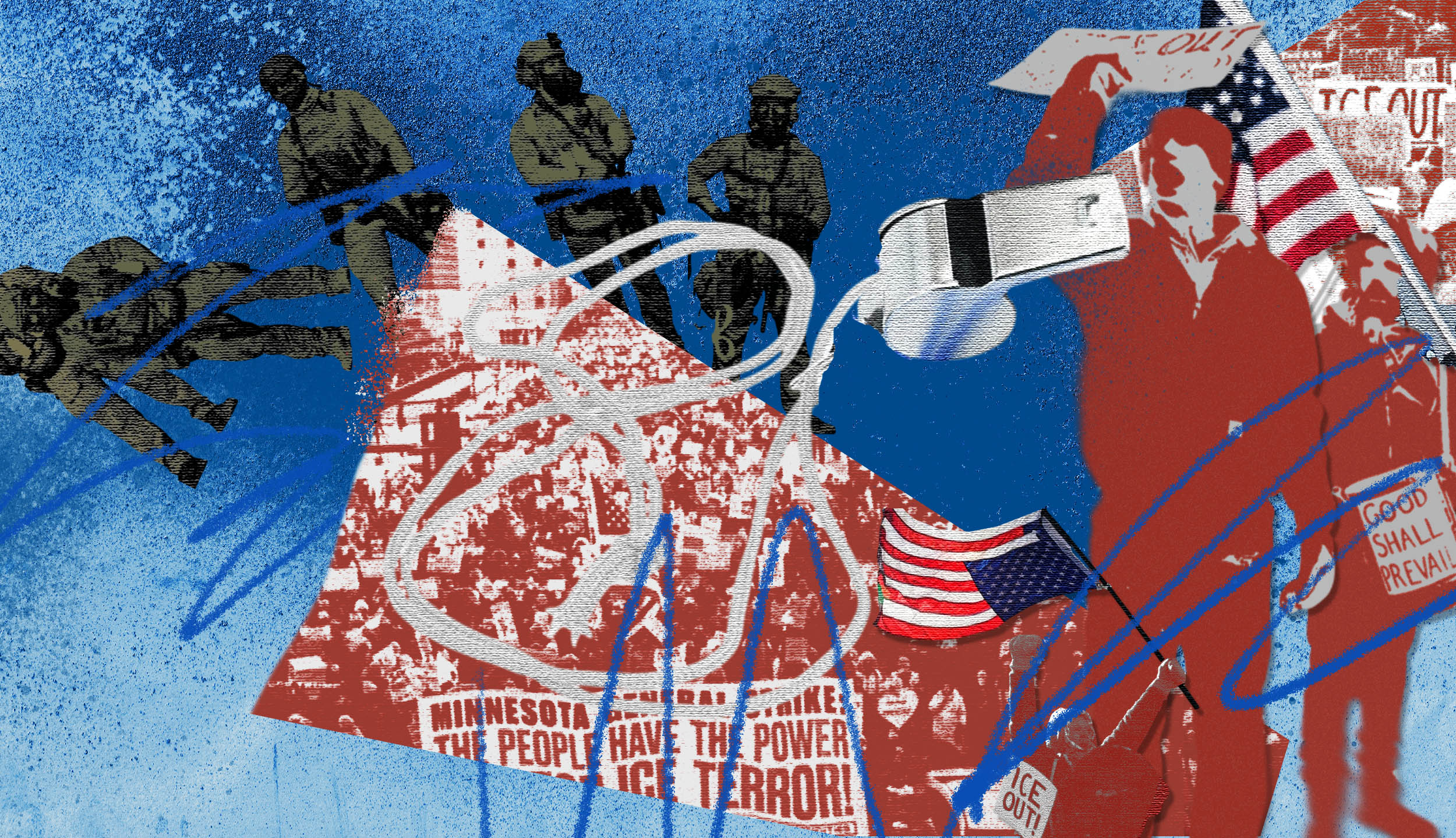
What is the Trump administration using ICE for? What tactics is it employing? And how are American citizens resisting the immigration police? These questions are answered by Suzi Weissman, professor of political science and longtime political commentator.
This article was first published in Maio, a new labor journal in Portuga
Something has shifted in the United States. The Trump administration’s drive to impose mass deportation in service of its ethno-nationalist agenda has run into determined mass resistance in the country’s largest blue cities—from Los Angeles to Chicago to Minneapolis. Federal troops, the National Guard, ICE and Border Patrol agents—and even the Marines in Los Angeles—have been forced back by ordinary people mounting extraordinary opposition. In neighborhoods, workplaces, hospitals, schools, and transit stops, residents have confronted a federal deportation machine and refused to be intimidated. Moral outrage has been transformed into collective disruption on a scale not seen in the United States in decades. And in several cities, at least temporarily, it has forced one of the most aggressive authoritarian administrations in American history to retreat.
The movement taking shape in cities besieged by ICE demonstrates the limits of authoritarian rule in the US. Organized communities, organized labor and democratic institutions can confront and limit authoritarian power, even in an expanding security state.
An Occupation, Not a Policy
To understand what has unfolded in Minneapolis and Los Angeles, one must begin with what Trump has wrought. This is not immigration enforcement in any conventional sense. It is a political war on cities and communities that are democratic strongholds, often led by people of color, and the bonds of solidarity that hold them together.
ICE and Border Patrol ranks have mushroomed, fueled by $50,000 signing bonuses designed to attract recruits who are then quickly trained and deployed. Border Patrol agents sent to Minneapolis—not a border city—are treating protestors like they treat immigrants at the border – meaning they aren’t used to dealing with people who have First Amendment rights. Both forces deploy military weapons and tactics, treating civilian populations as enemy targets.
This is not policing as usual, nor even the familiar pattern of immigrant sweeps. This is the militarization of immigration enforcement and the transformation of federal agencies into a domestic security force.
The enormous expansion of the federal security apparatus—at the very moment when Trump and Musk fired hundreds of thousands of other federal workers—has been described as a form of policing Keynesianism: a jobs program built around repression. More bluntly, it is a recruitment pipeline for the Proud Boys and other far-right militia-type formations.
Yet even as a jobs program, it fails. Unlike Nazi military rearmament, which tied significant sectors of the German population to Hitler’s project through real employment and rising economic expectations, the expansion of the national security state through ICE cannot deliver stability or affordability to working people. It creates no broad base of beneficiaries. Instead, it generates fear, anger, and revulsion. Minneapolis has revealed both the limits of ICE’s coercive power and the political limits of Trump’s deportation project.
The Trump administration deployed over 3,000 ICE and Border Patrol agents to Minneapolis -- more than double the combined police forces of the Twin Cities of Minneapolis and St. Paul -- in what the administration called “Operation Metro Surge.” ICE agents beat and gassed protesters, tailed school buses, dropped tear gas canisters outside hospitals, and raided small businesses. On January 7, 2026, ICE agent Jonathan Ross shot and killed Renée Nicole Good, a poet and mother of three, while she and her wife were legally observing a raid in their neighborhood. “We had whistles,” Good’s wife Rebecca said afterward. “They had guns.” Three weeks later, federal agents executed protestor Alex Pretti on a street corner. The killing, captured from multiple angles, was watched frame by frame by tens of millions of horrified viewers.
Beyond the blood drenched snowbanks, the more mundane aspects of living under an occupation are as stark as the shocking crimes. Labor journalist Luis Feliz León was on the ground in Minneapolis in the days before and after the January 23rd Day of Truth and Freedom. He described what he saw: “porches stacked with tear-gassed coats airing in the winter wind; cats roaming the streets sniffing for the residual scent of abducted owners; children of color carpooling with white neighbors because their parents feared being pulled over; teachers collecting bags of laundry at school drop-off because the children’s parents could not venture out to wash it.” A journey to school had become perilous. Birthdays and quinceañeras were canceled. An entire community had been placed under siege.
The administration’s Deputy Attorney General Todd Blanche complained on Fox News: “In one city we have this outrage and this powder keg happening—it doesn’t happen anywhere else.” He meant it as an insult, but Minneapolis took it as a source of pride.
Deep Roots, Sudden Fire
The uprising that followed did not come from nowhere. This is one of the main arguments made by labor analysts who have studied what happened—and it is the argument that should hold the most significance for readers who seek to draw meaningful lessons rather than simply admire the courage displayed.
Minneapolis, as one organizer aptly put it, has a deep-rooted history of struggle, embedded in the frozen soil of Minnesota. The 1934 Teamsters’ strike, led by Trotskyist militants, stands as a pivotal moment in American industrial unionism. It combined flying pickets, the Women’s Auxiliary, disciplined mass action, and a politics that went beyond the confines of a narrow contract to challenge the character of the city itself. The 2020 uprising in response to the police murder of George Floyd, which took place just blocks from where Renée Good was later killed, built entirely new networks of neighborhood solidarity and trust across racial lines.
In 2022, the Minneapolis Federation of Educators struck not only for wages but for racial justice. Nurses struck. Healthcare workers organized. And for over a decade, a coalition of immigrant rights organizations, unions, faith communities, and worker centers had been building what the organizers consciously called not a coalition but an alignment—something deeper, where organizations are “underneath each other’s hoods,” deeply invested in each other’s organizational bases growing stronger.
Emilia González Avalos, executive director of Unidos, describes the trajectory: from being considered a “specialty group” peripheral to the progressive coalition, her organization spent years building power through electoral infrastructure, constituency development, and the passage of the “Minnesota Miracle” legislative agenda in 2023—drivers’ licenses for undocumented residents, paid sick leave, expanded healthcare, and more. By the time ICE arrived in force, the groundwork had already been laid for something much larger than any single organization could produce. The ICE surge provided the spark. Decades of organizing provided the fuel.
The Day of Truth and Freedom
On January 23, 2026, amidst temperatures of -20°F with wind chill plunging to -50°F, between 75,000 and 100,000 people poured into downtown Minneapolis in the middle of a workday. Schools, cultural institutions, and over a thousand small businesses closed. Over 80 percent of Communication Workers of America (CWA) Local 7250’s members were absent from work. Uber and Lyft drivers, almost entirely immigrant workers of color, wept when they heard that one hundred clergy had been arrested at the Minneapolis airport. They were demanding that Delta, Target, 3M, and General Mills take a public stand against the federal occupation of their city. A poll conducted afterward found that roughly a million Minnesotans, which is a quarter of the state’s population, had participated in some form that day, in an action called with barely two weeks’ notice. The action was joined by cities and towns across the country.
Was it a general strike? The question is less important than the significance of the day. Rosa Luxemburg, in her analysis of the 1905 Russian mass strike, argued that the general strike is not a single event but a process—a dynamic interplay between economic and political struggle, spontaneous eruption and organized response, individual courage and collective consciousness. Minneapolis exemplified this precisely: the moment when a community stops being an aggregate of isolated individuals and becomes, if briefly, a self-conscious collective actor.
Kieran Knutson, president of the CWA Local 7250 and one of the key architects of the labor response, acknowledges both the achievement and its limits. The large corporations continued to operate. The January 23rd action was a political mass strike, not a general strike in the classical sense. But something qualitatively new had happened. Workers who marched on their boss ahead of the day of action and demanded the business close down returned the next day with further demands: that ICE be barred from the premises permanently. “That’s the level of confidence we’re seeing,” said León. A newly self-confident working-class had, for the first time in a very long time, seized a major American city.
Eric Blanc, in a rigorous assessment of the Minneapolis moment, identifies three necessary ingredients for a genuine general strike: momentum, organization, and militant risk-tolerant leadership. Minneapolis had all three in unusual measure. But Blanc’s sobering point is that the movement’s Achilles heel lies in the private sector, where union density is just 6 percent nationally. Workers at companies like Target, Amazon, and Home Depot, whose employers are directly complicit with ICE, have the most structural leverage and the least organizational protection.
One of the most important tactical innovations in Minneapolis was what González Avalos calls the “constitutional observer on-ramp.” Unidos trained 30,000 Minnesotans to legally observe and document ICE raids. The act seemed modest, even passive: people filming, bearing witness. But standing face to face with seven armed federal agents arresting a father taking his children to school changed people. “It changes people,” González Avalos said simply. Those 30,000 observers became the base for deeper organizing, recruited not by ideology but by witnessing cruelty and deciding they would not look away.
Los Angeles: The Blueprint
Before Minneapolis, there was Los Angeles—and the story of Los Angeles holds a special significance for me, as someone who lives and works there.
Trump hates Los Angeles: a majority-Black and Brown city that overwhelmingly votes Democratic, nearly 35 percent immigrant, a strong union town, and a proud sanctuary city. Between June and July 2025, he deployed 4,800 National Guard troops and 700 Marines into the city, explicitly intending to crush the resistance, serve as an example, and foment violence. What he got instead was the template for his defeat.
The resistance intensified when the troops arrived. The governor, mayor, both US senators, the California legislative supermajority, and the county supervisors all united in opposition, giving the resistance political cover and mainstream legitimacy. But Homeland Security Secretary Kristi Noem declared she was going to “liberate Los Angeles from its socialist mayor and governor”—apparently unaware she had no authority to remove elected officials from office.
The turning point came on June 6, when SEIU California president David Huerta was beaten and arrested while documenting an ICE raid downtown. From his hospital bed, Huerta framed what was happening not as an incident but as a movement: “This is about how we as a community stand together and resist the injustice that’s happening.” The LA County Federation of Labor—one of the largest in the country—mobilized immediately. Unions organized rallies and immigrant defense actions across the city.
What emerged was a broad anti-fascist front: unions and worker centers including the Pilipino Workers Center, the Korean Immigrant Workers Alliance, and CHIRLA, the Coalition for Humane Immigrant Rights of Los Angeles; faith communities including the Catholic Diocese and Holman United Methodist, the largest Black church in the city; legal organizations including the ACLU and MALDEF; artists and musicians; and—crucially—the business community. The LA Chamber of Commerce and Business Council both spoke out, not out of solidarity but because the raids were devastating the city’s economy. Construction companies, restaurants, hotels, car washes and garment factories all lost revenue as immigrant workers stayed home and immigrant customers stayed away.
A federal judge ruled that the troop deployment violated the Posse Comitatus Act, which prohibits the military’s involvement in domestic law enforcement.
Trump eventually pulled his forces out, claiming implausibly that he had “saved the city from burning down.” The sound that followed was, as organizer Bill Gallegos noted, millions of Angelenos laughing at the absurdity of the claim. A broad, disciplined, multi-sectoral front had forced the retreat.
The Los Angeles lesson is not identical to Minneapolis—the organizational infrastructure, the political culture, and the trigger events are different. But the core logic is the same: build off your organizational foundation; unite all who can be united; maintain a clear and consistent demand; and don’t give them the violence they crave.
What This Is, and What It Could Become
Between Los Angeles and Minneapolis came Chicago—where ICE was brutal, but resistance equally fierce. Chicago’s contribution to the arsenal of popular struggle was practical and elegant: the mass distribution of whistles so that communities could alert neighbors the moment ICE appeared on their streets. The whistle brigades spread to Minneapolis and beyond, becoming a near-universal tool of the resistance, a small but perfect illustration of how people appropriated forms of self-organization and defense, passing the experience of each city from one to the next.
Luis Feliz León invokes Rosa Luxemburg’s concept of the mass strike to describe what was happening: not a single scheduled event but a process of mutual radicalization between outrage and organization, between the spontaneous action of ordinary people and the institutional scaffolding that gives it direction and durability. The general strike, wrote Luxemburg, is the “living pulse-beat of the revolution”—it cannot be decreed, only prepared for and seized.
This process is underway in the United States in ways that would have been almost unimaginable five years ago. The organizational infrastructure—years of coalition-building, leadership development, workers' assemblies, mutual aid networks, constitutional observer trainings—was already there. The spark of ICE’s violence ignited it. And in the burning, something new was created: a working-class self-confidence and a new sense of collective possibility that does not disappear when the immediate crisis recedes.
The story is ongoing. Trump has pulled back on some of the most aggressive tactics—they proved wildly unpopular, damaged his approval ratings and enraged even Republicans, furious that the Trump-Miller approach has damaged their signature political issue, demonizing immigrants. For decades “illegal immigration” was wielded as a cudgel to mobilize fear while its real economic function – creating a super-exploited immigrant workforce without rights to undercut wages -- went unremarked. Now the violence is visible, the victims are sympathetic, and the politics are corrosive.
ICE has retreated but continues its deportation mission with more targeted force. The resistance has responded with new energy. No Kings rallies have grown massive; in Los Angeles community members patrol Home Depot parking lots looking out for their hard-working neighbors, because “silence is violence.”
A graphic designer in a LA neighborhood described what many first-time protestors are experiencing: “I find it’s like a gateway drug—because even people who have never done anything activist in their life eventually find themselves at a protest, buoyed by community, purpose, and the love of democracy.” Another activist put it simply: “Minneapolis is the model. When two innocent people were killed protesting ICE raids, the community came together and rose in protest, forcing a retreat of Trump’s forces. Minneapolis pushed back with humanity – and that’s the future we want to build.”
Kieran Knutson is now convening Workers’ Assemblies in Minneapolis—new democratic bodies bringing together union and non-union workers, neighborhood groups, and community organizations to make collective decisions about next steps. These are not standing committees of the existing labor movement. They are something new: directly democratic forms of self-organization aimed at holding onto the power generated by the mass-strike moment, rather than ceding it back to those with different interests and different agendas, including the Democratic officials who condemned ICE publicly while cooperating with it privately.
The immediate horizon is May Day 2026, a national day of No Work, No School, No Shopping. The longer term sees strikes being organized for 2028, as unions align contract expirations to maximize leverage across manufacturing, logistics, education, and grocery sectors.
Neither of these dates is a guarantee. But what is already real is this: tens of thousands of ordinary Americans have looked federal agents in the eye, blown their whistles, stood their ground, and refused to leave.
As Boris Kagarlitsky wrote from inside a Russian prison colony, in a very different context but with a spirit that resonates here: “We are not victims. We are fighters.”
The movement in Minneapolis, Chicago and Los Angeles is telling us something that left movements worldwide should heed. Resistance alone is not enough—but it is the foundation for all other actions. When people organize, stand firm, and refuse to be drawn into the violence the state provokes, even a president bent on repression can be pushed back.
And in the process, people are changed. New leaders emerge. New forms of organization take root. New horizons become imaginable.
That is what a mass strike does. It does not just win demands. It remakes the people who make it.

Мы намерены продолжать работу, но без вас нам не справиться
Ваша поддержка — это поддержка голосов против преступной войны, развязанной Россией в Украине. Это солидарность с теми, чей труд и политическая судьба нуждаются в огласке, а деятельность — в соратниках. Это выбор социальной и демократической альтернативы поверх государственных границ. И конечно, это помощь конкретным людям, которые работают над нашими материалами и нашей платформой.
Поддерживать нас не опасно. Мы следим за тем, как меняются практики передачи данных и законы, регулирующие финансовые операции. Мы полагаемся на легальные способы, которыми пользуются наши товарищи и коллеги по всему миру, включая Россию, Украину и республику Беларусь.
Мы рассчитываем на вашу поддержку!


To continue our work, we need your help!
Supporting Posle means supporting the voices against the criminal war unleashed by Russia in Ukraine. It is a way to express solidarity with people struggling against censorship, political repression, and social injustice. These activists, journalists, and writers, all those who oppose the criminal Putin’s regime, need new comrades in arms. Supporting us means opting for a social and democratic alternative beyond state borders. Naturally, it also means helping us prepare materials and maintain our online platform.
Donating to Posle is safe. We monitor changes in data transfer practices and Russian financial regulations. We use the same legal methods to transfer money as our comrades and colleagues worldwide, including Russia, Ukraine and Belarus.
We count on your support!
другие тексты


другие подкасты


Политический дневник #49: В ожидании наступления, скандалы в оппозиции, турецкие выборы

Политический дневник #52: После Пригожина, национализм как мазохизм, горящая планета

«Это Базис». Как нас подводит здравый смысл и что об этом говорил Грамши
SUBSCRIBE
TO POSLE
Get our content first, stay in touch in case we are blocked

Еженедельная рассылка "После"
Получайте наши материалы первыми, оставайтесь на связи на случай блокировки


.svg)

