

НАСТОЯЩИЙ МАТЕРИАЛ (ИНФОРМАЦИЯ) ПРОИЗВЕДЕН, РАСПРОСТРАНЕН И (ИЛИ) НАПРАВЛЕН ИНОСТРАННЫМ АГЕНТОМ ПРОЕКТОМ “ПОСЛЕ”, ЛИБО КАСАЕТСЯ ДЕЯТЕЛЬНОСТИ ИНОСТРАННОГО АГЕНТА ПРОЕКТА “ПОСЛЕ” 18+
Healthcare in Wartime: How Women’s Labor Is Changing
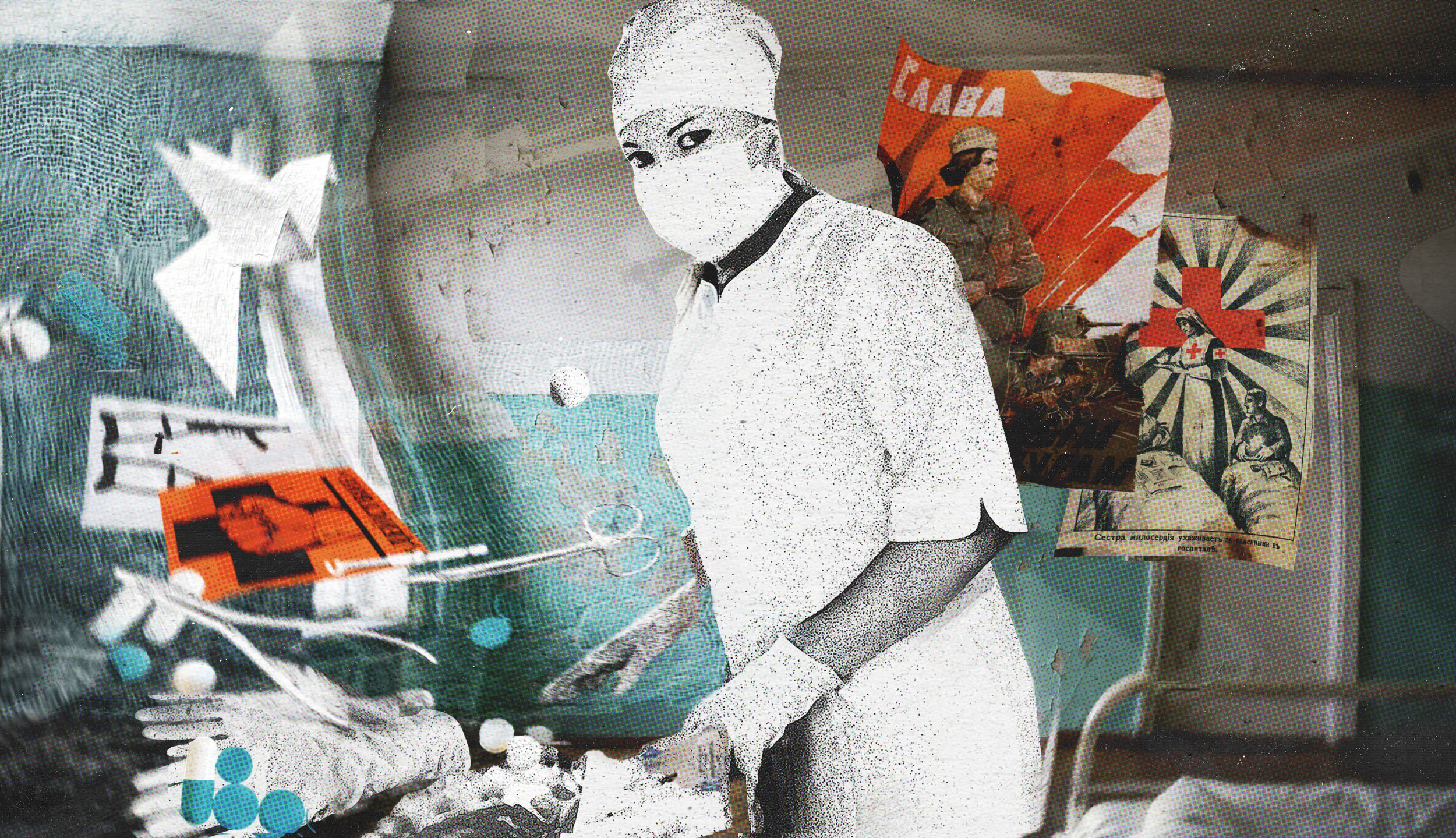
How has the situation with labor rights in healthcare changed since February 2022? Why is the state closing hospitals and cutting medical staff as the war enters its fifth year? Why does Russian propaganda so often glorify the image of the brave female nurse? And why does healthcare remain one of the most protest-prone sectors in contemporary Russia? Sasha Fokina, femactivist and political analyst, explores these questions
Beyond weapons and the defense industry, war also relies on the constant replenishment of human resources. For years, the Defense Ministry has struggled with a persistent shortage of frontline soldiers. Meanwhile, labor deficits in the defense industry, transportation, energy, and other sectors essential to sustaining the war economy are forcing the Kremlin to exploit migrant labor from new regions.
In this context, healthcare becomes an extension of the wartime infrastructure essential to sustaining both the military and the economy. At first glance, this should incentivize the state to strengthen the medical system by improving working conditions and increasing funding across the sector. Yet the logic of militarization demands the continuous reallocation of material and human resources toward the armed forces and the defense industry, thereby compounding the longstanding crises of Russian healthcare. Rather than reinforcing the system, the state seeks to extract maximum output at minimal cost. Underfunding, severe staff shortages, mounting workloads, and deteriorating labor conditions are no longer just collateral damage of the war. By the fifth year of the full-scale invasion, they have become the structural mechanism for governing the healthcare system itself.
These processes are particularly pronounced for women, as healthcare remains one of the most highly feminized sectors in Russia. According to official data, women account for 70% of doctors and 95% of nursing staff nationwide. The state continues to rely heavily on their labor while expecting them to absorb the consequences of budget cuts, understaffing, and the skyrocketing demand for medical care. Ultimately, women in healthcare are bearing the direct social and economic costs of societal militarization.
How the War Has Exacerbated the Longstanding Socioeconomic Problems of Russian Healthcare
Since 2010, Russian healthcare has been shaped by a policy of ‘optimization’ — a bureaucratic euphemism used by authorities to mask the closure and consolidation of medical facilities, particularly in small towns and rural areas, alongside sweeping layoffs. This policy has severely undermined access to medical care nationwide, with hospital bed capacity declining by an average of 20,000 per year, including an additional 5.4% reduction between 2020 and 2024. Authorities routinely justify these measures by citing low occupancy rates, despite widespread outrage among both medical staff and patients.
The war has also triggered a severe decline in medical supplies. Polina, a maxillofacial surgeon interviewed by Posle Media (whose name was changed for security reasons), noted that medication shortages at her hospital became particularly acute between 2022 and 2024. As she recalls, staff were told bluntly: “You know where the medications are going.” Another Posle Media source, a surgeon named Mariya, reported that the supply crisis became apparent immediately after the full-scale invasion of Ukraine. Her workplace faced an overnight deficit of high-quality medical consumables, many of which had previously been imported from Western countries. “The substitutes at our disposal are noticeably inferior; this applies even to basic items like venous catheters,” she said.
Amid years of war and the authorities’ aggressive campaign to boost the birth rate, the optimization policy has taken a particularly heavy toll on maternity hospitals and obstetric departments nationwide, especially in small towns and rural areas. Closures are typically blamed on low annual delivery numbers or local authorities’ lack of funding for repairs, equipment, and staff salaries. As a result, pregnant women in regions such as Kemerovo, Sverdlovsk, Tula, Novosibirsk, and Kurgan, as well as the Moscow region, are forced to travel to the nearest remaining facilities, with extreme cases requiring travel of hundreds or thousands of kilometers for basic care.
Following the elimination of ‘excess’ hospital beds, staff positions are also being cut. Labor unions, in particular, point to particularly painful cuts at ambulance stations. Even remaining positions face wage reductions, despite pay levels in the regions already being shockingly low compared to Moscow and other major cities. For example, a group of ambulance workers in the Sverdlovsk Region reported monthly salaries ranging from just 12,000 to 28,000 rubles. Similarly, the medical staff at Glazov Interdistrict Hospital in the Udmurt Republic collectively receive a mere 12,000 rubles for attending a birth — an amount split among doctors, midwives, nurses, and orderlies, with the hospital administration pocketing the largest portion. According to the medical professionals, “Under the childbirth certificate system, a doctor receives 270 rubles for a natural delivery; for a surgical delivery, the surgeon gets 320 rubles, and the assistant receives 150 rubles.” These abysmal wages perpetuate a troubling practice where expectant mothers make unofficial, out-of-pocket payments to midwives and doctors in advance. While framed as a matter of personal choice, these bribes actually function to mitigate the risk of obstetric violence and secure basic medical care when women are at their most vulnerable.
An anonymous expert from the labor mutual-aid project Antijob, speaking to Posle, confirmed that the situation is equally critical for pediatricians. According to the source, pediatricians “receive poverty-level wages — for example, just 35,000 rubles for two full-time positions — while seeing four to six times the standard number of patients.” The expert noted that since 2024, pediatricians have increasingly reported deteriorating working conditions: “Their workload has surged dramatically without any corresponding pay raise. They are forced to extend consultation hours to squeeze in roughly 40 patients per shift. Restroom and lunch breaks have become virtually impossible, as the time allotted for each appointment has been slashed to just 10 minutes. Hospital administrators justify these grueling schedule adjustments as necessary to ‘improve access to care.’”
Already strained by meager wages, working conditions became even more challenging after the outbreak of the war, particularly regarding interactions with patients. All of Posle’s sources described a systemic pattern of their labor being routinely devalued. Polina, the maxillofacial surgeon, explained that the war fundamentally shifted her hospital’s patient demographics after a specialized ward was opened for combat casualties. “Let me outline the specific circumstances surrounding these patients,” Polina said. “Given their supposedly heroic status and difficult lives, they are permitted to drink alcohol regularly while undergoing hospital treatment. In fact, this behavior is actively encouraged by the administration.”
The safety risks women face under these conditions are rarely taken into account. One Posle interviewee shared that she feels increasingly unsafe treating patients under the influence of alcohol or struggling with substance abuse. She explained, “I am not a military doctor; I am a civilian physician and a woman. I never signed up for these kinds of working conditions, and I honestly never thought I would have to deal with anything like this in my career. Maybe it’s naive of me, but I should be able to feel safe at work — yet I see the hospital administration doing less and less to guarantee that.”
These concerns are echoed in the Health Ministry’s guidelines on communication between medical staff and veterans of the war in Ukraine. The guidelines advise workers to bear in mind that minor triggers, such as waiting for an appointment or having a request denied, can spark a violent or aggressive reaction. This approach leaves medical workers isolated; instead of treating post-traumatic stress disorder (PTSD) among returning soldiers as a systemic consequence of military service requiring institutional solutions, the state effectively tasks frontline doctors and nurses with managing the fallout on the ground.
Speaking to Posle, an expert from Na Ravnykh, an initiative providing support in labor disputes, summarized the crisis: “On one hand, the sector’s longstanding problems persist: understaffing, low base salaries, unpaid overtime, dependence on opaque performance-based bonuses, and a steady expansion of responsibilities without a corresponding increase in personnel. On the other hand, the war and mobilization have introduced severe new pressures: surging workloads at individual facilities, expanded military-registration duties, a brain drain of specialists, and even greater opacity in management decisions.”
Because healthcare remains a predominantly female workforce, these conditions carry a distinct gender dimension. The expert emphasized that unpaid domestic labor — including childcare and caregiving for other family members — still falls disproportionately on women. “Consequently, irregular schedules, night shifts, sudden substitutions, and being called in on short notice take an especially heavy toll on them.” She pointed out that while the Russian Federation’s Labor Code formally protects pregnant women, parents of young children, and workers with family responsibilities, reality tells a different story. “In practice, attempting to exercise these rights frequently invites managerial backlash, slashed performance bonuses, or a deterioration in workplace relations with superiors.”
Recruiting the Next Generation
Low wages and harsh working conditions have long deterred young professionals from entering the healthcare sector. According to Health Ministry estimates, in 2026, one-third of graduates from medical universities and colleges will not pursue careers in healthcare, a figure amounting to tens of thousands of specialists. Moreover, more than half of medical students say they do not plan to work in state-run clinics. According to the newspaper Izvestiya, Russia’s healthcare system is expected to have a shortage of approximately 23,000 doctors and over 63,000 paramedical professionals by 2026.
The authorities are acutely aware of the healthcare staffing crisis, leading to a November 2025 State Duma law that mandates service requirements for medical school graduates. This measure, which opponents have likened to modern-day serfdom, sparked an immediate backlash within the medical community, with Deystviye trade union co-chair Andrey Konovalov stating the state has “effectively admitted that it was unable to solve the staffing crisis through other means — namely, by genuinely improving working conditions and making medical professions more attractive.”
In a comment to Posle, human rights lawyer Yevgeniy Stupin described the measure as the most significant policy shift affecting medical workers since the outbreak of the war. An Antijob expert emphasized that graduates will lose all agency over their placements: “Young medical professionals will be funneled into the most troubled facilities, where staffing deficits are most severe — shortages that exist precisely because of low wages and abysmal working conditions.” Critics also warn that this mandate will trigger a new wave of systemic crises, including inadequate compensation for supervising physicians, worsening personnel deficits, and an overwhelming burden of responsibility for those overseeing newly qualified doctors.
Beyond mandatory service, the state is pursuing other avenues to ‘support’ young medical professionals — coercively or otherwise. Starting in 2026, medical universities began actively recruiting doctors and residents to serve in the war in Ukraine. Those who sign military contracts are promised lucrative incentives: monthly salaries ranging from 200,000 to 300,000 rubles, one-time payments worth millions of rubles, federal benefits, preferential mortgages, and even the cancellation of loan debts. The medical outlet Medvestnik discovered over a dozen recruitment advertisements published within a single week on a Russian job-listing platform, targeting individuals both with and without formal medical training for contract service in the combat zone. According to the publication, recruiters were operating out of major hubs, including Moscow, St. Petersburg, Kovrov, Yekaterinburg, Ufa, Samara, Rostov-on-Don, and Ivanovo.
“We Will Definitely Win. Because We Are Victors”: Women in Healthcare and Propaganda
The deployment of medical workers to the front lines has become a cornerstone of the official narrative of national unity in the face of an external threat. Propaganda portrays “thousands of Russian women” serving in the “special military operation zone” as having chosen “a path where steely determination and feminine fragility are two sides of the same coin.” The dichotomy of fulfilling a role on the front lines that is vital to the state, combined with the supposedly traditionally feminine character traits of female medical workers, is a constant source of fascination for Russian propaganda. For example, media outlets frequently quote Warrant Officer Angelina Manova, a four-time decorated wartime medic, who states: “My boys out there on the front line are heroes. And I must bring them back. Sometimes I need to support, comfort, or reassure them — that’s where a woman’s strength at the front lies.” Ultimately, female healthcare workers are instrumentalized to manufacture a myth of absolute, universal support for the war in Ukraine — proving that even society’s most inherently nurturing, gentle, and compassionate members back the invasion.
The first woman to receive the Hero of Russia title since the beginning of the war was Corporal Lyudmila Bolilaya. State media described her as a ‘delicately built female nurse’ serving with a motorized rifle unit who saved the life of a wounded soldier by shielding him with her own body and taking the full force of the blast. Russian media reports also emphasize that, after recovering from her injuries, Bolilaya returned home to raise her son, Vanya, in peacetime. Yet, she is unlikely to forget her experiences on the front lines:
“Today, when she walks past memorials to the Great Patriotic War, tears well up in her eyes. She says she feels as though she has joined the ranks of those who defended the Motherland before her. ‘I did what I had to do. We are bound to win. We won’t let them get any further… Because we are victors.”
Aydysmaa Mongush, a female military medic, is another figure whose story has become firmly embedded in the pantheon of Russian wartime propaganda — with a feature film about her already in production. She is from Tuva, the region with the lowest standard of living in Russia, where nearly 20% of the population lives below the poverty line. According to Russian media reports, in 2023 Mongush went to the combat zone to join her husband, who was serving with another unit. In September 2024, he was killed in a shelling attack, and Mongush evacuated his body herself. When presenting her with a state award, President Vladimir Putin urged Mongush not to return to the front line, telling her she needed to ‘raise the children’ — a reference to her three children who had just lost their father.
The Most Protest-Prone Sector in Russia?
The notion that healthcare workers serve as a pillar of social support for Kremlin policies, particularly the invasion of Ukraine, is pure wishful thinking. In reality, healthcare remains one of the most protest-prone sectors in Russian society. Speaking to Posle, an expert from Na Ravnykh challenged the state’s narrative by citing data from the Center for Monitoring and Analysis of Social and Labor Conflicts at the St. Petersburg University of the Humanities and Social Sciences. The Center’s data shows that labor unrest peaked in 2024, with 105 social and labor conflicts recorded in healthcare, accounting for a staggering 62% of all documented disputes that year. As of 2026, healthcare remains one of Russia’s top three most conflict-prone sectors, even though its share of overall disputes has dipped to 22%, ranking alongside manufacturing (23%) and construction (19%). The expert attributes this statistical decline to a broader shift in labor dynamics: friction has intensified in manufacturing, construction, transportation, and extractive industries due to the growing structural imbalances of the war economy. These include the massive reallocation of budgetary resources, severe manpower deficits, accelerated production lines, heavy reliance on government contracts, and highly uneven wage hikes and workloads across industries. Consequently, the systemic crises within healthcare have not dissipated; they are simply being overshadowed by the macro-level volatility of other sectors.
However, formal strikes are rarely utilized as a tool of resistance in this sector. Given the legal and organizational hurdles involved, coupled with a deep sense of professional duty toward patients, collective action usually manifests as petitions, complaints, open letters, work-to-rule actions (such as refusing extra shifts), or mass resignations. For example, in January 2026, the staff of the intensive care and resuscitation unit at Kursk City Hospital No. 6 recorded a video appeal to regional Health Minister Svetlana Yermolova. They demanded an investigation into their meager wages, the hospital’s deteriorating conditions, and what they described as unlawful demands from management. Shockingly, the video featured footage of black body bags containing deceased patients. The workers revealed that because the hospital lacked a morgue, bodies were frequently left in the corridors for hours, emitting a foul odor and distressing living patients. The appeal went viral and sparked widespread public outrage. Just five days after the regional governor publicly condemned the crisis, the hospital finally designated a proper facility for body storage.
The Antijob expert identified several key drivers behind the persistent labor unrest in Russian healthcare. Chief among them is a strong professional solidarity rooted in the nature of medical labor itself, defined by “the deep interdependence among colleagues and industry-specific struggles that only fellow medical workers can truly grasp.” The source emphasized that healthcare routinely demands navigation of shared high-stress, life-or-death situations, naturally forging tight-knit communities.
In this respect, Russian healthcare is no exception to global trends. Decades of international organizational research demonstrate that hospitals are fundamentally cooperative institutions. Through informal coordination and highly interdependent daily operations, healthcare workers develop resilient social bonds. Ultimately, these professional networks build the necessary social infrastructure to launch organized resistance and collective action — including formal labor strikes.
Another distinctive feature of healthcare, according to the Antijob representative, is that medical workers cannot improve their situation by simply changing employers. “In other professions, the differences between employers can be vast,” the source noted. “In healthcare, however, the state-run public sector dominates, and the same systemic crises plague every facility. This is especially true in smaller towns and rural settlements, where private clinics are entirely nonexistent. Consequently, while medical workers might initially feel that ‘there’s no point in fighting,’ they are actually more likely to engage in collective action because they have no other viable alternatives.”
The potential for protest ultimately hinges on the presence of an organizing force — most notably, independent trade unions. Recent media reports of successful medical worker protests frequently highlight the Deystviye (Action) trade union, which was founded in 2013 specifically to combat the devastating fallout of the state’s ‘optimization’ policies. A prime example occurred at the Borzya Central District Hospital in Zabaykalsky Krai, where surgical nurses successfully pressured hospital management to improve their working conditions. Backed by Deystviye’s legal team, the nurses successfully negotiated substantial monthly hazard bonuses and forced a formal review of staffing quotas, ultimately compelling the hospital to create new, full-time positions to ease the workload.
Extensive media coverage of egregious decisions by hospital administrators demonstrates that public pressure can sometimes influence the outcome of labor disputes, as the Antijob representative told Posle Media. Yet, the source characterized the gains won by healthcare workers as modest, noting, “Essentially, these are all rearguard actions. Then again, workers in other sectors don’t have major victories to boast about either. While Deystviye frequently wins court cases and restores a semblance of justice, it remains a drop in the ocean.” The expert stressed that systemic crises demand systemic solutions enacted at the level of state policy rather than within individual healthcare facilities. As long as the Kremlin enforces its optimization agenda, meaningful reform will remain out of reach. As the source concluded, “Russia is still a very long way from that.”
As in other spheres of Russian society, emigration has emerged as an alternative form of dissent for those within the medical community who have the means to leave. While the precise scale of politically motivated emigration among healthcare workers since the outbreak of the war remains difficult to quantify, the barriers are undeniably high. Expatriating requires overcoming steep structural challenges, including validating medical credentials abroad, mastering a new language, and rebuilding professional networks from scratch. Yet for many medical professionals, the urgent need to evade military conscription has provided more than enough motivation to flee the country.
However, exiled medical professionals also report significant improvements in the standard aspects of their professional lives. Mariya, a surgeon who fled Russia in late 2022 — first to Armenia and later to Germany — told Posle Media that “doctors don’t leave just for higher salaries, as is commonly assumed, but for vastly superior working conditions. Hospitals are better equipped, patients receive higher-quality care because facilities are properly staffed with nurses, and medical professionals are treated with genuine respect. You’re no longer being hassled over trivial matters, and professional liability insurance is available. You can make a living from a single full-time job without having to take on additional workload.” Mariya added that “many simply want to live in a freer, more democratic society, and the demand for doctors that exists in almost every country makes emigration easier.”
A Resource for Sustaining the War Machine
Ultimately, the war has not fundamentally altered the model of exploitation plaguing Russian healthcare workers; rather, it has intensified it. The sector continues to grapple with chronic funding and personnel deficits, stagnant wages, crushing workloads, and aggressive workforce downsizing. The critical shift lies in how the labor, professionalism, and resilience of medical workers are now being weaponized to sustain the state’s war machine. Authorities continuously demand greater sacrifices from frontline personnel while systematically stripping away their professional autonomy.
Women in healthcare bear the brunt of this crisis, forced to compensate for the catastrophic fallout of Kremlin policies with their own time, labor, and physical and emotional exhaustion. Meanwhile, state propaganda deftly recasts this institutional exploitation as heroic sacrifice, framing women’s caregiving as a natural, duty-bound, and voluntary contribution to the war effort.
However, the image of medical workers as submissive and loyal to the regime is rather unrealistic. The same conditions that make healthcare vulnerable to exploitation also lay the groundwork for collective resistance. Workers’ interdependence, shared professional experience, and limited ability to leave the sector transform workplace solidarity into a source of collective power. Although petitions, collective actions, and trade union efforts may have only a limited impact in Russia’s authoritarian system, they highlight an important distinction: fulfilling one’s professional duties does not imply consenting to exploitation, degrading conditions, or danger. Ultimately, the forced militarization of healthcare does not automatically translate into support for the war.

Мы намерены продолжать работу, но без вас нам не справиться
Ваша поддержка — это поддержка голосов против преступной войны, развязанной Россией в Украине. Это солидарность с теми, чей труд и политическая судьба нуждаются в огласке, а деятельность — в соратниках. Это выбор социальной и демократической альтернативы поверх государственных границ. И конечно, это помощь конкретным людям, которые работают над нашими материалами и нашей платформой.
Поддерживать нас не опасно. Мы следим за тем, как меняются практики передачи данных и законы, регулирующие финансовые операции. Мы полагаемся на легальные способы, которыми пользуются наши товарищи и коллеги по всему миру, включая Россию, Украину и республику Беларусь.
Мы рассчитываем на вашу поддержку!


To continue our work, we need your help!
Supporting Posle means supporting the voices against the criminal war unleashed by Russia in Ukraine. It is a way to express solidarity with people struggling against censorship, political repression, and social injustice. These activists, journalists, and writers, all those who oppose the criminal Putin’s regime, need new comrades in arms. Supporting us means opting for a social and democratic alternative beyond state borders. Naturally, it also means helping us prepare materials and maintain our online platform.
Donating to Posle is safe. We monitor changes in data transfer practices and Russian financial regulations. We use the same legal methods to transfer money as our comrades and colleagues worldwide, including Russia, Ukraine and Belarus.
We count on your support!


другие подкасты


Политический дневник #50: Россия и соседи, загадка персональных санкций, коррупция и сущность российской элиты

«Это базис»: Сначала институты, потом политика? Необходимость и достаточность институциональных реформ для России

«Это базис». Почему леваки не ходят голыми?
SUBSCRIBE
TO POSLE
Get our content first, stay in touch in case we are blocked

Еженедельная рассылка "После"
Получайте наши материалы первыми, оставайтесь на связи на случай блокировки


.svg)

