

НАСТОЯЩИЙ МАТЕРИАЛ (ИНФОРМАЦИЯ) ПРОИЗВЕДЕН, РАСПРОСТРАНЕН И (ИЛИ) НАПРАВЛЕН ИНОСТРАННЫМ АГЕНТОМ ПРОЕКТОМ “ПОСЛЕ”, ЛИБО КАСАЕТСЯ ДЕЯТЕЛЬНОСТИ ИНОСТРАННОГО АГЕНТА ПРОЕКТА “ПОСЛЕ” 18+
“Russia’s Aggression against Ukraine Demonstrates How Dangerous Historical Amnesia Can Be”
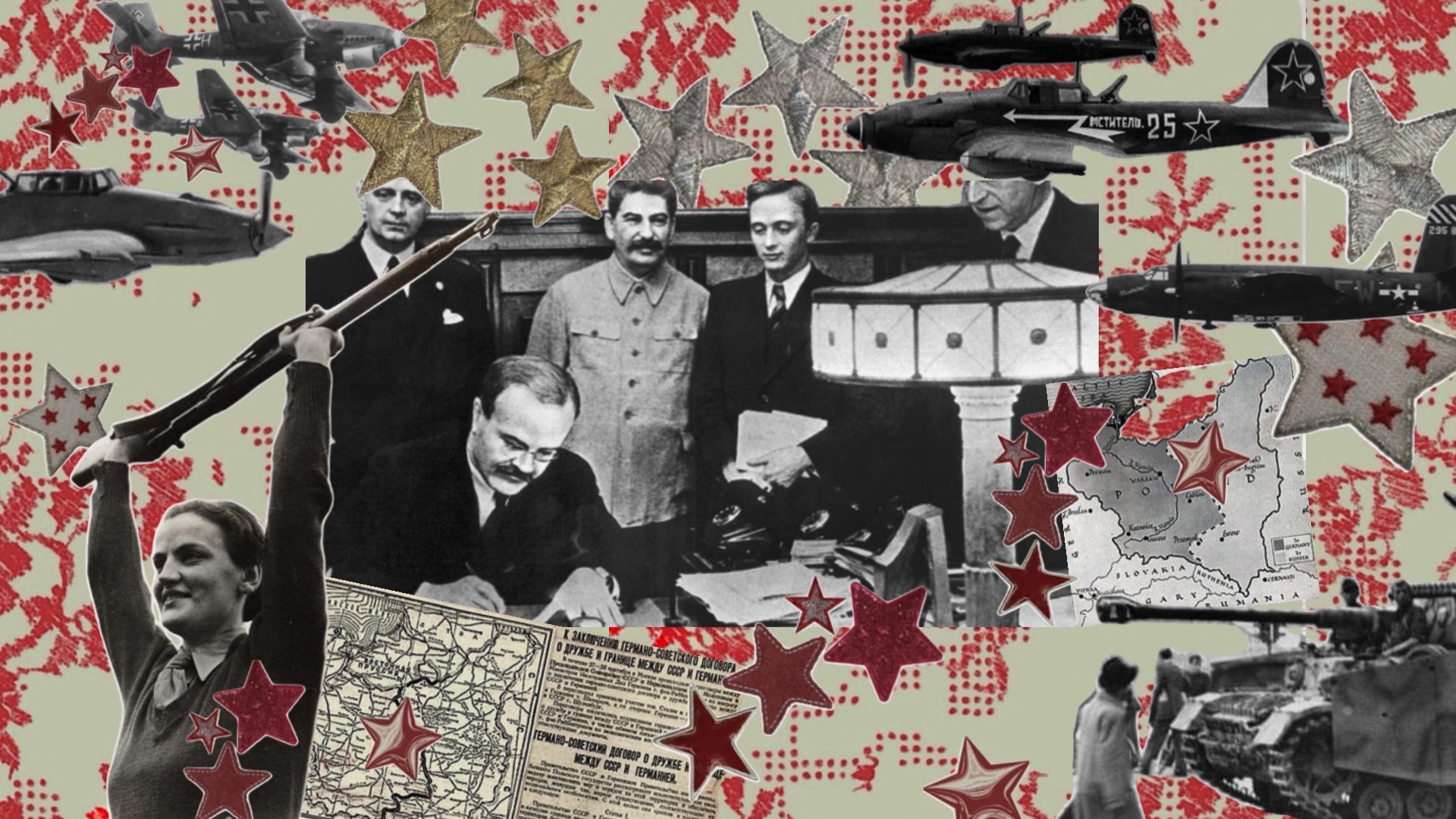
Why was the Molotov-Ribbentrop Pact signed? What was its impact on Ukraine? How is this deal debated in modern-day Germany? Historian Bernhard H. Bayerlein, author of the book "The traitor, Stalin, is you!", shares his findings
— What led you to your research on the Pact?
— In my work I seek to combine different things — archival research, public history and contemporary political relevance for Europe. My starting points were the history of international communism and socialism as well as the European exile and resistance networks of the 1930s. What struck me was that the Hitler-Stalin Pact has often featured in Western memory as an isolated diplomatic event, even though its contemporaries experienced it as a political and moral earthquake [editor’s note: the Ribbentrop-Molotov Pact was a 1939 non-aggression treaty signed by Nazi Germany and the Soviet Union that secretly divided Eastern Europe into mutual spheres of influence]. More striking, when one examines the history of propaganda and public perceptions, one discovers that the Pact became the centerpiece of what perhaps was the greatest web of lies in the 20th century. The more intensely I was able to work with the once inaccessible and highly secretive Moscow archives, the clearer it became that Stalin’s rapprochement with Hitler did not begin in 1939.
As a historian, used to examining sources critically, I was particularly intrigued by the fact that despite its enormous significance, the Pact remains a remarkable blind spot in parts of German Eastern European Studies, for example, and also in memory politics.
It is still often described merely as a non-aggression Pact even though it effectively prepared the partition of Europe, facilitated Hitler’s war against the continent and the whole world and gravely weakened anti-fascism.
This increasingly led me to a broader historical question: How could the originally internationalist tradition of the October revolution evolve into such a nationalized, authoritarian and ultimately openly collaborationist [with Hitler] Stalinism? After all, where did what may have been humanity’s greatest political dream — brought to life by the October Revolution — ultimately end up? It ended in a devastating return to national oppression and the cruel barbarism of fascism and Stalinism.
Critical contemporaries and dissidents such as Victor Serge, Willi Münzenberg, Manès Sperber, Leon Trotsky, and Anna, Hans and August Siemsen recognized from the outset that the essence of the Pact stood in flagrant contradiction to the way it was presented as a peace and non-aggression agreement.
The German-Soviet Pact was much deeper than a fleeting, tactical alliance. It stood for an active strategic collaboration that secured Hitler’s expansion across Europe while decisively weakening democratic and anti-fascist forces.
— So, what sets apart your findings from previous research?
— I’ve already highlighted some of those key differences. First and foremost, my research seeks to expose the full magnitude of the Pact. German-Soviet collaboration was by no means confined to secret protocols or territorial arrangements, only very difficult to find in the archives. It encompassed politics, economy, military affairs, culture, propaganda and even language itself. It is telling that the agreement of late August 1939 was reinforced just a month later by the official German-Soviet Boundary and Friendship Treaty. This friendship was not merely rhetorical. Above all, I want to emphasize three elements of active collaboration. Beyond the joint destruction of Poland and subjugation of East Central Europe, the collaboration included Soviet logistical support for the Wehrmacht by deliveries of oil, raw materials and grain, the weakening of the anti-Hitler opposition and the weakening of the European Resistance, the destruction of left-wing solidarity and the handover of German-speaking opponents of Nazism directly to the Gestapo. The Pact effectively covered Hitler’s back and created the conditions for the conquest of a large part of Europe.
As the editor of the published diaries of Georgi Dimitrov — the General Secretary of the Communist International at the time — and author of The traitor, Stalin, is you!, my work focused heavily on communist parties at the outbreak of World War II. From this research, which was also published in Russian in 2008, I was able to analyze the transnational consequences of the Pact for the Comintern and its individual parties.
It was here that the full historical and moral shock of the agreement truly came to light. Within weeks, communist parties were forced to abandon their anti-fascist stance, which was essentially their core identity. Nazi Germany was no longer cast as the primary aggressor; suddenly, Great Britain and France were forced into that role. Communist parties across Europe were instructed to oppose a war that, in reality, had been made possible by the very collaboration between Hitler and Stalin.
The cultural dimension of this cooperation was especially telling — and remains the least known. Anti-fascist content vanished overnight from Soviet media, culture, and public life. The very word ‘fascism’ virtually disappeared from official discourse. Works by authors such as Thomas Mann, Heinrich Mann, and Franz Werfel were purged from Soviet libraries. Anti-fascist films were pulled from theaters, and émigré newspapers were shut down. Meanwhile, with a heavy dose of cynicism, Sergei Eisenstein staged Wagner at the Bolshoi Theatre. For contemporaries like Wolfgang Leonhard, this sudden shift was an ideological and psychological shock that disrupted even daily life.
One of the central conclusions of my research is that although the Pact came as a political and moral shock to contemporaries, Stalin’s rapprochement with Hitler began much earlier than previously assumed.
I think this is a very important point. Russian archival documents effectively raise the question of whether Stalin had been working towards a lasting arrangement with Nazi Germany as early as 1933, even, so to say, in the period immediately preceding the events of 1933! Shortly after Hitler’s seizure of power, Soviet leadership was already treating the suppression of the German opposition of all kinds, including Communists, as Germany’s internal affair. At the same time, a little bit later, the Great Terror eliminated many internationally-minded Communist diplomats and military officers who had opposed an alliance with Hitler.
This broader perspective has the potential to reshape our understanding of European history as a whole. The Pact was clearly not just a tactical non-aggression agreement, but a symptom of a deeper transformation within Stalinism. Stalin viewed the German-Russian axis as a vehicle to jointly overturn the post-Versailles order and dismantle the existing European map. His goal was not to build a unified Europe, but rather to carve it up along new imperial lines.
This leads to another, broader historical conclusion: by the time the Hitler-Stalin Pact was signed, it was not only fascists and nationalists who had adopted the national idea as their primary political anchor, but also the originally internationalist communist movement. One might describe this process, dialectically, as a ‘transnational nationalization.’ Domestically, it meant tightening a system of oppression and coercion; internationally, it meant pursuing an increasingly anti-revolutionary and imperial line — a shift already clearly visible prior to the pact during the brutal events of the Spanish Civil War.
— What did the Pact mean for Ukraine?
— For Ukraine it was a double historical catastrophe: the partition of East Central Europe between the two imperial powers, Germany and the Soviet Union; and the renewed violent suppression of Ukrainian self-determination. The Pact sealed plans for the reordering of Eastern Europe and from the outset worked decisively to Hitler’s advantage by facilitating Nazi expansion across the continent. At the same time, the Soviet deliveries of oil, grain and raw materials that I mentioned, were being sent from Ukraine and helped sustain the German war machine. Cynically, Stalin justified the Soviet invasion of eastern Poland in September 1939 as an effort to protect Ukrainian and Belarusian “brothers,” as he called them. But in reality, it was about incorporating western Ukraine into the Soviet sphere, which was legitimated and made official by the Pact. At the same time it was dismantling independent political, social and cultural structures — structures for a possible future national liberation of Ukraine. The destruction of western Ukraine was also an attempt to extinguish, once again, the spark of Ukrainian independence, a nation that had already suffered under Russian domination as few others had.
The fate of Poland, Ukraine, the Baltic states and Romania cannot be viewed in isolation. The Hitler-Stalin Pact was much more than a border adjustment. It constituted the core of an active German-Soviet collaboration aimed at the imperial repartition of Europe. For many Ukrainians, this represented the continuation of a history of violence already experienced before 1939. Only a brief period of federal Soviet nationality policies at the beginning of the 1920s had recreated some conditions for the reemergence of a Ukrainian nation. This is often forgotten today by historians and the monument destroyers, which we also have seen in Ukraine.
Ironically, Putin in his criticism of Lenin for “inventing” Ukraine does not forget this, because he understands how dangerous a free and independent Ukraine was and is for Russian imperialist ambitions.
And this, at least, possibility of an independent Ukrainian identity was foreshadowed in the Soviet constitution.
The French historian Jean-Jacques Marie has pointed out that the early promotion of Ukrainian language as well as the (temporary) promotion of Yiddish stemmed largely from the federalist vision of Lenin and Trotsky, and other Bolshevik figures like, for example, Christian Rakowsky who later was persecuted as a Trotskyist in the Soviet Union. It was only with Stalin’s consolidation of power that the later centralizing russification could prevail. Ukrainian autonomy was curtailed, national rights restrained, and Ukrainian, Yiddish and also Crimean Tatar cultures suppressed.
There is another tragic dimension: Stalin’s accommodating policies towards Hitler and his strategic misjudgments ultimately increased the number of victims of Germany’s invasion of the Soviet Union in 1941. Stalin remained committed to the alliance with Hitler until the very end and ignored repeated warnings of his own secret services, which is a well-known fact. Ukraine suffered particularly consequences from this, becoming the main theatre of the Nazi war of annihilation. Millions of Ukrainians died as civilians, victims of occupation, the Holocaust and also, of course, as soldiers of the Red Army. That is why Ukraine remains of such immense historical significance today. Then, it was a key region of Europe’s reordering and now it is again. This is why I claim that as long as Ukraine is not free and independent, there will be no stable peace in Europe.
— Let’s continue discussing the significance of the Pact for the current political situation. You have argued that German politics of remembrance still do not adequately tackle the role that the Pact played in the history of World War II. How do you explain this?
— The Hitler-Stalin Pact still does not fit comfortably into the established narratives of remembrance. After 1945, Nazism became, quite rightly so, the central focus of German memorial culture. At the same time, however, the period of German-Soviet collaboration between 1939 and 1941 was largely marginalised, relativised or simply forgotten. The Soviet Union’s role as the victorious power that defeated Nazi Germany is the reason. The victory overshadowed the preceding alliance between fascism and Stalinism. The myth of an allegedly always anti-fascist Soviet Union, which never existed, was not to be questioned. Yet an anti-edifice of memory politics was built upon precisely this founding myth. The official doctrine of Soviet-German friendship in East Germany after 1945 further contributed to erasing Stalin’s active collaboration with Hitler from public consciousness. Germany’s remarkable tolerance towards Stalinism until today is rooted, at least in part, in this legacy.
As a result, the Pact is still frequently portrayed merely as a non-aggression Pact or even as some kind of tactical marriage of convenience, even though it effectively prepared the partition of Europe, facilitated Hitler’s war and even fed the German war machine. Attention is often diverted away from what was genuinely new about the Pact — the comprehensive German-Russian collaboration that shaped European politics for decades and whose consequences continued well into the post-war era.
Even when the geopolitical consequences are acknowledged, striking imbalances remain. The destruction of Poland, the dissection of other states, at least for Ukraine is at least discussed. Stalin’s Winter War against Finland (1939–1940), conducted in the shadow of the Pact, or even the joint expulsions and persecutions, including anti-Jewish measures, was not very well known until today. Amongst the newly created frontiers between the Soviet Union and Germany all this receives far less attention.
There of course are also repeated narratives of justification. One frequently encounters the arguments that Stalin had no alternative, that Stalin was militarily unprepared, or that the Pact bought valuable time for rearmament. Of course, all these arguments are in part correct. Molotov’s later rationalizations are often repeated today with surprisingly little critical scrutiny. As I said, there is a grain of truth in some of these claims — for example, the military weakness of the Soviet Union at that time is an evident historical fact, but it followed Stalin’s decapitation of the Red Army during the Great Terror. Yet such arguments obscure the essential point: the overall active strategic collaboration with Nazi Germany and the liquidation of both European anti-fascism and revolutionary alternatives.
— Do you have more concrete examples on how this looks in German memory culture or politics?
— Particularly troubling is, for instance, the fact that these debates are largely absent from the official, very important structures of political education in Germany. Propaganda narratives, relativizations and sometimes even outright denial continue to exert a certain influence. Even terms such as “betrayal,” which I for example use in my books, are often dismissed as supposedly not historical — despite the fact that many contemporaries, from Willi Münzenberg to Victor Serge, used precisely that expression. The memory gap became especially apparent during the 85th anniversary of the Pact in 2024. Apart from a handful of official statements, Germany saw very few exhibitions, public readings or commemorative initiatives.
And still until today, some German debates remain marked by a problematic indulgence towards Russia, if not by a form of historical amnesia, also in the context of the present Russian war of aggression against Ukraine.
Positions such as those of the prominent historian Jörg Baberowski, for example, who has expressed understanding for Putin’s power politics and publicly downplayed Ukraine’s strategic importance — such statements are symptomatic of this imbalance. Likewise, the current President of Germany, Frank-Walter Steinmeier, long defended the Nordstream II pipeline policy during his time as Foreign Minister, even as Russia’s aggression against Ukraine became increasingly evident. For many years, an open discussion of Germany’s own responsibility for decades of political and economic entanglement with Putin’s Russia was, and partly still is, avoided.
Yet, Russia’s present-day aggression against Ukraine, as I said, demonstrates just how dangerous this historical amnesia can be. Many patterns of imperial politics, propaganda, and historical manipulation bear disturbing similarities to those of 1939. Remembering the Hitler-Stalin Pact is, therefore, not merely a matter of historical justice, it is essential for understanding Europe’s present.
— What can present-day Left movements learn from this to withstand the current international shift to the right?
— This is an important question, and I think it’s important that today historians try to answer it too, it’s simply their responsibility. As in 1939 we are once again living through a dangerous authoritarian and neo-imperial moment. One historical lesson is clear: democracy, human rights and political freedom must never be sacrificed to reasons of state or geopolitical expediency. Democracy not only as a formal democratic regime, but democracy as the essence of the character of a progressive movement, even the precondition for such a progressive movement. Yet, in many countries today, democracy and parliamentary politics have lost much of their credibility or have already been displaced by increasingly authoritarian or presidential or semi-presidential regimes — such a regime had already been adopted by the Russian Federation in the early 90s under the claim of democracy.
What is at stake is no longer merely the future of democracy as such or of individual nation states or spheres of influence, but something far greater: nothing less than the preservation of civilization itself and ultimately the protection of our planet from a new era of violence, destruction, climate change and imperial barbarism. Part of the historical Left lost its moral compass during the 1930s, definitely, because it came to believe that defending the Soviet Union justified defending any form of politics. The catastrophe of the Hitler-Stalin Pact emerged precisely from this logic. Stalinism destroyed not only internationalism but ultimately Left solidarity itself. A section of today’s Left still risks repeating this tragic pattern. While rightly defending the rights of Palestinians and other oppressed peoples, it often relativizes or even rejects Ukrainian struggle for freedom. In doing so, it falls once again into a geopolitical trap, a sort of geopolitical camp mentality that no longer proceeds from universal principles of freedom and self-determination but from assumptions about which bloc a conflict belongs to. One of the central lessons of the Hitler-Stalin Pact is precisely this: Once emancipatory politics subordinates its moral principles to geopolitical loyalties, it loses its progressive character.
The historical reality that Stalin first helped to create the conditions for Hitler’s rise and through the Pact, later facilitated his conquest of Europe, remains insufficiently acknowledged. The emerging strategic understanding between Trump and Putin does not take the same historical form, but it could once again trigger further wars in Europe and destabilize the continent. Such ambitions are openly discussed in Moscow. Russia has long returned to a mode of imperial power politics and permanent military escalations, yet while Russia transformed Kaliningrad into a nuclear outpost directed against Europe, only some 600 kilometres from Berlin, German politics continued to cling to an illusion of a special German-Russian partnership. This represented a form of strategic blindness with potentially disastrous consequences.
Putin ideologue Dmitry Evstafyev еxpressed this logic with unusual candor when he argued that peace in Ukraine is merely a codeword for the repartition of Ukraine between the United States and Russia. For that reason, political, societal and military support for Ukraine today is not a prolongation of war but the most effective policy precisely in the service of peace.
Put differently, helping Ukraine as much as possible and as quickly as possible is currently the most effective means of preserving peace in Europe.
The prerequisite for this is resisting the emerging authoritarian axis between Trumpism and Putinism, which openly seeks to destabilize and subordinate the continent. Recent wars may have weakened this axis but they do not alter the fundamental logic of this relationship.
The history of the 20th century demonstrates where such arrangements can lead. Donald Trump appears in some respects to have assumed the role of a revisionist destroyer of the international order, while Putin honors Stalin’s imperial legacy all too faithfully. Just as the struggle against Hitler could not be separated from opposition to Stalinism, so the defense of European freedom cannot be separated from the resistance to the authoritarian marriage between Trumpism and Putinism. The democratic alternatives then came from pluralist, dissident and transnational networks. In those days, socialists, Christians, humanists and independent intellectuals, as well as some militant pacifists all worked together to defend democracy and cultural diversity against both totalitarian regimes — a relevant lesson for our time, even if it only lasted briefly during the end of the 1930s and was then destroyed.
This is why historical memory matters so deeply, I think. In his well-known Reichstag speech of September 1st, 1939, where he announced the attack on Poland, Hitler also praised the Pact with Stalin and declared that any conflict between Germany and the Soviet Union would benefit only others. Not long after, Stalin himself celebrated the German-Soviet friendship in a telegram to Ribbentrop, describing it as having been sealed in blood. Europe therefore needs to convince people by means of an empirical, truth-based politics of memory. As long as the poisonous worldviews of the inter- and postwar eras remain insufficiently examined, we will continue to carry with us their political and moral burdens, and all these collective traumas. This is our task as historians. Without a historical understanding it will be difficult to understand the present, and impossible to shape the future in a democratic way. And this is precisely why Ukraine, once again, stands at the center of [European] history. I am convinced that whether politicians (or historians) like it or not, as long as Ukraine is not free and independent there will be no stable peace in Europe. Ukraine is not merely a geopolitical issue, it is a moral test for Europe and all progressive forces.

Мы намерены продолжать работу, но без вас нам не справиться
Ваша поддержка — это поддержка голосов против преступной войны, развязанной Россией в Украине. Это солидарность с теми, чей труд и политическая судьба нуждаются в огласке, а деятельность — в соратниках. Это выбор социальной и демократической альтернативы поверх государственных границ. И конечно, это помощь конкретным людям, которые работают над нашими материалами и нашей платформой.
Поддерживать нас не опасно. Мы следим за тем, как меняются практики передачи данных и законы, регулирующие финансовые операции. Мы полагаемся на легальные способы, которыми пользуются наши товарищи и коллеги по всему миру, включая Россию, Украину и республику Беларусь.
Мы рассчитываем на вашу поддержку!


To continue our work, we need your help!
Supporting Posle means supporting the voices against the criminal war unleashed by Russia in Ukraine. It is a way to express solidarity with people struggling against censorship, political repression, and social injustice. These activists, journalists, and writers, all those who oppose the criminal Putin’s regime, need new comrades in arms. Supporting us means opting for a social and democratic alternative beyond state borders. Naturally, it also means helping us prepare materials and maintain our online platform.
Donating to Posle is safe. We monitor changes in data transfer practices and Russian financial regulations. We use the same legal methods to transfer money as our comrades and colleagues worldwide, including Russia, Ukraine and Belarus.
We count on your support!


другие подкасты


«Это базис». Дебаты: что делать с бездомными животными?

«Это базис». Почему леваки не ходят голыми?

«Это Базис». Stonks 📉: что такое экономика дероста
SUBSCRIBE
TO POSLE
Get our content first, stay in touch in case we are blocked

Еженедельная рассылка "После"
Получайте наши материалы первыми, оставайтесь на связи на случай блокировки


.svg)

