

НАСТОЯЩИЙ МАТЕРИАЛ (ИНФОРМАЦИЯ) ПРОИЗВЕДЕН, РАСПРОСТРАНЕН И (ИЛИ) НАПРАВЛЕН ИНОСТРАННЫМ АГЕНТОМ ПРОЕКТОМ “ПОСЛЕ”, ЛИБО КАСАЕТСЯ ДЕЯТЕЛЬНОСТИ ИНОСТРАННОГО АГЕНТА ПРОЕКТА “ПОСЛЕ” 18+
Our Dear Friends in Moscow: From Journalists to Propagandists
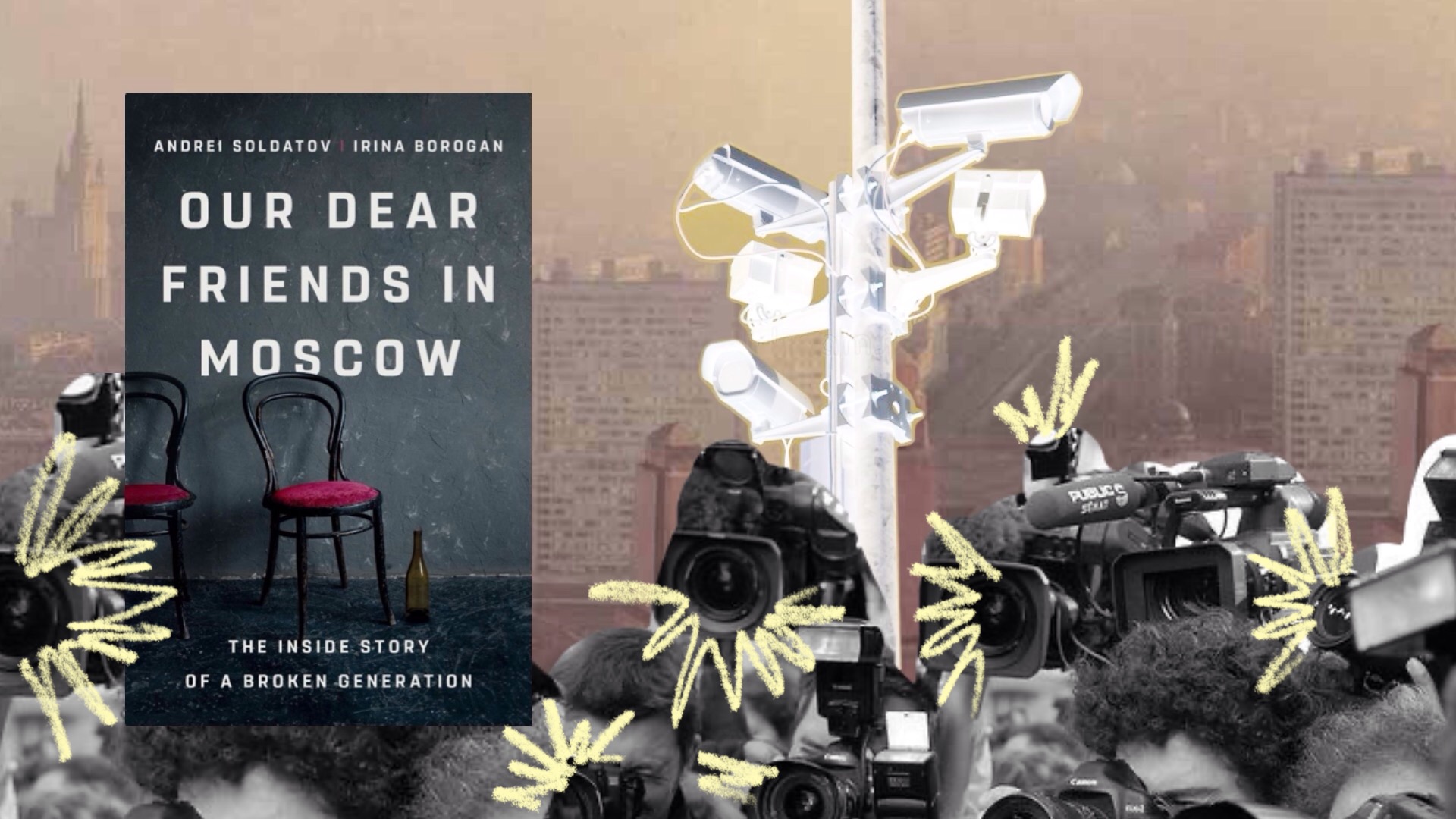
What became of those who forged their careers in Russian journalism in the 2000s? How did the country’s political trajectory affect their lives? What transformations did Russian media undergo in the early years of Vladimir Putin’s rule, and to what extent were journalists themselves responsible for those changes? In a new text from the column “A View from the Left”, Kseniya Lepekha reflects on the book Our Dear Friends in Moscow by Andrei Soldatov and Irina Borogan
In the three years since the full-scale invasion of Ukraine began, a significant number of books have been published on the history, politics, and ideology of contemporary Russia. These books are written in various languages and reflect diverse perspectives, and yet they have one thing in common: they are all published outside Russia. Given the conditions of total censorship that now prevail inside the country, the publication of such books and their free discussion are inconceivable. This is precisely the reason why today it is so crucial to foster a critical dialogue concerning these texts, particularly from a leftist perspective, which is presently underrepresented in public discourse.
In a new text from the column “A View from the Left”, Kseniya Lepekha reflects on the book Our Dear Friends in Moscow by Andrei Soldatov and Irina Borogan.
What became of those who forged their careers in Russian journalism in the 2000s? How did the country’s political trajectory affect their lives? What transformations did Russian media undergo in the early years of Vladimir Putin’s rule, and to what extent were journalists themselves responsible for those changes? These questions lie at the heart of a new book by Andrei Soldatov and Irina Borodan. Veteran Russian investigative reporters with more than two decades of experience and co-founders of Agentura.ru, both were forced to leave Russia in 2020 and relocate to London. Soldatov was placed on Russia’s wanted list in 2022; Borogan was labeled a “foreign agent” in 2025.
Their names are well known in journalistic circles — they have spent years writing extensively about Russia’s security services, censorship, and the state’s gradual takeover of the internet. Their work includes books such as The New Nobility: The Restoration of Russia’s Security State and the Enduring Legacy of the KGB, The Red Web: The Struggle Between Russia’s Digital Dictators and the New Online Revolutionaries, and The Compatriots: The Kremlin, the KGB, and the Battle for Russia Abroad.
Their new book, Our Dear Friends in Moscow: The Inside Story of a Broken Generation, was published in English by PublicAffairs in the summer of 2025. It traces the fate of those young editors and reporters who entered the field of journalism in the late 1990s and early 2000s. As state pressure mounted, some became propagandists; others learned to play by the new rules — “less criticism, more balance” — while still others were forced into exile.
The book assembles a gallery of portraits of those very “dear friends in Moscow” who, through self-deception or compromise, ultimately became embodiments of the ideal state propagandist. Among them are Svetlana Babaeva, who worked in the presidential press pool and headed RIA Novosti’s London bureau; Pyotr Akopov, formerly of Nezavisimaya Gazeta and later a columnist at Izvestia and RIA Novosti; and Yevgeny Krutikov of Izvestia and Sovershenno Sekretno. Through meetings with former friends and recollections of their shared past, Soldatov and Borogan surface the granular details that illuminate how fear, inertia, and cynicism shaped a new breed of media bureaucrat. Seen this way, the total subordination of Russo-Ukrainian war coverage to state propaganda appears less a rupture than a logical outcome.
The Russian media of the 1990s were vulnerable not only to state pressure but also to the structural immaturity of the media system itself. The absence of sustainable economic models and transparent ownership structures left outlets dependent on the interests of major capital holders. Television channels and newspapers often served not the public but powerful businessmen, becoming tools in information wars and kompromat campaigns. This entanglement corroded professional ethics: some journalists came to believe that the profession’s guiding principle was not objectivity or the delivery of truthful information, but personal gain. Cynicism gradually became a professional norm, and public trust in the press eroded accordingly.
When Putin began methodically tightening his grip on federal television in the early 2000s, the fragility of media institutions was laid bare. Rather than close ranks in defense of their profession, many journalists opted for compromise — remaining within the system to preserve their status, influence, or financial stability. That willingness to concede made them easy prey for the state. Those who refused to abandon independent journalism were gradually marginalized, forced to seek new formats and platforms.
At the heart of Soldatov and Borogan’s book are the personal stories of former colleagues — journalists who moved into state media, telling themselves it was out of concern for their families, a desire to keep their audience, or a hope to shape events “from within.” What started as rationalization slowly hardened into self-deception, and with it, part of the intellectual elite became instruments of authoritarian legitimation.
For a time, it seemed the regime might tolerate a limited space for liberal journalism. “Many believed such coexistence could last for years and that one day Putin would simply disappear,” the authors write. “And everything would return to normal, whatever that meant.” Putin did not disappear. Repression intensified, and journalists faced a stark choice: resistance and inevitable conflict with the system, or voluntary integration into the propaganda apparatus.
But why did educated, experienced journalists — many of whom had traveled widely abroad — so readily become conduits for state disinformation? In part, because those who wanted to remain in Russia and continue working in media found their options narrowing to almost nothing. Financial pressures, family obligations, illness — all pushed them toward conformity, which in a climate of lawlessness could pass for rational calculation. Yet that was not the whole story. The Soviet legacy — or its lingering echoes, passed down through parents, schools, and society — played an equally significant role: revanchism, the conviction that the collapse of the Soviet Union was engineered by the West, nostalgia for lost greatness, and the entrenched hierarchies of Soviet cultural dynasties to which some of the book’s protagonists belonged, along with the habit of seeing the world as a besieged fortress.
Even more consequential was a specifically Soviet strain of cynicism that resurfaced with renewed force as the direction of Putin’s policies became clear. It did not consume the entirety of Soviet society, but it left a mark on many. Contemporary Russian discourse is saturated with phrases like “we all understand how it works,” “we don’t know the whole truth,” and the weary refrain “it’s not so simple.” It is no coincidence that many of today’s propagandists come from Soviet cultural dynasties — the Mikhalkovs among them — for whom merging with the state has long been the surest road to success.
Yet the book’s intensely personal format is also its limitation. The portrait it paints can appear overly linear — even one-sided. Russia never lost independent media entirely during these years — the authors being prime examples — as journalists gradually abandoned state-controlled television and major outlets for the internet, social media, and new platforms, keeping their critical voice intact. After February 2022, many were forced into exile, but they have continued their work, retaining substantial Russian-speaking audiences.
The personal lens limits broader analytical scope and places the book outside the realm of academic inquiry. Yet it also gives the work its power: it is an important, if at times chaotic, work of testimony. This is a story told by people who witnessed institutional decay from the inside, who ultimately became its victims, and who remain haunted by the question of how it was ever allowed to happen.
For anyone who has worked in Russian media or followed the country’s political trajectory closely, the book breaks little new ground. What it offers instead is a careful systematization and documentation of processes that were long visible. Editorial decisions, rhetorical shifts, and personnel changes that once seemed like isolated incidents or situational compromises reveal themselves, in retrospect, as constituent parts of a deformed institutional model in which dependence and loyalty gradually displaced professional autonomy. The book allows readers to see that evolution in its entirety, from the slow erosion of professional standards to their ultimate replacement by the logic of propaganda.

Мы намерены продолжать работу, но без вас нам не справиться
Ваша поддержка — это поддержка голосов против преступной войны, развязанной Россией в Украине. Это солидарность с теми, чей труд и политическая судьба нуждаются в огласке, а деятельность — в соратниках. Это выбор социальной и демократической альтернативы поверх государственных границ. И конечно, это помощь конкретным людям, которые работают над нашими материалами и нашей платформой.
Поддерживать нас не опасно. Мы следим за тем, как меняются практики передачи данных и законы, регулирующие финансовые операции. Мы полагаемся на легальные способы, которыми пользуются наши товарищи и коллеги по всему миру, включая Россию, Украину и республику Беларусь.
Мы рассчитываем на вашу поддержку!


To continue our work, we need your help!
Supporting Posle means supporting the voices against the criminal war unleashed by Russia in Ukraine. It is a way to express solidarity with people struggling against censorship, political repression, and social injustice. These activists, journalists, and writers, all those who oppose the criminal Putin’s regime, need new comrades in arms. Supporting us means opting for a social and democratic alternative beyond state borders. Naturally, it also means helping us prepare materials and maintain our online platform.
Donating to Posle is safe. We monitor changes in data transfer practices and Russian financial regulations. We use the same legal methods to transfer money as our comrades and colleagues worldwide, including Russia, Ukraine and Belarus.
We count on your support!


другие подкасты


Политический дневник #53: Империализм и идеология special

«Это базис»: От неолиберализма до феминитивов. Ответы на вопросы

«Это базис». Экономическая идеология. Почему мы так любим описывать политику в экономических категориях
SUBSCRIBE
TO POSLE
Get our content first, stay in touch in case we are blocked

Еженедельная рассылка "После"
Получайте наши материалы первыми, оставайтесь на связи на случай блокировки


.svg)

