

НАСТОЯЩИЙ МАТЕРИАЛ (ИНФОРМАЦИЯ) ПРОИЗВЕДЕН, РАСПРОСТРАНЕН И (ИЛИ) НАПРАВЛЕН ИНОСТРАННЫМ АГЕНТОМ ПРОЕКТОМ “ПОСЛЕ”, ЛИБО КАСАЕТСЯ ДЕЯТЕЛЬНОСТИ ИНОСТРАННОГО АГЕНТА ПРОЕКТА “ПОСЛЕ” 18+
Impossible Island
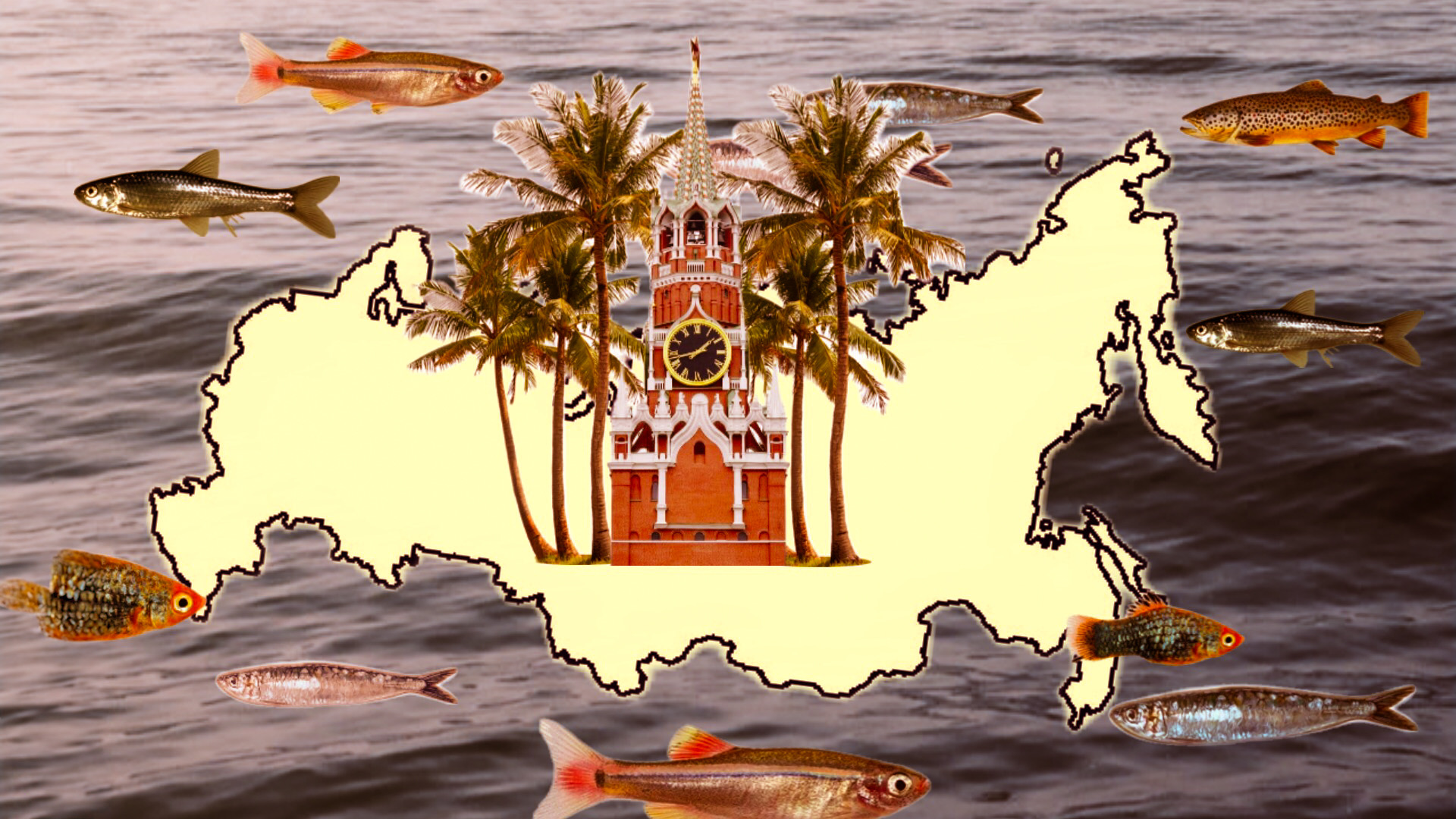
What would Russian foreign policy look like after a peace treaty with Ukraine? And what would such a deal mean for the future of Russia and its neighboring countries? Journalist and researcher Georgy Birger, creator of the project Playing Civilization, finds deeply unsettling answers in the “Island Russia” concept — at first glance, one of the most peaceful ideas in Russia’s geopolitical discourse
Russia’s full-scale invasion of Ukraine has, once again, narrowed the boundaries of what is permissible in the country’s domestic political discourse. One telling example of this is Gosudarstvo [State], an academic journal that RANEPA — the Russian Presidential Academy of National Economy and Public Administration — has been publishing since August 2025. According to Vedomosti, the journal primarily focuses on traditional values and their importance to national security; in practice, it is little more than a collection of essays built around the ideas of Russian exceptionalism and the sanctity of authority.
Since the collapse of the Soviet Union, this kind of literature has been abundant in Russia, but Gosudarstvo marks something new: after 2022, such publications became part of the official agenda, with senior government figures now standing directly behind them. Andrei Polosin, the editor-in-chief of Gosudarstvo, is the vice rector of RANEPA. Boris Rapoport, the deputy head of the Presidential Administration’s Department for Monitoring and Analysis of Social Processes, sits on the editorial board, while his boss, department director Alexander Kharichev, is a regular contributor to the journal.
Although the department’s name is vague, its two key functions are evident: running complex electoral campaigns and setting the country’s ideological agenda. Gosudarstvo is clearly a product of the latter. Long before the journal’s launch, Kharichev had already made his ideological convictions known — a series of articles in various publications left little doubt about where he stood. Meduza has covered one such piece, and the rest follow a similar line: Russia is portrayed as a “country-civilization” fundamentally opposed to the West.
The civilizational framework is gradually becoming Russia’s Overton window — any idea that does not affirm Russia’s uniqueness and its “special path” has no place within it.
The consequences of this worldview have found their most devastating expression in the war in Ukraine — a war the Russian state portrays, among other things, as self-defense against NATO expansion: an attempt to keep the West from coming into direct conflict with Russian civilization. But what will happen once a peace agreement — however limited — is reached? What does the other side of Russian civilization look like — the peaceful one?
Both questions — and, with them, an attempt at understanding how today’s Overton window came into being — lead back to a geopolitical concept from the 1990s: “Island Russia,” developed by philosopher, historian, and political scientist Vadim Tsymbursky. A 1993 essay of the same name introduced the concept; a year later, Tsymbursky expanded on it for the anthology Inoe [translator’s note: the author of the article suggests in another publication that, while the title of the anthology could be translated as “Other,” a more accurate translation would be “Something Else”]. Placing the idea in the context of that collection helps reveal how it mirrored the intellectual climate of the time — and how it was perceived then.
The Inoe collection was a three-volume set of 35 long essays, each proposing a different vision of Russia’s future. The range of ideas was wide. On the mainstream end were right-liberal fantasies of a “normal country” in the age of the “end of history” — a continuation of the existing path toward Western liberalism and European integration. A few left-wing ideas were present, mostly of the authoritarian variety. Finally, there was a remarkable number of conservative projects of varying degrees of radicalism.
One thing was apparent: for all their differences, these conservative projects were united by a “civilizational” reading of the world — one that saw history as a struggle among a small number of distinct civilizations, each defined by religion, history, and shared identity, each competing for dominance. In the collection, at least eight essays — a quarter of the total — portrayed Russia as a “country-civilization.”
Even more striking is that many of these essays ignored Samuel Huntington’s 1993 article “The Clash of Civilizations?” — the piece that reintroduced the civilizational approach to global geopolitical debate — and instead drew on older sources: Nikolay Danilevsky, who originated the concept of Russian civilization; Oswald Spengler, author of the 1918 work The Decline of the West; and their intellectual heir, the Soviet historian Lev Gumilev. One of the Inoe contributors, Vladimir Makhnach, had been a student of Gumilev: whenever the topic of civilizational theory arose, he always simply noted that “it is a given.”
Of course, “Island Russia” was also a conservative and civilizational project, albeit the most peaceful of them all. Unlike the others, Tsymbursky did not see conflict as inevitable; instead, he proposed thinking of Russia as an island of sorts, one that needed to be isolated from the rest of the world.
Although still an imperial project, Tsymbursky’s empire had no appetite for conquering new lands — it looked inward, toward internal colonization. At the heart of his vision was the concept of the “abduction of Europe”: the idea that whenever Russia attempted to integrate with Europe, it would inevitably expand westward, provoke resistance, and ultimately fail.
By internal colonization, Tsymbursky meant primarily the development of the country’s eastern territories — a position that brought him close to Eurasianism, but only up to a point, given his rejection of forced expansion. Tsymbursky reserved particular contempt for Alexander Dugin’s neo-Eurasianism and wrote one of the most scathing reviews of Dugin’s magnum opus, The Foundations of Geopolitics (1997). Like Tsymbursky, Dugin portrays Russia as a distinct civilization alien to Western values — but in 1994, Dugin was too marginal a figure to be invited to contribute to Inoe. Today, however, he sits on the editorial board of the journal Gosudarstvo.
Another key distinction between Tsimbursky’s vision of Russian civilization and those of the others was his attempt to offer a more secular interpretation. The concept of “Russian civilization” is closely tied to Orthodox Christianity and the notion of Russia as the successor to Byzantium, with Moscow as the “Third Rome.” Tsymbursky acknowledged Orthodoxy’s influence but did not think it needed to remain at the center of the project. He defined civilization through geography, following Gumilev, and a shared path of cultural development — Orthodoxy mattered as a foundation, as the force that had set the trajectory, but not as one that needed to steer it.
Tsymbursky took a similar stance on ethno-nationalism: he rejected the radical slogan “Russia for Russians,” while acknowledging that an ethno-cultural core exists — one that guarantees Russians the right of the majority.
At the same time, Tsymbursky firmly rejected the liberal consensus on the right to self-determination of the republics along Russia’s western border. He wrote that the Westernizers “see the Baltic states, Poland, the Czech Republic, and Hungary as part of genuine Catholic-Protestant Europe — a part left bereft by historical circumstance, trampled time and again under the rough Russian boot. However, social and economic history refutes the liberals’ pathetic (sic!) tendency to conflate Central and Eastern Europe.”
Tsymbursky found a compromise in the concept of the “Great Limitrophe” — though the term itself came later; in his original essay, he had called these territories “strait-countries.” By the “Great Limitrophe,” he meant a belt of states separating Russian civilization from the “Romano-Germanic” one. These countries do not need to be subordinate to Russia; however, they cannot integrate with other civilizational blocs either. Their role is to serve as buffers between civilizations — a kind of cordon sanitaire.
What is striking is how much more clearly the “Island Russia” concept was seen for what it was in the 1990s than it is today. Back then, Tsymbursky was dismissed as a pessimistic reactionary. His rejection of military expansion set him apart from radicals like Dugin but did not earn him a reputation as a more humane or progressive conservative. It was obvious that his refusal to recognize the right of neighboring countries to self-determination, and his insistence on entrenched privileges for ethnic Russians, had nothing to do with democracy or the path Russia had chosen at that time.
Today, both of these issues are largely up for debate. The events of the late 1990s — the severe economic crisis and the NATO operation in Kosovo — dealt a serious blow to faith in the European project. From the disparate groups that had lost out in the reforms of that decade, political strategists assembled what became known as the “Putin majority.” This majority’s discourse gradually pushed the liberal one out of the public sphere, and “Island Russia” gradually began to shed its marginal status.
However, Tsymbursky kept refining his concept until his death in 2009 — and with each revision, it became more aggressive. The most significant shift occurred in 2008, following the Russo-Georgian War, when he introduced the concept of the “trail of Island Russia.” By this he meant the border regions so vital to the “island” that any attempt by an outside power to interfere in their affairs could justify intervention — and, if necessary, annexation. The occupied territories of Georgia fell into this category, as did Crimea, left-bank Ukraine, and Kazakhstan. With this adjustment, “Island Russia” had fully matured as a geopolitical doctrine by the 2010s, while still managing to present itself as a more sober and restrained vision for the revival of the Russian Empire than its rivals.
With the occupation of Crimea in 2014, “Island Russia” moved from the margins of the Overton window straight into the mainstream. One could argue that Tsymbursky’s vision found its practical expression in the Minsk Agreements — under which the Donetsk and Luhansk regions would have represented the ideal version of the “trail.” Mikhail Suslov, a professor at the University of Copenhagen, made the same observation, suggesting that Vladislav Surkov, the architect of the Minsk Agreements, was in all likelihood familiar with Tsymbursky’s ideas and sympathetic to them.
Tsymbursky’s influence was never overt. Senior officials did not cite him, and when Putin spoke of “Russian civilization,” he more often invoked the better-known Danilevsky or Ivan Ilyin. Yet within Russian political science — which feeds directly into decision-making — the presence of “Island Russia” is hard to miss. After 2014, philosopher Boris Mezhuev worked diligently to bring Tsymbursky’s ideas into the mainstream. Another advocate is Andrei Tsygankov, a member of the Valdai Discussion Club.
Perhaps the best illustration of how “Island Russia” has broken into the mainstream of geopolitical discourse is the career of Dmitri Trenin, former director of the Carnegie Moscow Center [author’s note: the author of this essay is a former employee of the center and may be biased; that said, this is not a criticism of the organization, but an attempt to trace the career path of its former director — the Carnegie Endowment for International Peace severed all ties with Dmitri Trenin in the spring of 2022]. The Moscow Center was the Russian branch of the American Carnegie Endowment for International Peace, and its mission — put simply — was to keep diplomatic channels with Russia open even in times of tension, preventing the situation from escalating. To that end, the foundation needed someone at the helm of its Moscow office who commanded respect among the Russian elite. Colonel Trenin, who remained centrist through every shift in the Overton window, was perfectly suited for the role.
In the 1990s and early 2000s, Trenin was considered a pro-Western voice: he called for Russia to modernize, join Western institutions, and leave the Cold War behind. But when, by the mid-2000s, the prospect of integrating with Europe and NATO had vanished, he shifted his focus to criticizing the West for setting unrealistically high standards for Russian democracy. He stated, “[The West] must understand that positive changes in Russia can only come from within, and that the economy — not democratic ideals — will be the driving force behind these changes.” He then began describing Russia as a “lonely power” — a rising power with no friends, only partners. This already brought Trenin closer to Tsymbursky’s concept, even as he continued to insist that “Russia is not a distinct civilization.”
Following the Medvedev-Putin swap and Putin’s effective return to power in 2012, the discourse shifted again — and so did Trenin’s position. The director of the Carnegie Moscow Center accepted the new reality of “superpower confrontation.” However, other members of the center’s staff — among them prominent political scientists Nikolai Petrov, Maria Lipman, and Lilia Shevtsova — took a more critical stance toward the government, found themselves outside the boundaries of the new Overton window, and ultimately left the team.
It was around that time that Trenin began citing Tsymbursky with growing frequency. At first, the references seemed more or less incidental, but by the time his book New Balance of Power: Russia in Search of Foreign Policy Equilibrium was published in 2021, Igor Torbakov, a research fellow at Uppsala University, had already described it as “Tsymburskian through and through.”
This position allowed Trenin to remain moderately liberal and anti-war. The centrist consensus he proposed could be explained, in Tsymbursky’s terms, as follows: the occupation of Crimea and compliance with the Minsk agreements in Donbas could be normalized through the idea of a “trail,” while the war had to be stopped and escalation avoided — since further conflict would only trigger another round of “the abduction of Europe.”
Then came February 2022. With the start of the full-scale invasion of Ukraine, even this carefully calibrated civilizational centrism was pushed to the periphery. The Carnegie Moscow Center was shut down by the Ministry of Justice, and Trenin recalibrated his position — aligning himself with the new center.
Among other things, this story serves as a cautionary tale about submissive centrism — and reveals what “Island Russia” truly represented for those who kept trying to adapt to reality: a temporary path on the road toward the mainstream of civilizational thought and a way to reconcile oneself with the idea of Russia’s “special path” without embracing its fascist extremes — yet still ending up with fascism. This is all because the traditional values of “Russian civilization” are too precious to allow the West even a foothold in the “Great Limitrophe” — and that is the root of the culture war: first cold, then hot.
The Russian quasi-fascist publicist Yegor Kholmogorov laid bare the logic behind this trajectory with particular clarity. In a 2020 article on “Island Russia,” he praised Tsymbursky while simultaneously arguing that the philosopher’s rejection of expansion was nothing more than self-delusion: “By and large, Tsymbursky masks a strictly expansionist project under the guise of isolationism.” Kholmogorov seized on the concept of the “Great Limitrophe” with particular enthusiasm: “The numerous small and medium-sized peoples flitting about Russia’s borders are nothing more than the flora and fauna of the waters that surround the ‘island’ part of the Russian civilizational platform.” There was, it turned out, only a single step separating Tsymbursky’s ideas from the worst excesses of Great Russian chauvinism — and Kholmogorov showed just how effortlessly it could be taken.
Tsymburski himself once said that “fascism is a form of a nation’s rebellion against attempts to force it into an undignified and uncomfortable world order that treats it as a ‘second-class’ nation.” Given that this is precisely what Russia claims to be doing today, it is not hard to imagine where the philosopher would have stood on the country’s current political course.
But not necessarily. Another lesson that the story of “Island Russia” teaches us is how meaning is actually constructed within the Russian state. Much like private equity firms that acquire companies only to strip them for parts, the state absorbed Tsymbursky’s ideas after his death — but only the ones it found useful. Something similar happened with the legacies of “Putin’s favorite philosopher” Ivan Ilyin, the pioneers of Eurasianism Petr Savitsky and Nikolai Trubetskoy, and even Joseph Stalin.
In Tsymbursky’s case, the state adopted the concepts of the “limitrophe” and the “trail,” and partially incorporated his proposal for an eastward reorientation into the “Greater Eurasian Partnership” project. But the concept of the “abduction of Europe” — which, as noted above, was central to Tsymbursky’s own vision — was virtually ignored. And yet Tsymbursky himself had written: “Russia’s defeats are usually linked to conditions in which she herself is forced to bleed out in some small section of the imperial periphery, among difficult territories or ‘straitlands’” — a description that is striking in how closely it mirrors what is happening today.
However, the fact that the Russian state adopts ideas in a distorted form — more often after the fact than as a guide for action — is no reason to stop studying them carefully. Nor does it mean that certain concepts, no matter how fantastical, cannot cause harm when the state pays them no attention. The history and future of “Island Russia,” therefore, still matter.
This matters in part because, the moment a peace agreement with Ukraine — and the West — is reached, the “Island Russia” doctrine will once again become a cornerstone of foreign policy. Recent experience suggests that this vision is either a deliberate lie or an act of self-deception.
In a world where “Island Russia” represents the most peaceful of Russia’s geopolitical concepts, lasting peace is only possible if Russia is allowed to function as a full-fledged empire across Eurasian territory. This would require western Ukraine, Georgia, Kazakhstan, and Moldova to accept the role of a “buffer zone” within the “Great Limitrophe” or join the Russian “civilizational state” — shifting the “Limitrophe” zone onto their western neighbors. This would also mean the gradual abandonment of liberal values.
In that case, the rest of the world would have to accept a reality in which it is divided among “great powers” and their respective spheres of influence. Multipolarity, under this arrangement, would mean nothing more than agreements between superpowers over who controls which part of the world: the United States would do as it pleases in the Americas, China in East Asia, and so on.
Recent events illustrate this logic with uncomfortable clarity: Putin has yet to comment on the U.S. military operation in Venezuela. According to the “civilizational” and “island” doctrines, Trump has every right to engineer regime change in a neighboring country — provided, of course, that it helps deliver a peace plan for Ukraine on terms favorable to Russia. It is awkward to say this out loud: President Maduro, who was captured by the US, was considered a Russian ally. However, Putin’s silence speaks volumes.
As recently as 2022, there was still a general consensus that the freedom of Russia’s neighbors was inextricably linked to the freedom of the world as a whole. Even the most moderate of the Russian state’s geopolitical theories today only serve to reinforce this conviction.

Мы намерены продолжать работу, но без вас нам не справиться
Ваша поддержка — это поддержка голосов против преступной войны, развязанной Россией в Украине. Это солидарность с теми, чей труд и политическая судьба нуждаются в огласке, а деятельность — в соратниках. Это выбор социальной и демократической альтернативы поверх государственных границ. И конечно, это помощь конкретным людям, которые работают над нашими материалами и нашей платформой.
Поддерживать нас не опасно. Мы следим за тем, как меняются практики передачи данных и законы, регулирующие финансовые операции. Мы полагаемся на легальные способы, которыми пользуются наши товарищи и коллеги по всему миру, включая Россию, Украину и республику Беларусь.
Мы рассчитываем на вашу поддержку!


To continue our work, we need your help!
Supporting Posle means supporting the voices against the criminal war unleashed by Russia in Ukraine. It is a way to express solidarity with people struggling against censorship, political repression, and social injustice. These activists, journalists, and writers, all those who oppose the criminal Putin’s regime, need new comrades in arms. Supporting us means opting for a social and democratic alternative beyond state borders. Naturally, it also means helping us prepare materials and maintain our online platform.
Donating to Posle is safe. We monitor changes in data transfer practices and Russian financial regulations. We use the same legal methods to transfer money as our comrades and colleagues worldwide, including Russia, Ukraine and Belarus.
We count on your support!

.webp)

другие подкасты


«Это базис»: От Бонапарта до прекариата. Отвечаем на вопросы

«Это Базис»: Eat the rich: жизнь с неравенством и без него

«Это базис»: Представительная демократия: за и против
SUBSCRIBE
TO POSLE
Get our content first, stay in touch in case we are blocked

Еженедельная рассылка "После"
Получайте наши материалы первыми, оставайтесь на связи на случай блокировки


.svg)

